

Does creatine improve memory and brain function? What the trials show
Creatine is best known as a sports supplement, and it is increasingly studied for the brain. Small trials suggest a modest effect on memory that seems confined to older adults and a possible benefit during sleep loss; most of the evidence comes from short studies with a few dozen participants.
The grade WeakCreatine supplements for memory and thinking
In brief. Creatine supplements may produce a small improvement in memory, but the evidence is weak. Two meta-analyses of randomized trials found pooled standardized mean differences of about 0.3 for memory.25 In the first, the effect was confined to older adults and was absent in people aged 11 to 31, and the older-adult estimate came from two small trials with high heterogeneity.2 Four small trials suggest that creatine lessens the decline in some cognitive tasks during a night or more without sleep.12131516 High doses raise creatine measured in the brain by magnetic resonance spectroscopy (MRS), but by modest and variable amounts.20217 Creatine raises serum creatinine, a routine kidney test, without a measured change in kidney function in trials lasting up to about a year.27
Creatine is one of the most studied supplements in sport, and researchers have increasingly asked whether it also affects brain energy metabolism and cognition.9 This article reviews what the human trials have tested, the size of the effects, which groups have been studied, how well creatine reaches the brain, and what is known about safety.
How might creatine affect the brain?
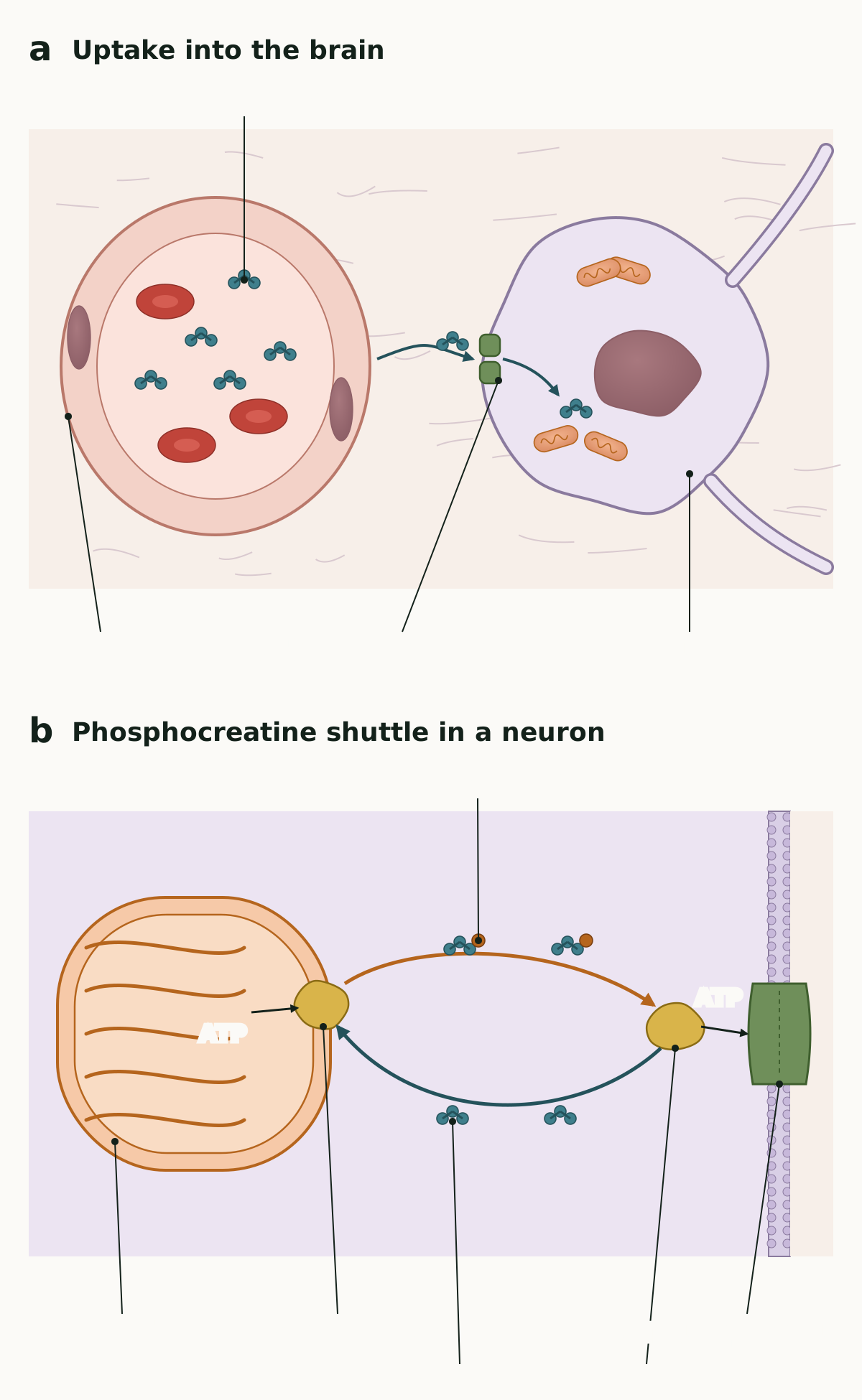
Creatine is made in the liver and kidneys from the amino acids arginine and glycine, and about half of the daily requirement in people who eat meat comes from food; a pound of uncooked beef or salmon provides about 1–2 g.26 Inside cells, creatine kinase transfers phosphate between ATP and creatine. Mitochondrial creatine kinase uses newly made ATP to form phosphocreatine, which diffuses into the cytosol, where cytosolic creatine kinase regenerates ATP at the sites where energy is used.26 This creatine kinase and phosphocreatine shuttle links sites of ATP production with sites of ATP use, and Rae and colleagues described creatine as a “temporal and spatial buffer” for ATP in the brain.2610
Creatine enters cells through a dedicated transporter, SLC6A8.26 Its importance for the brain is shown by an inherited disorder. In the first patient described with a defect in the SLC6A8 gene, a boy with developmental delay, MRS showed no creatine signal in the brain even though creatine in plasma and urine was raised.24 In a series of 101 males with creatine transporter deficiency, most had moderate to severe intellectual disability. Creatine levels in their cerebrospinal fluid were unexpectedly high, which the authors took to mean that the brain can make creatine and that the deficit lies in uptake into neurons.25 Prokopidis and colleagues proposed limited transport into the brain and the brain’s own synthesis as possible reasons why supplements raise brain creatine less than muscle creatine.2 None of this shows that adding creatine to a normal diet improves brain function in healthy people. That has to be tested directly.
Does creatine improve memory? What the randomized trials show
Three systematic reviews have pooled or summarized trials in this area. Avgerinos and colleagues, in 2018, found six randomized trials in 281 healthy people. They concluded that creatine may improve short-term memory and intelligence or reasoning tests, that results for other cognitive domains conflicted, that performance did not change in young people, and that vegetarians responded better than meat eaters on memory tasks.1 The trials were too varied to pool.1
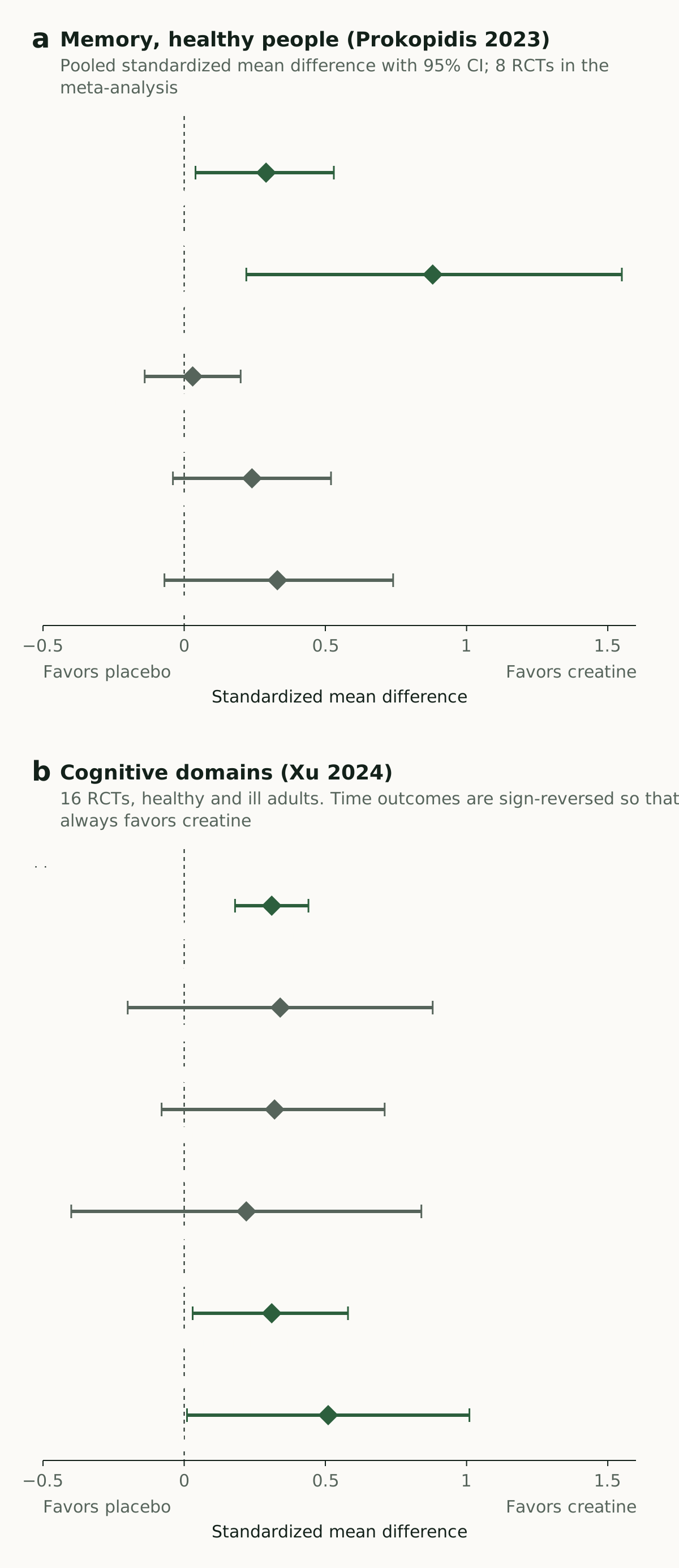
Prokopidis and colleagues, in 2023, included ten randomized trials in healthy people and pooled eight of them, in 225 participants, for memory.2 Doses ranged from about 2.2 to 20 g a day and durations from 5 days to 24 weeks. Creatine improved memory measures compared with placebo, with a standardized mean difference (SMD) of 0.29 (95% CI 0.04 to 0.53) and moderate heterogeneity (I² 66%).2 In a subgroup analysis by age, the SMD was 0.88 (0.22 to 1.55; I² 83%) in adults aged 66 to 76 and 0.03 (−0.14 to 0.20; I² 0%) in people aged 11 to 31.2 Neither the low-dose nor the high-dose subgroup reached statistical significance on its own.2 Eckert and Pascher argued in a letter that the analysis counted some participants more than once and that this produced false-positive results; the authors published a reply defending it.34
Xu and colleagues, in 2024, pooled 16 randomized trials in 492 adults aged about 21 to 76, including people with illnesses as well as healthy volunteers.5 For memory they reported an SMD of 0.31 (0.18 to 0.44), rated as moderate certainty. That estimate combined 24 comparisons with 1,000 participants in total, more than the number of people enrolled, so several trials contributed more than one comparison.5 Creatine shortened the time taken on attention tasks (SMD −0.31, −0.58 to −0.03) and processing-speed tasks (SMD −0.51, −1.01 to −0.01). Overall cognition (SMD 0.34, −0.20 to 0.88; 6 studies), executive function (SMD 0.32, −0.08 to 0.71; 4 studies) and attention scores (SMD 0.22, −0.40 to 0.84; 4 studies) did not differ significantly from placebo.5 The authors found larger effects in people with an illness than in healthy people, and rated the certainty of evidence for outcomes other than memory as low.5 A corrigendum corrected the wording of the attention and processing-speed results but not the figures.6
A 2024 systematic review by McMorris and colleagues reached a more skeptical conclusion: supplementation can increase brain creatine, but results for cognition were “somewhat equivocal”, and the authors called for trials that measure brain creatine alongside cognitive outcomes.7 In a 2026 trial in 40 young, active adults, a week of 20 g a day improved sprint cycling performance but not performance on the Stroop or Trail Making tests.19
Does creatine help older adults?
Two of the trials in the Prokopidis meta-analysis enrolled older adults. McMorris and colleagues gave 32 people aged 68 to 85 either 20 g of creatine a day for a week or placebo, and found improvements on all of the memory tasks tested except backward number recall.142 The other trial, by Alves and colleagues, gave 25 women aged 60 to 80 either 5 g a day or placebo for 24 weeks.2 The large pooled effect in older adults therefore rests on 57 participants and a high degree of inconsistency between the two trials.2
A 2026 systematic review by Marshall and colleagues looked at all study designs in adults aged 55 and over. It found six studies with 1,542 participants, but only two were supplementation trials; the other four estimated creatine intake from dietary recall.8 Five of the six reported a positive association with cognition, and the reviewers rated one study as good quality, two as fair and three as poor.8 In a 12-week trial in 64 adults aged 45 to 65, 10 g a day improved “selected markers” of cognition and memory, which the authors said should be interpreted as exploratory; the senior author chairs the scientific advisory board of AlzChem, a creatine manufacturer.18
Does creatine help during sleep deprivation or mental fatigue?
Sleep loss is the setting with the most consistent short-term results, although every trial has been small. McMorris and colleagues gave 19 young adults 5 g of creatine four times a day, or placebo, for a week before 24 hours without sleep with mild exercise. The creatine group showed less deterioration in random movement generation, choice reaction time, balance and mood.122 In a second study from the same group, in 19 men kept awake for 36 hours, creatine improved performance on a central executive task at 36 hours only, with no difference on the other measures.132
Gordji-Nejad and colleagues tested a single large dose, 0.35 g/kg body weight (about 25 g for a 70 kg adult), in a double-blind randomized crossover trial in 15 healthy young adults during 21 hours without sleep.15 Phosphorus and proton MRS showed changes in brain phosphocreatine and ATP after creatine, a fall in brain pH was prevented, and cognitive performance and processing speed were better than with placebo.15 A follow-up crossover trial in 29 young adults used a lower single dose of 0.2 g/kg and found less deterioration in logic and numerical tasks, language-related processing speed and the psychomotor vigilance test, with improvements of up to 12%.16 The second trial did not measure brain creatine and was registered after it was conducted.16 In both, the creatine was supplied by AlzChem, a creatine manufacturer; the first trial was funded by Forschungszentrum Jülich and RWTH Aachen University.1516
For mental fatigue without sleep loss, the evidence is thinner. In a Japanese trial, 8 g a day for five days reduced mental fatigue during repeated arithmetic and reduced the task-related rise in oxygenated hemoglobin in the brain measured by near-infrared spectroscopy.17 Avgerinos and colleagues judged the overall results for mental fatigue to be conflicting.1
Do vegetarians benefit more?
Vegetarians have lower muscle creatine stores than people who eat meat, because creatine comes mainly from meat and fish.26 In a double-blind crossover trial, Rae and colleagues gave 45 young adult vegetarians 5 g of creatine a day or placebo for six weeks, and found better performance on a working memory test (backward digit span) and an intelligence test (Raven’s Advanced Progressive Matrices).10 The trial had no meat-eating comparison group. Benton and Donohoe gave 128 young women, vegetarians and omnivores, 20 g a day or placebo for five days. Creatine did not affect verbal fluency or vigilance, it reduced the variability of choice reaction times in both groups, and it improved memory only in the vegetarians.11 In the MRS study by Solis and colleagues, a week of 0.3 g/kg a day raised muscle phosphocreatine in 14 vegetarians but did not change brain phosphocreatine in vegetarians or in any other group.22 The Prokopidis meta-analysis excluded vegetarians, so it cannot address the question.2
How much creatine reaches the brain?
The answer depends on dose, duration, the brain region studied and the MRS method. Candow and colleagues noted in a 2026 review that MRS measurement of brain creatine is sensitive to where the measurement volume is placed, signal quality, analysis pipeline and reporting conventions.9 In one of the first studies, six people took 20 g a day for four weeks, and total brain creatine rose by 3.5% to 13.3% across individuals, returning to baseline within three months of stopping.20 Lyoo and colleagues gave 10 healthy men 0.3 g/kg a day for a week and then 0.03 g/kg a day for a week, with 5 men on placebo; frontal creatine rose by 8.1% (as a ratio to N-acetyl aspartate), and phosphocreatine rose marginally, by 3.4%.21 In contrast, a week of 0.3 g/kg a day did not change brain phosphocreatine in children, omnivorous adults, vegetarians or older adults in the Solis study.22 A 2026 trial in 36 perimenopausal and menopausal women split across four groups reported that 1.5 g a day of creatine hydrochloride for eight weeks raised frontal brain creatine by 16.4%, compared with 0.9% with placebo, and modestly improved reaction time.23 The ISSN position stand notes that higher doses for longer periods may be needed to raise brain creatine than to saturate muscle, where 3–5 g a day after a loading phase is enough.26
Is creatine safe? Kidneys, creatinine and water weight
Creatine is broken down to creatinine,26 and serum creatinine, urea and estimated glomerular filtration rate (eGFR) are the standard blood measures of kidney function used in trials.27 In a 2026 meta-analysis of 19 randomized trials and one crossover trial, creatine raised serum creatinine by 0.13 mg/dL (95% CI 0.07 to 0.18) but did not significantly change urea (−0.60 mg/dL) or eGFR (−5.20 mL/min/1.73 m², 95% CI −15.00 to 4.60, 8 trials).27 The authors concluded that the rise in creatinine was not accompanied by significant changes in urea or eGFR, and called for trials lasting longer than a year.27 The International Society of Sports Nutrition (ISSN) position stand reported that long-term intake of up to 30 g a day for up to five years in patient populations had not been associated with more kidney dysfunction, and concluded that there is no compelling evidence that creatine harms kidney function in healthy or clinical populations. It noted that some recommend that people with preexisting kidney disease consult a physician first.26
Creatine draws water into cells. Early studies found that a loading phase caused short-term fluid retention of about 0.5 to 1.0 L, roughly matching the weight gained.26 Several authors of the ISSN position stand, including its lead author, declared industry funding or consulting for companies that sell creatine.26
Who funds this research?
Industry links are common in this field and should be read alongside the results. The Prokopidis meta-analysis had no external funding, but one author had been a scientific advisor to a company that sells creatine, and another, D.G. Candow, declared industry-sponsored creatine research, donated creatine for studies and membership of AlzChem’s scientific advisory board.2 Candow is also the lead author of the 2026 narrative review.9 The Xu meta-analysis was funded by the National Natural Science Foundation of China, and its authors declared no conflicts.5 The first Gordji-Nejad trial was publicly funded, and both used creatine supplied by AlzChem.1516 The Chun trial’s senior author chairs AlzChem’s scientific advisory board.18
What remains uncertain?
Most trials lasted from a single dose to a few weeks, and most enrolled fewer than 50 people.25 Tests of memory and attention differed from trial to trial, which is why heterogeneity was high and why the way repeated measures were combined has been disputed.23 The apparent benefit in older adults rests on two trials, and the apparent benefit in vegetarians rests on one trial without a meat-eating comparison group and one trial in young women.21011 Only a few trials measured brain creatine and cognition in the same people, and MRS methods vary.97 We found no trial showing that creatine slows cognitive decline or prevents dementia.
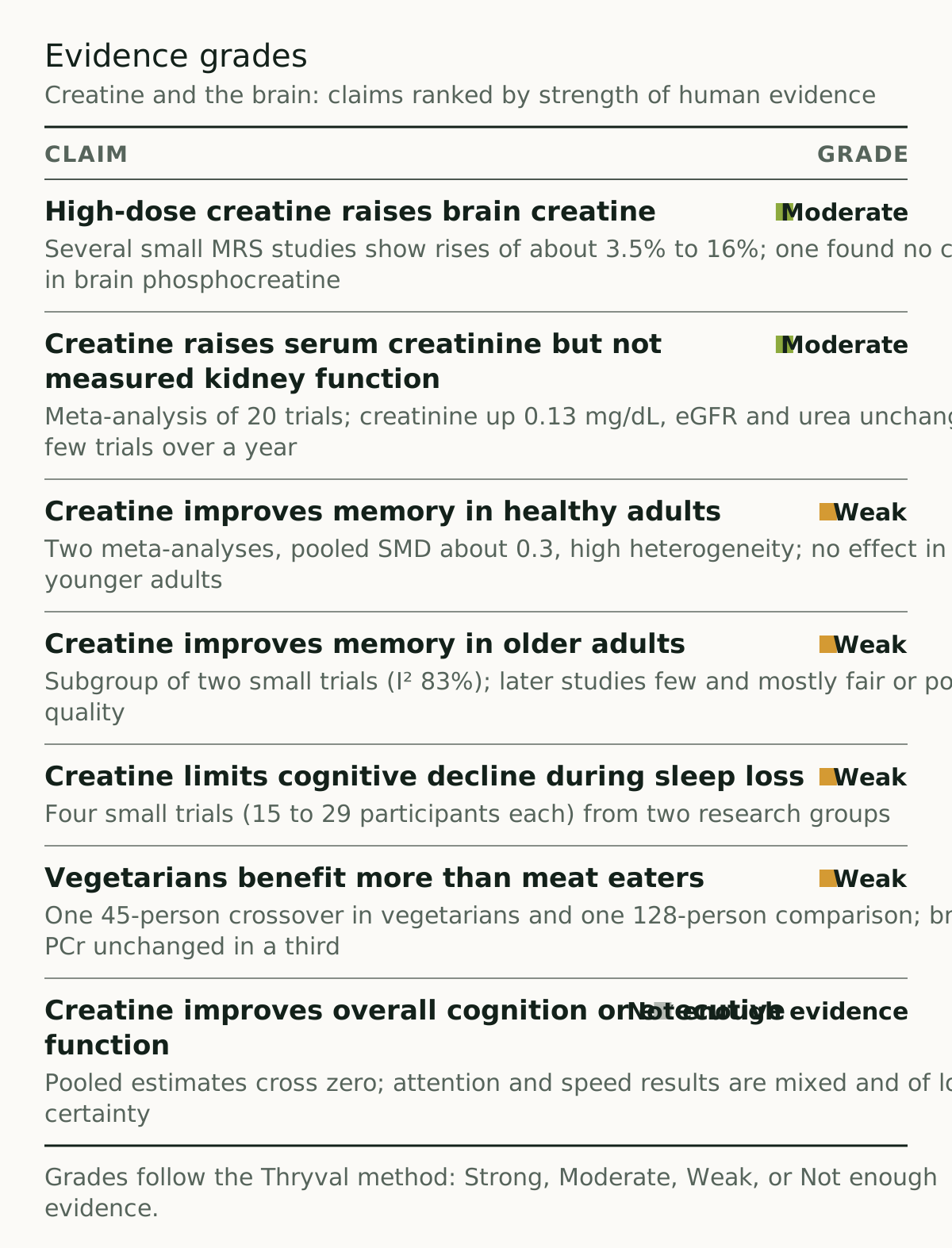
Evidence grades
The grades below are Thryval editorial judgments based on the studies cited in this article. The grading rules are set out on our Research page.
Frequently asked questions
Does creatine improve memory?
Possibly, by a small amount. Two meta-analyses of randomized trials found pooled effects of about 0.3 standard deviations, but in one of them the benefit was confined to older adults and was absent in people aged 11 to 31.25
Does creatine help when you are sleep deprived?
Four small trials found that creatine lessened the decline in some cognitive tasks during 21 to 36 hours without sleep, including two trials of a single large dose.12131516 None was large enough to be conclusive.
Is creatine good for the brain as you age?
Two small trials in older adults found better memory scores with creatine, and a 2026 systematic review found mostly positive but low-quality evidence.28 We found no trial showing that creatine slows cognitive decline or prevents dementia.
Does creatine get into the brain?
Yes, to a limited extent. MRS studies have measured rises in brain creatine of about 3.5% to 16% after several days to weeks of supplementation, although one study found no change in brain phosphocreatine after a week.20212322
Should vegetarians take creatine for brain function?
One trial in 45 vegetarians found better working memory and reasoning scores after six weeks of 5 g a day, and a trial in young women found a memory benefit only in vegetarians.1011 These results have not been confirmed in larger trials.
Is creatine bad for your kidneys?
In randomized trials, creatine raised serum creatinine by about 0.13 mg/dL without a significant change in eGFR or urea; trials longer than a year are lacking.27 People with kidney disease should talk to their physician before taking it.26
Implications for patients and clinicians
The trials do not support creatine as a way to improve memory or thinking in young, healthy adults.219 In older adults and during sleep loss, the results are promising but come from small, short trials, several of them involving researchers or suppliers with ties to creatine manufacturers.21518 For people who take creatine for exercise, the brain findings do not change the dose, which for muscle is 3–5 g a day after an optional loading phase.26 Because creatine raises serum creatinine in trials without a measured change in eGFR or urea, clinicians interpreting a raised creatinine should know whether the patient takes it.27
References
-
Avgerinos KI, Spyrou N, Bougioukas KI, Kapogiannis D. Effects of creatine supplementation on cognitive function of healthy individuals: a systematic review of randomized controlled trials. Exp Gerontol. 2018;108:166–173. Systematic review: 6 randomized trials, 281 participants. PMC6093191 · PubMed 29704637 ↩↩↩
-
Prokopidis K, Giannos P, Triantafyllidis KK, Kechagias KS, Forbes SC, Candow DG. Effects of creatine supplementation on memory in healthy individuals: a systematic review and meta-analysis of randomized controlled trials. Nutr Rev. 2023;81(4):416–427. Systematic review and meta-analysis: 10 randomized trials, 8 pooled (225 participants). Authors declared industry ties (see text). PMC9999677 · PubMed 35984306 ↩↩↩↩↩↩↩↩↩↩↩↩↩↩↩↩↩↩↩↩↩↩↩
-
Eckert I, Pascher E. Letter to the editor: double-counting due to inadequate statistics leads to false-positive findings in “Effects of creatine supplementation on memory in healthy individuals”. Nutr Rev. 2023;81(11):1495–1496. Letter. PubMed 36644917 ↩↩↩
-
Prokopidis K, Giannos P, Triantafyllidis KK, Kechagias KS, Forbes SC, Candow DG. Author’s reply to Eckert and Pascher. Nutr Rev. 2023;81(11):1497–1500. Reply. PubMed 36644912 ↩
-
Xu C, Bi S, Zhang W, Luo L. The effects of creatine supplementation on cognitive function in adults: a systematic review and meta-analysis. Front Nutr. 2024;11:1424972. Systematic review and meta-analysis (GRADE): 16 randomized trials, 492 participants. PMC11275561 · PubMed 39070254 ↩↩↩↩↩↩↩↩↩↩
-
Xu C, Bi S, Zhang W, Luo L. Corrigendum: The effects of creatine supplementation on cognitive function in adults. Front Nutr. 2025;12:1570800. Correction. PMC11873458 · PubMed 40034739 ↩
-
McMorris T, Hale BJ, Pine BS, Williams TB. Creatine supplementation research fails to support the theoretical basis for an effect on cognition: evidence from a systematic review. Behav Brain Res. 2024;466:114982. Systematic review. PubMed 38582412 ↩↩↩↩
-
Marshall S, Kitzan A, Wright J, Bocicariu L, Nagamatsu LS. Creatine and cognition in aging: a systematic review of evidence in older adults. Nutr Rev. 2026;84(2):333–344. Systematic review: 6 studies (2 trials, 4 cross-sectional), 1,542 participants. PMC12793482 · PubMed 40971619 ↩↩↩↩
-
Candow DG, Pratt J, Fabiano N, et al. Creatine supplementation and the brain: have we put the cart before the horse? J Diet Suppl. 2026;23(2):175–204. Narrative review. PubMed 41556609 ↩↩↩↩
-
Rae C, Digney AL, McEwan SR, Bates TC. Oral creatine monohydrate supplementation improves brain performance: a double-blind, placebo-controlled, cross-over trial. Proc Biol Sci. 2003;270(1529):2147–2150. Randomized crossover trial, n=45 vegetarians. PMC1691485 · PubMed 14561278 ↩↩↩↩↩
-
Benton D, Donohoe R. The influence of creatine supplementation on the cognitive functioning of vegetarians and omnivores. Br J Nutr. 2011;105(7):1100–1105. Placebo-controlled trial, n=128 young women. PubMed 21118604 ↩↩↩↩
-
McMorris T, Harris RC, Swain J, et al. Effect of creatine supplementation and sleep deprivation, with mild exercise, on cognitive and psychomotor performance, mood state, and plasma concentrations of catecholamines and cortisol. Psychopharmacology (Berl). 2006;185(1):93–103. Placebo-controlled trial, n=19. PubMed 16416332 ↩↩↩↩
-
McMorris T, Harris RC, Howard AN, et al. Creatine supplementation, sleep deprivation, cortisol, melatonin and behavior. Physiol Behav. 2007;90(1):21–28. Placebo-controlled trial, n=19. PubMed 17046034 ↩↩↩↩
-
McMorris T, Mielcarz G, Harris RC, Swain JP, Howard A. Creatine supplementation and cognitive performance in elderly individuals. Neuropsychol Dev Cogn B Aging Neuropsychol Cogn. 2007;14(5):517–528. Placebo-controlled trial, n=32. PubMed 17828627 ↩
-
Gordji-Nejad A, Matusch A, Kleedörfer S, et al. Single dose creatine improves cognitive performance and induces changes in cerebral high energy phosphates during sleep deprivation. Sci Rep. 2024;14(1):4937. Randomized crossover trial, n=15. PMC10902318 · PubMed 38418482 ↩↩↩↩↩↩↩↩
-
Gordji-Nejad A, Matusch A, Hengstler L, et al. Single-dose creatine reduces sleep deprivation-induced deterioration in cognitive performance. Nutrients. 2026;18(8):1192. Randomized crossover trial, n=29. PMC13119191 · PubMed 42075005 ↩↩↩↩↩↩↩
-
Watanabe A, Kato N, Kato T. Effects of creatine on mental fatigue and cerebral hemoglobin oxygenation. Neurosci Res. 2002;42(4):279–285. Placebo-controlled trial. PubMed 11985880 ↩
-
Chun J, Liu Y, Kibler GL, et al. Effects of creatine supplementation with and without exercise and diet intervention on body composition, cognitive function, and markers of health in middle-aged and older adults. J Int Soc Sports Nutr. 2026;23(sup1):2716273. Randomized controlled trial, n=64 analyzed; senior author chairs AlzChem’s scientific advisory board. PMC13463452 · PubMed 42578920 ↩↩↩
-
Silva JV, Nunes Oliveira T, Sampaio P, et al. Creatine monohydrate improved cycling Wingate performance but not cognitive function in young active males and females. Res Sports Med. 2026;34(5):575–589. Randomized controlled trial, n=40. PubMed 41960895 ↩↩
-
Dechent P, Pouwels PJ, Wilken B, Hanefeld F, Frahm J. Increase of total creatine in human brain after oral supplementation of creatine-monohydrate. Am J Physiol. 1999;277(3):R698–R704. MRS study, n=6. PubMed 10484486 ↩↩↩↩
-
Lyoo IK, Kong SW, Sung SM, et al. Multinuclear magnetic resonance spectroscopy of high-energy phosphate metabolites in human brain following oral supplementation of creatine-monohydrate. Psychiatry Res. 2003;123(2):87–100. Placebo-controlled MRS study, n=15. PubMed 12850248 ↩↩↩↩
-
Solis MY, Artioli GG, Otaduy MCG, et al. Effect of age, diet, and tissue type on PCr response to creatine supplementation. J Appl Physiol. 2017;123(2):407–414. Single-blind MRS study, n=64. PubMed 28572496 ↩↩↩↩↩
-
Korovljev D, Ostojic J, Panic J, et al. The effects of 8-week creatine hydrochloride and creatine ethyl ester supplementation on cognition, clinical outcomes, and brain creatine levels in perimenopausal and menopausal women (CONCRET-MENOPA): a randomized controlled trial. J Am Nutr Assoc. 2026;45(3):199–210. Randomized controlled trial, n=36. PubMed 40854087 ↩↩↩
-
Salomons GS, van Dooren SJ, Verhoeven NM, et al. X-linked creatine-transporter gene (SLC6A8) defect: a new creatine-deficiency syndrome. Am J Hum Genet. 2001;68(6):1497–1500. Case report with genetic analysis. PMC1226136 · PubMed 11326334 ↩
-
van de Kamp JM, Betsalel OT, Mercimek-Mahmutoglu S, et al. Phenotype and genotype in 101 males with X-linked creatine transporter deficiency. J Med Genet. 2013;50(7):463–472. Case series, n=101. PubMed 23644449 ↩
-
Kreider RB, Kalman DS, Antonio J, et al. International Society of Sports Nutrition position stand: safety and efficacy of creatine supplementation in exercise, sport, and medicine. J Int Soc Sports Nutr. 2017;14:18. Position statement; several authors declared industry funding or consulting. PMC5469049 · PubMed 28615996 ↩↩↩↩↩↩↩↩↩↩↩↩
-
Tsiaras A, Loufopoulos G, Theodoridis X, Liakopoulos V, Poulia KA, Chourdakis M. The effect of creatine supplementation on kidney function: a systematic review and meta-analysis of randomized controlled trials. J Ren Nutr. 2026. Published online April 24, 2026. Systematic review and meta-analysis: 19 randomized trials and 1 crossover trial. PubMed 42035842 ↩↩↩↩↩↩↩