

Does magnesium help you sleep? What the trials show
Magnesium is one of the most popular supplements taken for sleep. Randomized trials suggest a small benefit at best, the evidence is of low certainty, and no trial has shown that glycinate, L-threonate or any other form works better than the rest.
The grade WeakMagnesium supplements for insomnia symptoms
In brief. Oral magnesium may slightly improve self-reported insomnia symptoms, but the evidence is weak. A 2026 systematic review of 12 randomized trials found inconsistent results and rated the certainty of evidence as low to very low, and its authors concluded that the evidence does not support magnesium as a routine treatment for insomnia.1 In an earlier meta-analysis of trials in older adults, magnesium shortened the time taken to fall asleep by about 17 minutes, a result drawn from two small trials.2 Newer trials of magnesium bisglycinate and magnesium L-threonate report small or inconsistent effects, and we found no trial that compared one form of magnesium with another.345
Magnesium is widely sold as a sleep aid, often in forms marketed for that purpose. This article reviews what the human trials have tested, how large the effects were, what is known about the different forms, and the safety issues that apply to supplements.
How might magnesium affect sleep?
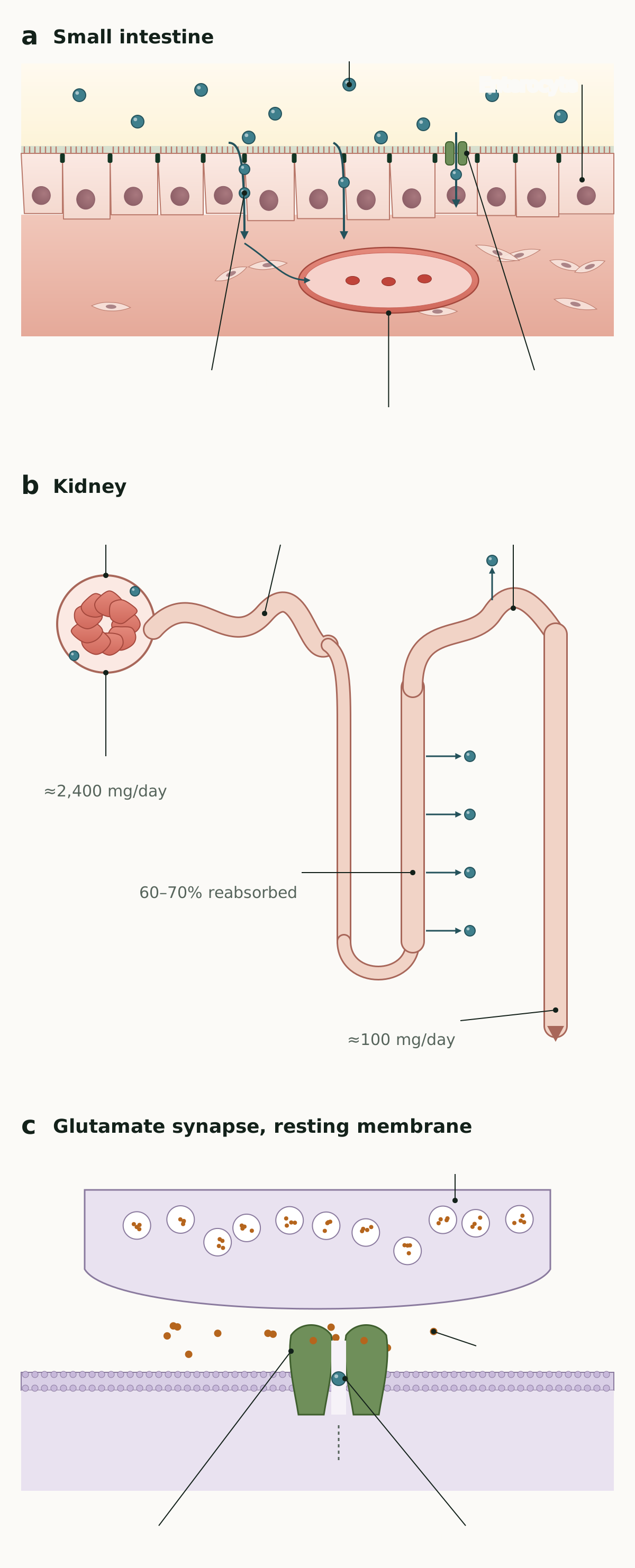
An adult body contains about 24 g of magnesium. About 99% of it is in bone, muscle and other soft tissue, and 50–60% is held in bone mineral.6 Less than 1% is in serum, which is why a normal blood level does not establish that total body magnesium is adequate.76 Most dietary magnesium is absorbed in the small intestine by a passive route between cells, with a smaller, regulated fraction passing through the TRPM6 and TRPM7 channels.6 Approximately 30–40% of the magnesium in food is absorbed.7 The kidneys filter about 2,400 mg a day and reabsorb about 95% of it, mostly in the thick ascending limb of the loop of Henle, so that roughly 100 mg is excreted in the urine.6
The proposed link with sleep comes mainly from neurophysiology. In 1984, two laboratory studies of mouse neurons showed that magnesium ions at physiological concentrations block the channel of the N-methyl-D-aspartate (NMDA) receptor, a receptor for the excitatory transmitter glutamate, and that the block is relieved when the cell is depolarized.89 Trial investigators have described magnesium as a natural NMDA antagonist and an agonist at GABA-A receptors, and have proposed this as the reason it might aid sleep.1011 None of the sleep trials discussed below measured magnesium in the brain, so whether supplements act through this mechanism in people is unknown.
Does magnesium help insomnia? What the randomized trials show
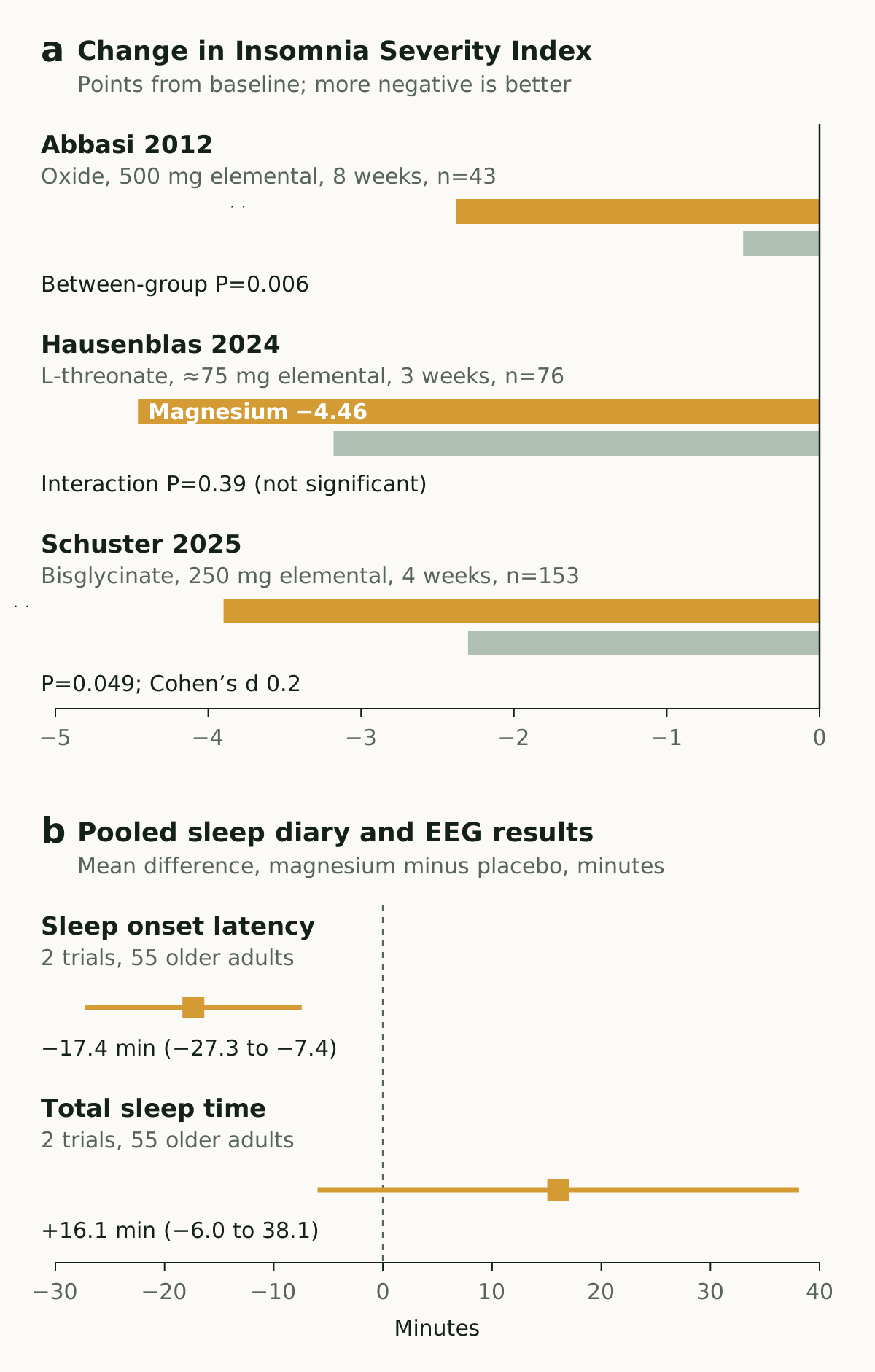
The first systematic review with a meta-analysis restricted to older adults was published by Mah and Pitre in 2021. It found three randomized placebo-controlled trials, in 151 older adults in three countries, using magnesium oxide or magnesium citrate at 320–729 mg of elemental magnesium a day for 20 days to 8 weeks.2 Pooled across two trials, sleep onset latency after treatment was 17.36 minutes shorter with magnesium than with placebo (95% CI −27.27 to −7.44). Total sleep time was 16.06 minutes longer, a difference that was not statistically significant (95% CI −5.99 to 38.12).2 The authors judged all three trials to be at moderate to high risk of bias, rated the evidence as low to very low quality, and concluded that the literature was not good enough for physicians to make well-informed recommendations.2
The largest of the three, by Nielsen and colleagues, randomized 100 adults aged 51 to 85 with poor sleep quality to 320 mg of magnesium a day as magnesium citrate or to a sodium citrate placebo for seven weeks. Pittsburgh Sleep Quality Index scores improved from 10.4 to 6.6, but they improved regardless of whether participants received magnesium or placebo.12 The trial by Abbasi and colleagues, which gave 46 adults aged 60 to 75 with insomnia either 500 mg of elemental magnesium as magnesium oxide or placebo for eight weeks, reported a greater fall in the Insomnia Severity Index (ISI) and a shorter sleep onset latency with magnesium. Total sleep time did not differ between groups.10 The third trial, by Held and colleagues, was a crossover study in 12 older adults; it recorded more slow-wave sleep on the electroencephalogram after 20 days of magnesium.11
The 2026 systematic review by Lopresti and colleagues is broader. It included randomized trials in adults in which magnesium was the only active treatment, searched registries as well as databases up to June 2026, and found 12 trials on sleep, insomnia or poor sleep.1 Populations, formulations, doses, durations and outcome measures varied too much to pool. Findings were inconsistent across questionnaires, electroencephalography, actigraphy and consumer wearables, and the certainty of evidence was low to very low. The authors concluded that magnesium may help some subjective outcomes in some adults but that current evidence does not support it as a routine treatment for insomnia.1
Does the form of magnesium matter? Glycinate, citrate, oxide and L-threonate
Forms of magnesium that dissolve well in liquid are absorbed more completely than less soluble forms. Small studies have found that the aspartate, citrate, lactate and chloride forms are more bioavailable than magnesium oxide and magnesium sulfate.7 A product’s label states the amount of elemental magnesium, not the weight of the whole compound.7 Better absorption has not been shown to translate into better sleep. Formulations and doses varied substantially across the sleep trials,1 and we found no randomized trial that compared two forms on a sleep outcome. Magnesium oxide, which is among the less bioavailable forms, was the product used in the Abbasi trial.107
Magnesium bisglycinate (glycinate)
The only placebo-controlled trial of magnesium bisglycinate that we found was conducted by Schuster and colleagues at Leibniz University Hannover and funded by the university. It randomized 155 adults aged 18 to 65 who reported poor sleep to 250 mg of elemental magnesium a day as bisglycinate or to placebo for four weeks.3 In the intention-to-treat analysis of 153 participants, the ISI fell by 3.9 points with magnesium and by 2.3 points with placebo (P=0.049). The authors described the effect size as small (Cohen’s d 0.2) and found no significant differences in the other psychological outcomes.3 Larger improvements in people with lower dietary magnesium intake came from an exploratory analysis.3 One coauthor is also the lead author of the 2026 systematic review and directs a contract research organization funded by nutraceutical companies.3
Magnesium L-threonate
Magnesium L-threonate is marketed for its effects on the brain. Two randomized trials of one branded product have measured sleep, and both were funded by industry: one by AIDP Inc., whose staff were coauthors, and one by Threotech, which makes the product.45 Hausenblas and colleagues gave 80 adults aged 35 to 55 with self-reported sleep problems 1 g a day of magnesium L-threonate, which provides about 75 mg of elemental magnesium, or placebo for 21 days. ISI scores fell in both groups, and the difference between groups over time was not significant (P=0.39).4 The investigators reported higher deep sleep and REM sleep scores from an Oura ring and improvements on some questionnaire subscales.4 In a six-week trial in 100 adults aged 18 to 45 with dissatisfied sleep, Lopresti and Smith found greater improvement in self-reported sleep-related impairment with 2 g a day of the same product, but no difference in sleep disturbance, restorative sleep or any sleep measure recorded by the ring. A difference in sleep disturbance appeared only in a subset of participants with more severe sleep problems.5
Magnesium citrate and oxide
These are the forms tested in the older trials. Citrate showed no advantage over a citrate placebo for sleep quality in the Nielsen trial,12 and oxide was associated with a lower ISI score in the Abbasi trial.10 Both trials are small, and the Mah and Pitre review found that neither reported how participants were randomized or how allocation was concealed.2
Who might benefit most?
Two trials hint that people with low magnesium status or intake respond better, but neither was designed to test this. In the Nielsen trial, 58% of participants consumed less than the estimated average requirement, and magnesium raised serum magnesium only in the 37 participants whose levels were low at baseline. Because sleep improved equally with placebo, the investigators could not determine whether low magnesium contributes to poor sleep.12 In the bisglycinate trial, the larger response in people with lower intake came from an exploratory analysis.3 Observational studies have found associations between magnesium status and sleep, but a 2022 systematic review noted that the randomized trials were contradictory.13
Combination products are a separate question. A trial in 43 residents of a long-term care facility found better sleep quality with a supplement containing 5 mg of melatonin, 225 mg of magnesium and 11.25 mg of zinc than with placebo,14 but a combination trial cannot show what the magnesium contributed.
For chronic insomnia, the American College of Physicians recommends cognitive behavioral therapy for insomnia as the initial treatment for all adults, a strong recommendation based on moderate-quality evidence.15 Magnesium has not been tested against it.
Is magnesium safe to take for sleep?
Magnesium from food does not pose a risk in healthy people, because the kidneys excrete the excess. The tolerable upper intake level for magnesium from supplements and medicines is 350 mg a day for adults, and higher doses often cause diarrhea, which may be accompanied by nausea and abdominal cramping.7 The forms most often reported to cause diarrhea are the carbonate, chloride, gluconate and oxide.7 Two of the trials discussed here used doses above the upper intake level: 500 mg a day in the Abbasi trial and up to about 729 mg a day in the Held trial.102
The risk of magnesium toxicity rises with impaired kidney function or kidney failure, because the ability to remove excess magnesium is reduced or lost.7 Magnesium also interacts with several medicines. It can reduce the absorption of oral bisphosphonates such as alendronate, which should be taken at least two hours apart from it. It forms insoluble complexes with tetracycline antibiotics such as doxycycline and with quinolones such as ciprofloxacin, which should be taken at least two hours before or four to six hours after a magnesium supplement.7 Loop and thiazide diuretics increase urinary losses of magnesium, potassium-sparing diuretics reduce them, and long-term use of proton pump inhibitors can lower serum magnesium.7
In the bisglycinate trial, 93% of participants reported no adverse events, and no serious adverse events occurred.3 Of the three older trials in the Mah and Pitre review, only one reported adverse events; in that trial all participants had soft stools.2
What remains uncertain?
The trials reviewed here lasted between three and eight weeks, and most enrolled people who reported poor sleep rather than people with diagnosed insomnia disorder.1012345 Most relied on questionnaires, and in several the placebo group improved almost as much as the magnesium group.1243 Findings across subjective and objective measures were inconsistent.1 The L-threonate trials were funded by companies that supply the product.45 We found no trial that tested whether correcting a measured magnesium deficiency improves sleep, or that compared forms of magnesium on a sleep outcome.
Evidence grades
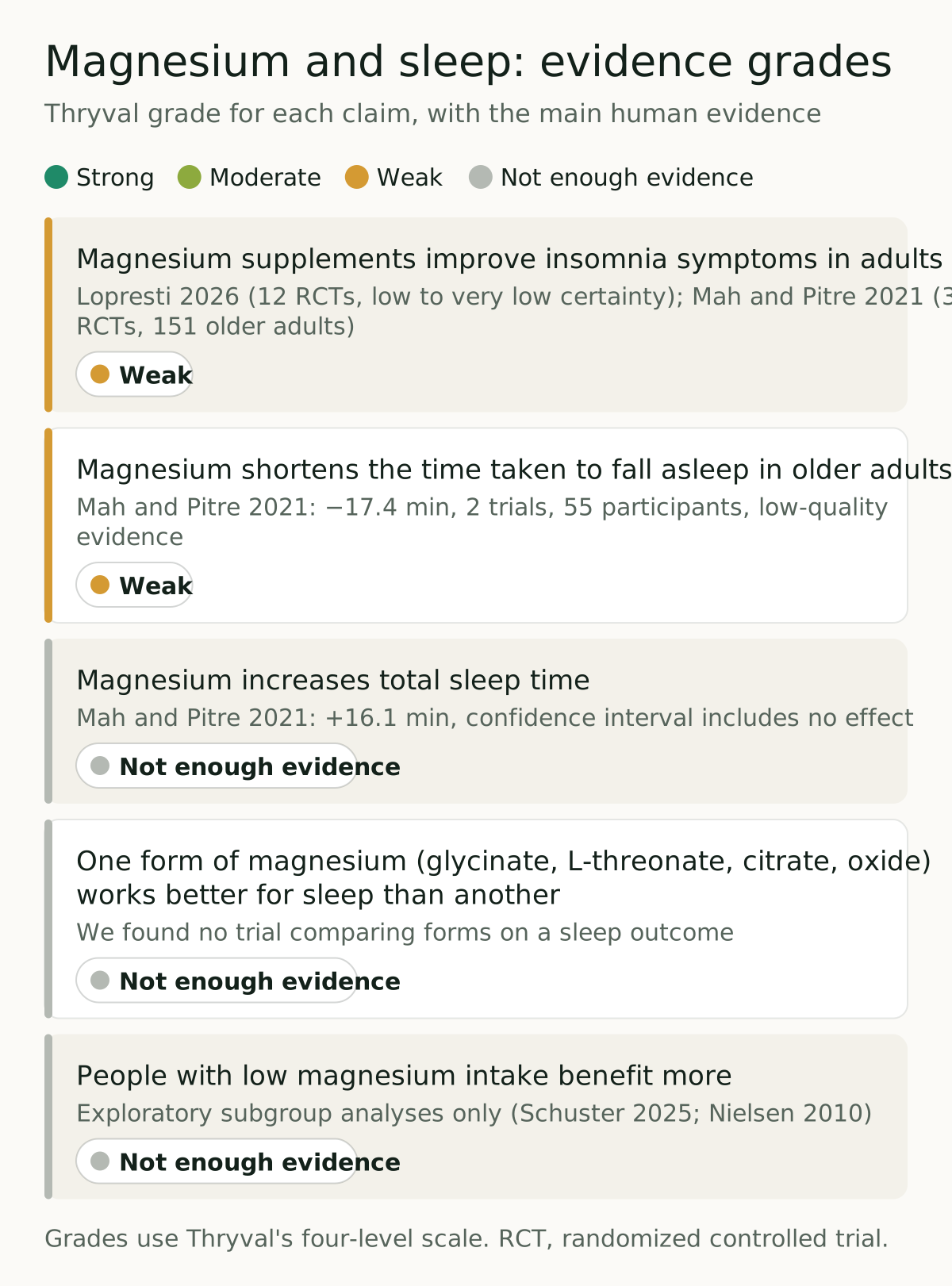
The grades below are Thryval editorial judgments based on the studies cited in this article. The grading rules are set out on our Research page.
Frequently asked questions
Does magnesium help you sleep?
It may help slightly. Trials have reported small improvements in self-reported insomnia symptoms, but the results are inconsistent and a 2026 systematic review rated the certainty of the evidence as low to very low.1
What is the best magnesium for sleep?
No form has been shown to work better than another for sleep, and we found no trial that compared them directly. Trial formulations varied widely.1 Positive trials have used oxide and bisglycinate, and L-threonate has two industry-funded trials with mixed results.10345
Is magnesium glycinate good for sleep?
One randomized trial in 155 adults with poor sleep found that over four weeks the Insomnia Severity Index fell by 3.9 points with 250 mg a day of magnesium bisglycinate and by 2.3 points with placebo, an effect the authors described as small.3
Does magnesium L-threonate improve sleep?
In two trials funded by its suppliers, it improved some self-reported or wearable-device measures but not others, and in the earlier trial the main insomnia score did not differ from placebo.45
How much magnesium is safe to take?
For adults, the tolerable upper intake level for magnesium from supplements is 350 mg a day; higher doses often cause diarrhea.7 People with reduced kidney function face a higher risk of magnesium toxicity and should not take supplements without medical advice.7
Can magnesium interact with medicines?
Yes. It reduces the absorption of oral bisphosphonates and of tetracycline and quinolone antibiotics, so doses need to be separated, and some diuretics and long-term proton pump inhibitor use affect magnesium levels.7
Implications for patients and clinicians
The trial evidence does not support magnesium as a treatment for insomnia disorder, for which cognitive behavioral therapy remains the recommended first step.151 For an adult with poor sleep who wants to try it, the trials suggest that any benefit is likely to be small, and the placebo groups in these trials improved substantially on their own.312 Keeping supplemental intake within the 350 mg upper level, avoiding it in kidney disease, and separating it from interacting medicines are the practical precautions.7 Paying more for a particular form is not supported by any comparative sleep trial.
References
-
Lopresti AL, Smith SJ, Drummond PD. Magnesium supplementation for sleep in adults: a systematic review of randomized controlled trials. J Diet Suppl. 2026;23(5):553–581. Systematic review (GRADE): 12 randomized trials in the main synthesis. doi.org/10.1080/19390211.2026.2719670 · PubMed 42661485 ↩↩↩↩↩↩↩↩↩
-
Mah J, Pitre T. Oral magnesium supplementation for insomnia in older adults: a systematic review & meta-analysis. BMC Complement Med Ther. 2021;21(1):125. Systematic review and meta-analysis: 3 randomized trials, 151 participants. Correction: 2024;24(1):418. doi.org/10.1186/s12906-021-03297-z · PubMed 33865376 ↩↩↩↩↩↩↩↩↩↩
-
Schuster J, Cycelskij I, Lopresti A, Hahn A. Magnesium bisglycinate supplementation in healthy adults reporting poor sleep: a randomized, placebo-controlled trial. Nat Sci Sleep. 2025;17:2027–2040. Randomized controlled trial, n=155. doi.org/10.2147/NSS.S524348 · PubMed 40918053 ↩↩↩↩↩↩↩↩↩↩↩↩↩↩
-
Hausenblas HA, Lynch T, Hooper S, Shrestha A, Rosendale D, Gu J. Magnesium-L-threonate improves sleep quality and daytime functioning in adults with self-reported sleep problems: a randomized controlled trial. Sleep Med X. 2024;8:100121. Randomized controlled trial, n=80; funded by AIDP Inc. Corrigendum: 2025;9:100141. doi.org/10.1016/j.sleepx.2024.100121 · PubMed 39252819 ↩↩↩↩↩↩↩↩↩↩
-
Lopresti AL, Smith SJ. The effects of magnesium L-threonate (Magtein) on cognitive performance and sleep quality in adults: a randomised, double-blind, placebo-controlled trial. Front Nutr. 2025;12:1729164. Randomized controlled trial, n=100; funded by Threotech Inc. Erratum: 2026;13:2010644. doi.org/10.3389/fnut.2025.1729164 · PubMed 41601871 ↩↩↩↩↩↩↩↩
-
Jahnen-Dechent W, Ketteler M. Magnesium basics. Clin Kidney J. 2012;5(Suppl 1):i3–i14. Review. doi.org/10.1093/ndtplus/sfr163 · PubMed 26069819 ↩↩↩↩
-
National Institutes of Health, Office of Dietary Supplements. Magnesium: fact sheet for health professionals. Updated January 6, 2026. Government fact sheet. ods.od.nih.gov/factsheets/Magnesium-HealthProfessional ↩↩↩↩↩↩↩↩↩↩↩↩↩↩
-
Nowak L, Bregestovski P, Ascher P, Herbet A, Prochiantz A. Magnesium gates glutamate-activated channels in mouse central neurones. Nature. 1984;307(5950):462–465. Laboratory study (mouse neurons). doi.org/10.1038/307462a0 · PubMed 6320006 ↩
-
Mayer ML, Westbrook GL, Guthrie PB. Voltage-dependent block by Mg2+ of NMDA responses in spinal cord neurones. Nature. 1984;309(5965):261–263. Laboratory study (mouse neurons). doi.org/10.1038/309261a0 · PubMed 6325946 ↩
-
Abbasi B, Kimiagar M, Sadeghniiat K, Shirazi MM, Hedayati M, Rashidkhani B. The effect of magnesium supplementation on primary insomnia in elderly: a double-blind placebo-controlled clinical trial. J Res Med Sci. 2012;17(12):1161–1169. Randomized controlled trial, n=46. PMC3703169 · PubMed 23853635 ↩↩↩↩↩↩↩
-
Held K, Antonijevic IA, Künzel H, et al. Oral Mg(2+) supplementation reverses age-related neuroendocrine and sleep EEG changes in humans. Pharmacopsychiatry. 2002;35(4):135–143. Randomized crossover trial, n=12. doi.org/10.1055/s-2002-33195 · PubMed 12163983 ↩↩
-
Nielsen FH, Johnson LK, Zeng H. Magnesium supplementation improves indicators of low magnesium status and inflammatory stress in adults older than 51 years with poor quality sleep. Magnes Res. 2010;23(4):158–168. Randomized controlled trial, n=100. PubMed 21199787 ↩↩↩↩↩↩↩
-
Arab A, Rafie N, Amani R, Shirani F. The role of magnesium in sleep health: a systematic review of available literature. Biol Trace Elem Res. 2023;201(1):121–128. Systematic review: 9 observational and interventional studies, 7,582 participants. doi.org/10.1007/s12011-022-03162-1 · PubMed 35184264 ↩
-
Rondanelli M, Opizzi A, Monteferrario F, Antoniello N, Manni R, Klersy C. The effect of melatonin, magnesium, and zinc on primary insomnia in long-term care facility residents in Italy: a double-blind, placebo-controlled clinical trial. J Am Geriatr Soc. 2011;59(1):82–90. Randomized controlled trial, n=43. doi.org/10.1111/j.1532-5415.2010.03232.x · PubMed 21226679 ↩
-
Qaseem A, Kansagara D, Forciea MA, Cooke M, Denberg TD. Management of chronic insomnia disorder in adults: a clinical practice guideline from the American College of Physicians. Ann Intern Med. 2016;165(2):125–133. Clinical practice guideline (GRADE). doi.org/10.7326/M15-2175 · PubMed 27136449 ↩↩