

Does melatonin help you sleep? What the trials show
Melatonin shortens the time it takes to fall asleep by a few minutes in people with insomnia. Its clearer uses are in resetting the body clock, for jet lag and delayed sleep phase. Many products do not contain the dose on the label, and poison center calls about children have risen sharply.
The grade WeakMelatonin supplements for chronic insomnia in adults
In brief. In people with insomnia, melatonin shortens the time taken to fall asleep by about 7 minutes and lengthens total sleep by about 8 minutes, according to a meta-analysis of 19 randomized trials.1 The American Academy of Sleep Medicine (AASM) advises clinicians not to use it for chronic insomnia, and cognitive behavioral therapy remains the recommended first treatment.23 The evidence is better for timing problems. In a Cochrane review, 9 of 10 trials found that melatonin taken near bedtime at the destination reduced jet lag after flights across five or more time zones,4 and in delayed sleep-wake phase disorder it moved sleep onset earlier by roughly 30 to 40 minutes.56 Laboratory tests of supplements found that most products differed from their labels by more than 10%,78 and calls to US poison centers about children swallowing melatonin rose 530% between 2012 and 2021.9
Melatonin is a hormone made by the pineal gland during darkness. In the United States it is sold as a dietary supplement, while several other countries treat it as a drug that needs a prescription.10 The share of US adults reporting its use rose from 0.4% in 1999–2000 to 2.1% in 2017–2018 in national survey data.11 This article reviews how the hormone is regulated in the body, what the trials found for insomnia, jet lag, shift work and delayed sleep phase, the doses and timing those trials used, the accuracy of supplement labels, and what is known about safety in adults and children.
What does melatonin do in the body?
Light reaches the brain’s master clock through a small set of retinal ganglion cells that contain the photopigment melanopsin. In rodents, these cells were shown to send their axons along the retinohypothalamic tract to the suprachiasmatic nucleus (SCN) of the hypothalamus.12 From the SCN, the signal to the pineal gland takes an indirect route. It passes through the paraventricular nucleus of the hypothalamus, down to the intermediolateral cell column of the spinal cord, out to the superior cervical ganglion in the neck, and back up to the pineal gland on sympathetic nerve fibers.13 Norepinephrine released from those fibers activates the enzymes that convert serotonin to melatonin, of which arylalkylamine N-acetyltransferase (AANAT) is rate limiting.14
In humans, melatonin secretion begins soon after dusk, peaks between about 2 and 4 in the morning and declines through the second half of the night. Night-time serum concentrations are around 80 to 120 pg/mL, compared with 10 to 20 pg/mL in daylight.14 The first rise in the evening, measured in saliva or blood under dim light, is called the dim light melatonin onset (DLMO) and is used in research as a marker of the timing of a person’s internal clock.156 Light at night suppresses secretion. In a study of 116 healthy adults aged 18 to 30 living in a research unit, room light of under 200 lux in the 8 hours before bedtime, compared with dim light, delayed melatonin onset in 99% of participants and shortened the nightly duration of secretion by about 90 minutes.16
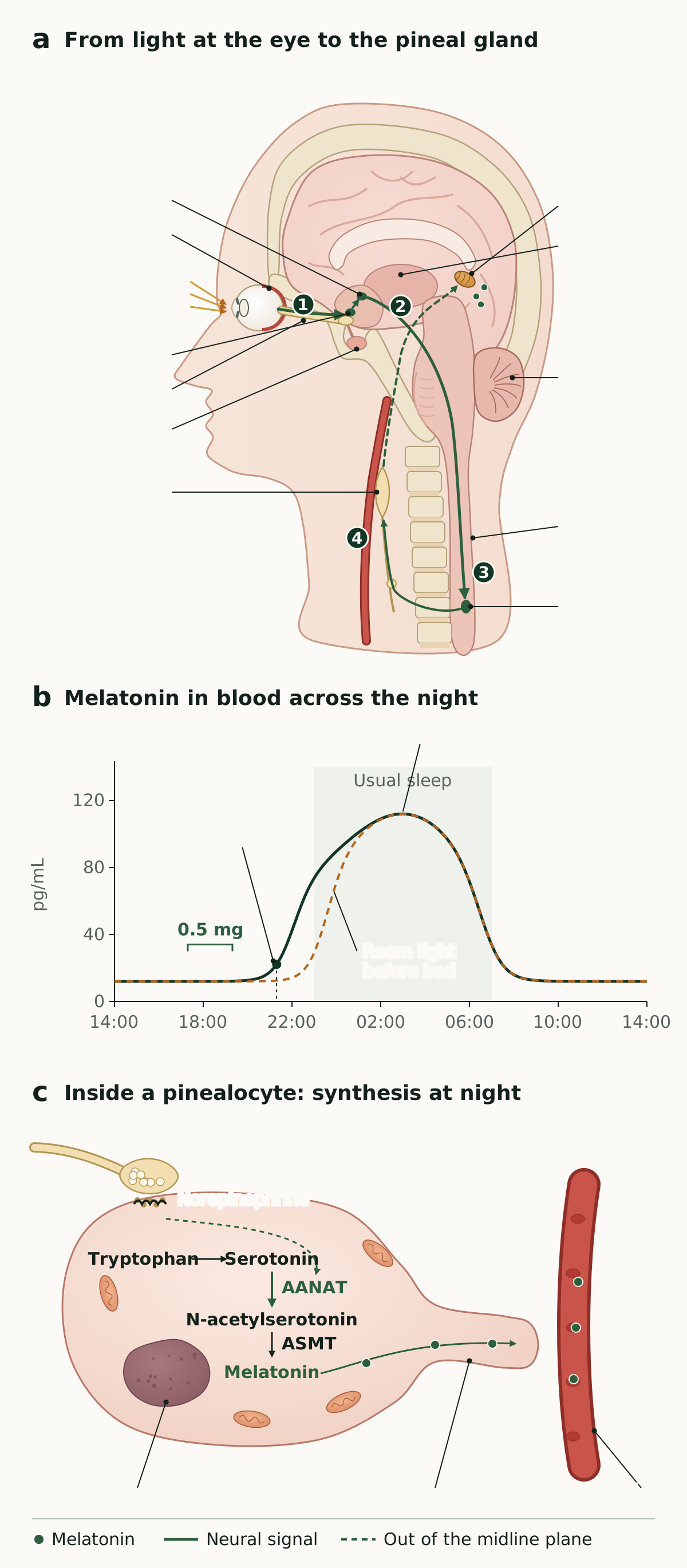
Melatonin taken by mouth behaves differently from the hormone the body makes. In a systematic review of 22 pharmacokinetic studies, immediate-release tablets reached peak blood levels about 50 minutes after a dose, the elimination half-life was about 45 minutes, and oral bioavailability averaged about 15%, ranging from 9% to 33%.17 A typical dose of 1 to 5 mg produces blood levels 10 to 100 times higher than the natural night-time peak within an hour, falling back to baseline over 4 to 8 hours.14 It is broken down mainly in the liver by the enzyme CYP1A2 and excreted in urine as 6-sulfatoxymelatonin.14
Does melatonin help insomnia? What the randomized trials show
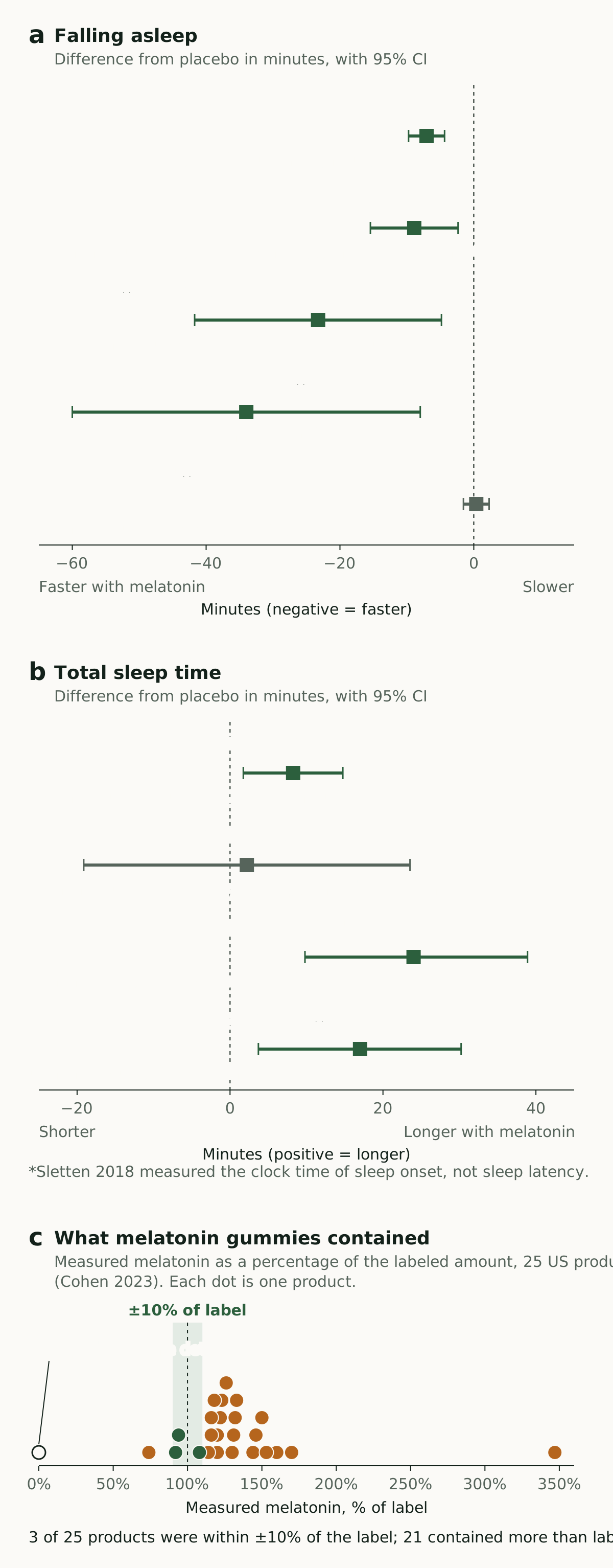
The most widely cited meta-analysis, by Ferracioli-Oda and colleagues in 2013, pooled 19 placebo-controlled trials with 1,683 adults and children with primary sleep disorders.1 Doses ranged from 0.1 to 5 mg (weight-based in one pediatric trial), and treatment lasted from 7 days to 26 weeks. Compared with placebo, melatonin shortened sleep onset latency by 7.06 minutes (95% CI 4.37 to 9.75) and increased total sleep time by 8.25 minutes (95% CI 1.74 to 14.75). Self-rated sleep quality improved by a standardized mean difference of 0.22 (95% CI 0.12 to 0.32), which is a small effect. Trials that used higher doses or ran longer reported larger effects on sleep latency and total sleep time, and the benefit did not appear to wear off with continued use.1 The authors noted that the absolute benefit was smaller than that of other drugs for insomnia. The analysis was partly funded by two Eli Lilly-supported research awards to its senior author.1
The AASM’s 2017 guideline on drug treatment of chronic insomnia in adults reached a more cautious conclusion. Its task force found three trials suitable for meta-analysis, all testing prolonged-release melatonin 2 mg in adults over 55, with 170, 40 and 354 participants.2 Pooled, sleep quality improved by a standardized mean difference of 0.21 (95% CI −0.36 to 0.77). In the one trial that measured sleep by polysomnography, sleep latency fell by 8.9 minutes (95% CI 2.35 to 15.45) and total sleep time rose by 2.2 minutes (95% CI −19.13 to 23.53). The task force judged the quality of evidence very low and suggested that clinicians not use melatonin for sleep onset or sleep maintenance insomnia, a weak recommendation.2
The largest long-term trial of the prolonged-release product, funded by its manufacturer Neurim Pharmaceuticals, randomized 791 adults aged 18 to 80 with primary insomnia.18 At three weeks, melatonin did not shorten sleep latency compared with placebo in people with low natural melatonin output, whatever their age. In participants aged 65 to 80, sleep latency fell by 19.1 minutes with melatonin and 1.7 minutes with placebo, and the improvement was maintained over six months.18 Its result for low secretors is relevant to how melatonin is marketed. Low measured melatonin did not predict who would respond.18
A 2024 dose-response meta-analysis of 26 randomized trials (1,689 observations) in people with insomnia and healthy volunteers estimated that the effect on sleep latency and total sleep time rose with dose up to about 4 mg a day. The interval between the dose and the sleep period was a significant predictor of the effect on sleep latency, and the authors proposed testing 4 mg about 3 hours before bedtime in place of the common practice of 2 mg 30 minutes before.19 That schedule is a model-based suggestion and has not been tested in its own trial.
Does melatonin help jet lag?
The Cochrane review of melatonin for jet lag, by Herxheimer and Petrie, included 10 randomized trials in airline passengers, airline staff and military personnel.4 Nine of the 10 found that melatonin taken close to the target bedtime at the destination, between 10 pm and midnight, reduced jet lag after flights across five or more time zones. Daily doses between 0.5 and 5 mg were similarly effective, although people fell asleep faster and slept better after 5 mg than after 0.5 mg, and doses above 5 mg appeared to add nothing. A 2 mg slow-release product was relatively ineffective. The reviewers estimated a number needed to treat of 2, with a larger benefit when more time zones were crossed and a smaller one after westward flights.4
Timing mattered. Taken at the wrong time, early in the day, melatonin caused sleepiness and could delay adaptation to local time.4 The review is from 2002, its trials were small, and it reported the proportion of positive trials rather than a pooled effect size. Its conclusion that melatonin is effective for jet lag has not been overturned, but the precision of the estimate is limited.
Does melatonin help shift workers sleep?
A Cochrane review by Liira and colleagues found 15 randomized placebo-controlled trials with 718 shift workers, nine of which tested melatonin at 1 to 10 mg.20 Melatonin taken after a night shift lengthened the following daytime sleep by 24 minutes (95% CI 9.8 to 38.9; seven trials, 263 participants) and night-time sleep by 17 minutes (95% CI 3.71 to 30.22; three trials, 234 participants). It did not shorten the time taken to fall asleep (mean difference 0.37 minutes, 95% CI −1.55 to 2.29; five trials, 74 participants), and there was no sign of a dose-response relation. The reviewers rated all of this evidence as low quality.20
Does melatonin help delayed sleep-wake phase disorder?
In delayed sleep-wake phase disorder, the internal clock runs late, so people cannot fall asleep at a conventional hour and struggle to wake for daytime commitments.6 A meta-analysis by van Geijlswijk and colleagues pooled five trials in 91 adults and four trials in 226 children.5 Melatonin moved the DLMO earlier by 1.18 hours (95% CI 0.89 to 1.48) and the clock time of sleep onset earlier by 0.67 hours (95% CI 0.45 to 0.89), and shortened sleep onset latency by 23.27 minutes (95% CI 4.83 to 41.72). Wake-up time and total sleep time did not change significantly.5
The largest single trial, by Sletten and colleagues in Australia, randomized 116 patients with clinically diagnosed disorder and a confirmed late DLMO to 0.5 mg of fast-release melatonin or placebo, taken 1 hour before their desired bedtime for at least five nights a week for four weeks.6 Both groups were also told to keep a scheduled bedtime. Measured by actigraphy, sleep onset moved 34 minutes earlier with melatonin than with placebo (95% CI 8 to 60 minutes), and 52.8% of melatonin patients were rated by clinicians as more than minimally improved, compared with 24.0% on placebo. In the 43 patients who had a repeat DLMO, it did not differ between groups.6 The trial was funded by Australia’s National Health and Medical Research Council, and Philips Respironics paid for recruitment advertising.6
The AASM’s 2015 guideline on circadian rhythm sleep-wake disorders suggests strategically timed melatonin for delayed sleep-wake phase disorder in adults and in children and adolescents, for blind adults with non-24-hour sleep-wake rhythm disorder, and for children and adolescents with neurological disorders and irregular sleep-wake rhythm.21 All of these are weak recommendations. The same guideline suggests avoiding melatonin in older people with dementia and irregular sleep-wake rhythm, based on a trial that found no benefit on total sleep time and on evidence of possible harm in that group.21
What dose of melatonin should you take, and when?
No single dose has been established. The trials used a wide range. The insomnia meta-analysis included doses from 0.1 to 5 mg,1 the jet lag trials 0.5 to 5 mg,4 and the shift work trials 1 to 10 mg.20 As little as 0.1 to 0.3 mg can raise blood levels in young adults into the normal night-time range,8 and common doses of 1 to 5 mg produce levels far above it.14 In US national survey data, the share of adults reporting more than 5 mg a day rose from 0.08% in 2005–2006 to 0.28% in 2017–2018.11
The timing depends on what the dose is meant to do. For jet lag, the positive trials gave melatonin near bedtime at the destination.4 For moving the clock earlier, the effect depends on when the dose is taken relative to a person’s own DLMO. In a laboratory study of 34 healthy adults, 0.5 mg produced its largest advance when taken in the afternoon, 2 to 4 hours before DLMO, while the peak time for 3.0 mg came about 2 hours earlier relative to DLMO. Given at its best time, each dose produced shifts of similar size, about 1.5 hours over three days for 0.5 mg.15 The delayed sleep phase trial that used 0.5 mg 1 hour before the desired bedtime is the clinical example of a low, timed dose.6 In the jet lag trials, a 2 mg slow-release product was relatively ineffective, which the reviewers took to suggest that a short, higher peak in blood levels works better.4
Do melatonin supplements contain what the label says?
Often they do not. Erland and Saxena measured melatonin by liquid chromatography in 31 supplements.7 Content ranged from 83% less to 478% more than the label, and more than 71% of products were outside 10% of their stated dose. Different lots of the same product differed by as much as 465%, and eight products contained serotonin at 1 to 75 μg.7 An accompanying commentary noted that the products were bought from grocery stores and pharmacies in one Canadian city, and that the most variable sample, a chewable tablet labeled 1.5 mg, contained almost 9 mg.22
Cohen and colleagues tested 25 melatonin gummy products bought in the United States in 2022, chosen from the National Institutes of Health’s Dietary Supplement Label Database.8 One contained no detectable melatonin but did contain 31.3 mg of cannabidiol (CBD). In the other 24, measured melatonin ranged from 74% to 347% of the label. Only 3 of the 25 products were within 10% of their declared amount, and five declared CBD.8 The authors analyzed one sample per brand and could not say whether batches within a brand vary.8 In the United States, melatonin is regulated as a dietary supplement, under less strict rules than prescription or over-the-counter drugs.10
Is melatonin safe?
In the short term, side effects appear to be few and mostly mild. A systematic review of 37 randomized trials, with daily doses from 0.15 to 12 mg, found that the most common adverse events were daytime sleepiness (1.66%), headache (0.74%), other sleep-related events (0.74%), dizziness (0.74%) and hypothermia (0.62%).23 No life-threatening events were identified. Most trials lasted four weeks or less, only 8 of the 37 were rated good on the Cochrane risk-of-bias criteria, and the authors concluded that long-term safety cannot be judged from the available data.23
Several precautions come from case reports and pharmacology, not from trials. The Cochrane jet lag review found case reports suggesting that people with epilepsy and people taking warfarin may be harmed by melatonin,4 and the US National Center for Complementary and Integrative Health (NCCIH) advises that people with epilepsy and those taking blood thinners use it only under medical supervision.10 Its absorption and clearance are altered by age, caffeine, smoking, oral contraceptives, food and the antidepressant fluvoxamine.17 Safety in pregnancy and breastfeeding has not been studied, and in older people melatonin may stay active for longer and cause daytime drowsiness.10 Melatonin is not a substitute for medicines a clinician has prescribed, and anyone taking a prescription sleep medicine or one of the drugs above should discuss it before starting or switching.
Should children take melatonin?
Use in children is common. In an online survey of parents of 993 US children aged 1 to 13, 5.6% of preschool children, 18.5% of school-aged children and 19.4% of preteens had taken melatonin in the previous 30 days.24 Median doses rose from 0.5 mg in preschool children to 2 mg in preteens, with some preteens given 10 mg. Gummies were the most common form (64.3%), and children who were taking melatonin had done so for a median of 12 to 21 months, depending on age.24 Given the gummy results above, a child taking these products as directed could receive 40 to 130 times the 0.1 to 0.3 mg needed to reach normal night-time levels, according to Cohen and colleagues.8
Accidental ingestion has risen in parallel. US poison control centers recorded 260,435 melatonin ingestions in people aged 19 or younger from 2012 to 2021, and the annual number rose by 530%.9 Most involved children aged 5 or younger (83.8%), and 94.3% were unintentional. Of 27,795 children who were seen at a health care facility, 4,097 were admitted to hospital and 287 needed intensive care. Five required mechanical ventilation and two died, aged 3 months and 13 months.9
The strongest pediatric evidence is in children with neurodevelopmental conditions, whose sleep problems are often severe. In a 13-week trial in 125 children and adolescents aged 2 to 17.5 years, almost all with autism spectrum disorder, whose sleep had not improved with behavioral measures, a pediatric prolonged-release melatonin (2 mg, increased to 5 mg) increased total sleep time by 57.5 minutes, compared with 9.14 minutes on placebo.25 The adjusted difference was 32.43 minutes (P=.034), and sleep latency fell by 25.30 minutes more than with placebo. Two of the five authors worked for Neurim Pharmaceuticals, which makes the product.25 An earlier meta-analysis of five small crossover trials in autism found that melatonin increased sleep duration by 44 minutes and shortened sleep onset latency by 39 minutes compared with placebo, with large variation between studies.26
For healthy children, there are few trials. NCCIH notes that the best dose and timing are uncertain, that long-term effects are unknown, and that because melatonin is a hormone, an effect on puberty, menstrual cycles or prolactin cannot be ruled out.10 It advises working with a health care provider before giving melatonin to a child.10
What melatonin does not do
Melatonin does not do much to keep people asleep. The pooled gain in total sleep time in insomnia trials was about 8 minutes,1 and in the AASM’s polysomnography trial wake time after sleep onset did not improve; it rose by 8.5 minutes (95% CI −11.75 to 28.75).2 Taking it does not appear to correct a deficiency that predicts benefit, since low natural output did not identify responders in the largest insomnia trial.18 It did not help shift workers fall asleep faster,20 and the AASM advises against it for older adults with dementia.21 Melatonin products are not approved by the US Food and Drug Administration.8 For chronic insomnia, the American College of Physicians recommends cognitive behavioral therapy for insomnia as the first treatment.3
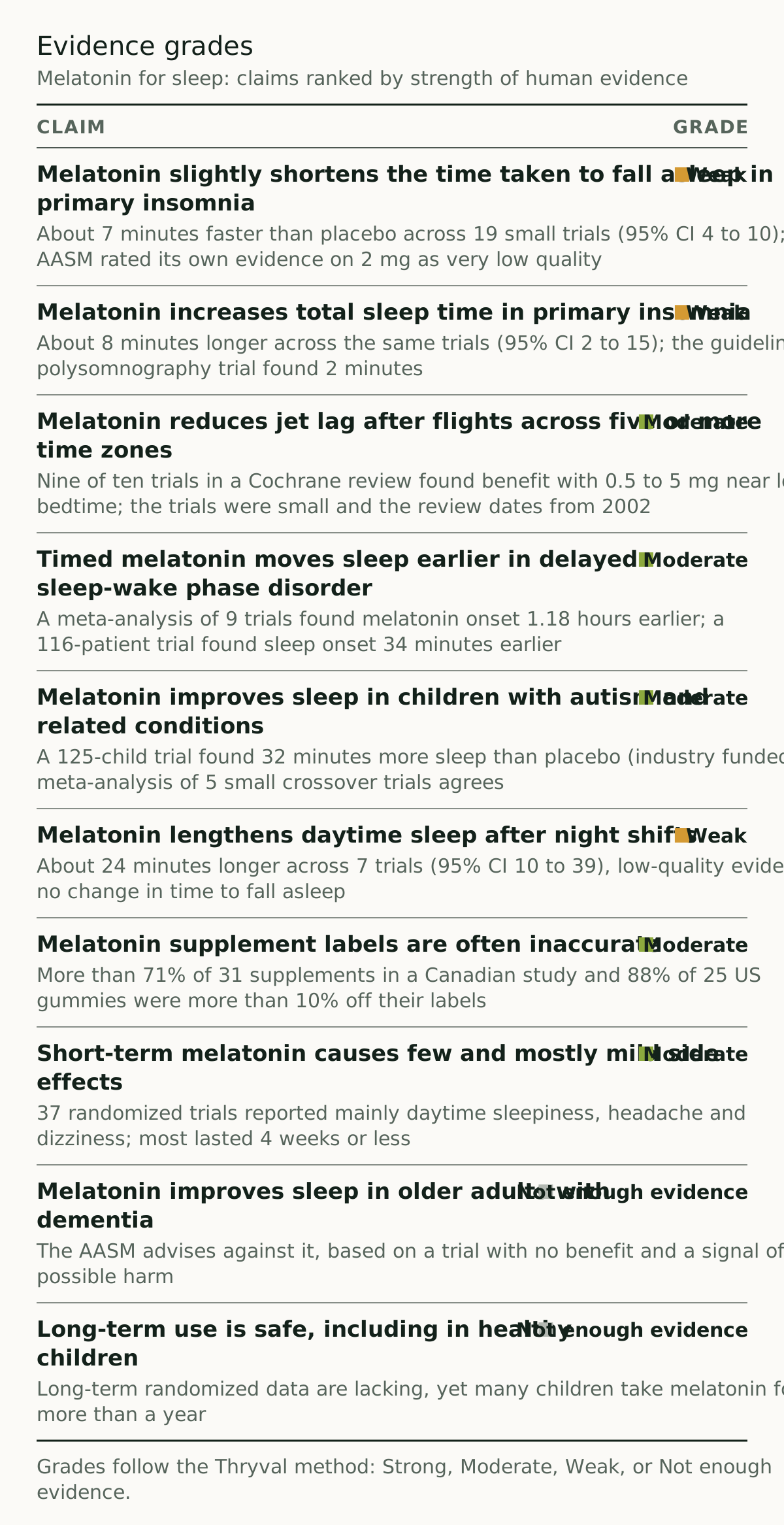
Evidence grades
The grades below are Thryval editorial judgments based on the studies cited in this article. The grading rules are set out on our Research page.
Frequently asked questions
Does melatonin help you sleep?
It helps a little. In people with insomnia it shortened the time taken to fall asleep by about 7 minutes and increased total sleep by about 8 minutes in a meta-analysis of 19 trials, and the AASM advises against it for chronic insomnia.12
How much melatonin should I take?
No dose has been established. Trials used 0.1 to 10 mg, jet lag trials found 0.5 to 5 mg similarly effective, and doses as low as 0.1 to 0.3 mg raise blood levels into the normal night-time range.14208
When should I take melatonin?
It depends on the goal. For jet lag, the positive trials gave it near bedtime at the destination.4 To move the body clock earlier, 0.5 mg worked best taken 2 to 4 hours before a person’s natural melatonin onset, and a clinical trial used 0.5 mg 1 hour before the desired bedtime.156
Does melatonin work for jet lag?
In a Cochrane review, 9 of 10 trials found that it reduced jet lag after flights across five or more time zones, especially eastward, when taken near bedtime at the destination.4
Is melatonin safe for children?
Short-term side effects in trials have been mild, but long-term safety in children is unknown.2310 Poison center calls about children swallowing melatonin rose 530% from 2012 to 2021, and most gummies tested contained more melatonin than labeled.98 NCCIH advises involving a health care provider.10
Can you take melatonin every night?
Trials have lasted up to about six months without signs that the effect wears off, but most safety data come from trials of four weeks or less.11823
Implications for patients and clinicians
For chronic insomnia, the trials show a small effect on falling asleep and little effect on staying asleep, and guidelines favor cognitive behavioral therapy as the first treatment.123 Melatonin’s better-supported uses are about timing: jet lag after long eastward flights, and delayed sleep-wake phase disorder, where a low dose taken some hours before the natural melatonin onset can move sleep earlier.456 Because product contents vary widely, the dose on a label is an unreliable guide.78 For children, the evidence supports use mainly in those with neurodevelopmental conditions under clinical supervision, and products should be stored out of reach.25219
References
-
Ferracioli-Oda E, Qawasmi A, Bloch MH. Meta-analysis: melatonin for the treatment of primary sleep disorders. PLoS One. 2013;8(5):e63773. Meta-analysis: 19 randomized trials, 1,683 participants; partly funded by APIRE/Eli Lilly and AACAP/Eli Lilly research awards to one author. PMC3656905 · PubMed 23691095 ↩↩↩↩↩↩↩↩↩↩↩↩
-
Sateia MJ, Buysse DJ, Krystal AD, Neubauer DN, Heald JL. Clinical practice guideline for the pharmacologic treatment of chronic insomnia in adults: an American Academy of Sleep Medicine clinical practice guideline. J Clin Sleep Med. 2017;13(2):307–349. Clinical practice guideline (GRADE). PMC5263087 · PubMed 27998379 ↩↩↩↩↩↩↩↩
-
Qaseem A, Kansagara D, Forciea MA, Cooke M, Denberg TD. Management of chronic insomnia disorder in adults: a clinical practice guideline from the American College of Physicians. Ann Intern Med. 2016;165(2):125–133. Clinical practice guideline (GRADE). PubMed 27136449 ↩↩↩
-
Herxheimer A, Petrie KJ. Melatonin for the prevention and treatment of jet lag. Cochrane Database Syst Rev. 2002;(2):CD001520. Cochrane systematic review: 10 randomized trials. PubMed 12076414 ↩↩↩↩↩↩↩↩↩↩↩↩↩
-
van Geijlswijk IM, Korzilius HP, Smits MG. The use of exogenous melatonin in delayed sleep phase disorder: a meta-analysis. Sleep. 2010;33(12):1605–1614. Meta-analysis: 9 randomized trials, 317 participants. PMC2982730 · PubMed 21120122 ↩↩↩↩↩
-
Sletten TL, Magee M, Murray JM, et al. Efficacy of melatonin with behavioural sleep-wake scheduling for delayed sleep-wake phase disorder: a double-blind, randomised clinical trial. PLoS Med. 2018;15(6):e1002587. Randomized controlled trial, n=116; funded by the NHMRC, with recruitment advertising paid for by Philips Respironics. PMC6005466 · PubMed 29912983 ↩↩↩↩↩↩↩↩↩↩
-
Erland LA, Saxena PK. Melatonin natural health products and supplements: presence of serotonin and significant variability of melatonin content. J Clin Sleep Med. 2017;13(2):275–281. Laboratory analysis of 31 supplements. PMC5263083 · PubMed 27855744 ↩↩↩↩↩
-
Cohen PA, Avula B, Wang YH, Katragunta K, Khan I. Quantity of melatonin and CBD in melatonin gummies sold in the US. JAMA. 2023;329(16):1401–1402. Laboratory analysis of 25 products (research letter). PMC10130950 · PubMed 37097362 ↩↩↩↩↩↩↩↩↩↩↩
-
Lelak K, Vohra V, Neuman MI, Toce MS, Sethuraman U. Pediatric melatonin ingestions — United States, 2012–2021. MMWR Morb Mortal Wkly Rep. 2022;71(22):725–729. Poison center surveillance report (CDC). PMC9169525 · PubMed 35653284 ↩↩↩↩↩
-
National Center for Complementary and Integrative Health. Melatonin: what you need to know. Last updated May 2024. Government fact sheet. nccih.nih.gov/health/melatonin-what-you-need-to-know ↩↩↩↩↩↩↩↩
-
Li J, Somers VK, Xu H, Lopez-Jimenez F, Covassin N. Trends in use of melatonin supplements among US adults, 1999–2018. JAMA. 2022;327(5):483–485. Repeated cross-sectional survey (NHANES), n=55,021. PMC8808329 · PubMed 35103775 ↩↩
-
Hattar S, Liao HW, Takao M, Berson DM, Yau KW. Melanopsin-containing retinal ganglion cells: architecture, projections, and intrinsic photosensitivity. Science. 2002;295(5557):1065–1070. Laboratory study (rodents). PMC2885915 · PubMed 11834834 ↩
-
Bonmati-Carrion MA, Arguelles-Prieto R, Martinez-Madrid MJ, et al. Protecting the melatonin rhythm through circadian healthy light exposure. Int J Mol Sci. 2014;15(12):23448–23500. Review. PMC4284776 · PubMed 25526564 ↩
-
Tordjman S, Chokron S, Delorme R, et al. Melatonin: pharmacology, functions and therapeutic benefits. Curr Neuropharmacol. 2017;15(3):434–443. Review. PMC5405617 · PubMed 28503116 ↩↩↩↩↩
-
Burgess HJ, Revell VL, Molina TA, Eastman CI. Human phase response curves to three days of daily melatonin: 0.5 mg versus 3.0 mg. J Clin Endocrinol Metab. 2010;95(7):3325–3331. Double-blind, placebo-controlled crossover laboratory study, n=34. PMC2928909 · PubMed 20410229 ↩↩↩
-
Gooley JJ, Chamberlain K, Smith KA, et al. Exposure to room light before bedtime suppresses melatonin onset and shortens melatonin duration in humans. J Clin Endocrinol Metab. 2011;96(3):E463–E472. Laboratory study, n=116. PMC3047226 · PubMed 21193540 ↩
-
Harpsøe NG, Andersen LP, Gögenur I, Rosenberg J. Clinical pharmacokinetics of melatonin: a systematic review. Eur J Clin Pharmacol. 2015;71(8):901–909. Systematic review: 22 studies. PubMed 26008214 ↩↩
-
Wade AG, Ford I, Crawford G, et al. Nightly treatment of primary insomnia with prolonged release melatonin for 6 months: a randomized placebo controlled trial on age and endogenous melatonin as predictors of efficacy and safety. BMC Med. 2010;8:51. Randomized controlled trial, n=791; funded by Neurim Pharmaceuticals, three authors employed by or founder of Neurim. PMC2933606 · PubMed 20712869 ↩↩↩↩↩
-
Cruz-Sanabria F, Bruno S, Crippa A, et al. Optimizing the time and dose of melatonin as a sleep-promoting drug: a systematic review of randomized controlled trials and dose-response meta-analysis. J Pineal Res. 2024;76(5):e12985. Dose-response meta-analysis: 26 randomized trials. PubMed 38888087 ↩
-
Liira J, Verbeek JH, Costa G, et al. Pharmacological interventions for sleepiness and sleep disturbances caused by shift work. Cochrane Database Syst Rev. 2014;(8):CD009776. Cochrane systematic review: 15 randomized trials, 718 participants. PMC10025070 · PubMed 25113164 ↩↩↩↩↩↩
-
Auger RR, Burgess HJ, Emens JS, Deriy LV, Thomas SM, Sharkey KM. Clinical practice guideline for the treatment of intrinsic circadian rhythm sleep-wake disorders: advanced sleep-wake phase disorder (ASWPD), delayed sleep-wake phase disorder (DSWPD), non-24-hour sleep-wake rhythm disorder (N24SWD), and irregular sleep-wake rhythm disorder (ISWRD). An update for 2015. J Clin Sleep Med. 2015;11(10):1199–1236. Clinical practice guideline (GRADE). PMC4582061 · PubMed 26414986 ↩↩↩↩↩↩
-
Grigg-Damberger MM, Ianakieva D. Poor quality control of over-the-counter melatonin: what they say is often not what you get. J Clin Sleep Med. 2017;13(2):163–165. Commentary. PMC5263069 · PubMed 28095978 ↩
-
Besag FMC, Vasey MJ, Lao KSJ, Wong ICK. Adverse events associated with melatonin for the treatment of primary or secondary sleep disorders: a systematic review. CNS Drugs. 2019;33(12):1167–1186. Systematic review: 37 randomized trials. PubMed 31722088 ↩↩↩↩↩↩
-
Hartstein LE, Garrison MM, Lewin D, Boergers J, LeBourgeois MK. Characteristics of melatonin use among US children and adolescents. JAMA Pediatr. 2024;178(1):91–93. Online survey of parents, n=993 children (research letter). PMC10644249 · PubMed 37955916 ↩↩↩
-
Gringras P, Nir T, Breddy J, Frydman-Marom A, Findling RL. Efficacy and safety of pediatric prolonged-release melatonin for insomnia in children with autism spectrum disorder. J Am Acad Child Adolesc Psychiatry. 2017;56(11):948–957.e4. Randomized controlled trial, n=125; two authors employed by Neurim Pharmaceuticals, the product’s maker. PubMed 29096777 ↩↩↩↩
-
Rossignol DA, Frye RE. Melatonin in autism spectrum disorders: a systematic review and meta-analysis. Dev Med Child Neurol. 2011;53(9):783–792. Systematic review and meta-analysis: 5 randomized crossover trials in the meta-analysis. PubMed 21518346 ↩↩