

Does vitamin D do anything if you're not deficient? What the trials show
Low vitamin D levels go with fractures, infections, depression and cancer in observational studies. In large randomized trials of adults who were mostly not deficient, supplements did not prevent fractures, falls, cancer, heart disease or depression. A few smaller signals remain, and very large intermittent doses can cause harm.
The grade StrongVitamin D alone does not prevent fractures or falls in adults who are not deficient
In brief. For adults who are not deficient, vitamin D supplements have shown little benefit in the largest trials. VITAL gave 25,871 US adults 2,000 IU a day or placebo for a median of 5.3 years; their average blood level at the start was 30.8 ng/mL, and supplements did not lower the risk of cancer, major cardiovascular events, fractures or depression.123 Trials in Australia and New Zealand that used monthly doses found no effect on deaths, fractures or falls.456 Pooled across 81 trials, vitamin D alone did not prevent fractures or falls.7 Smaller benefits remain possible: a slight reduction in respiratory infections, fewer cancer deaths in trials of daily dosing, and less progression to diabetes in people with prediabetes.8910 Very large doses given once a year or once a month increased falls in two trials.1112 Routine testing of healthy adults is not supported by trial evidence.1314
Vitamin D is a fat-soluble vitamin that the body makes in the skin under ultraviolet light and also absorbs from food and supplements.15 Low blood levels have been associated with musculoskeletal, cardiovascular, autoimmune, infectious and malignant diseases, and with depression later in life, and those associations led to widespread supplementation and testing.143 Associations of this kind cannot show whether low vitamin D causes disease or simply accompanies poor health. Over the past decade several large randomized trials have tested the question directly. This article reviews what they found, how blood levels are interpreted, and what is known about safety.
How does the body make and activate vitamin D?
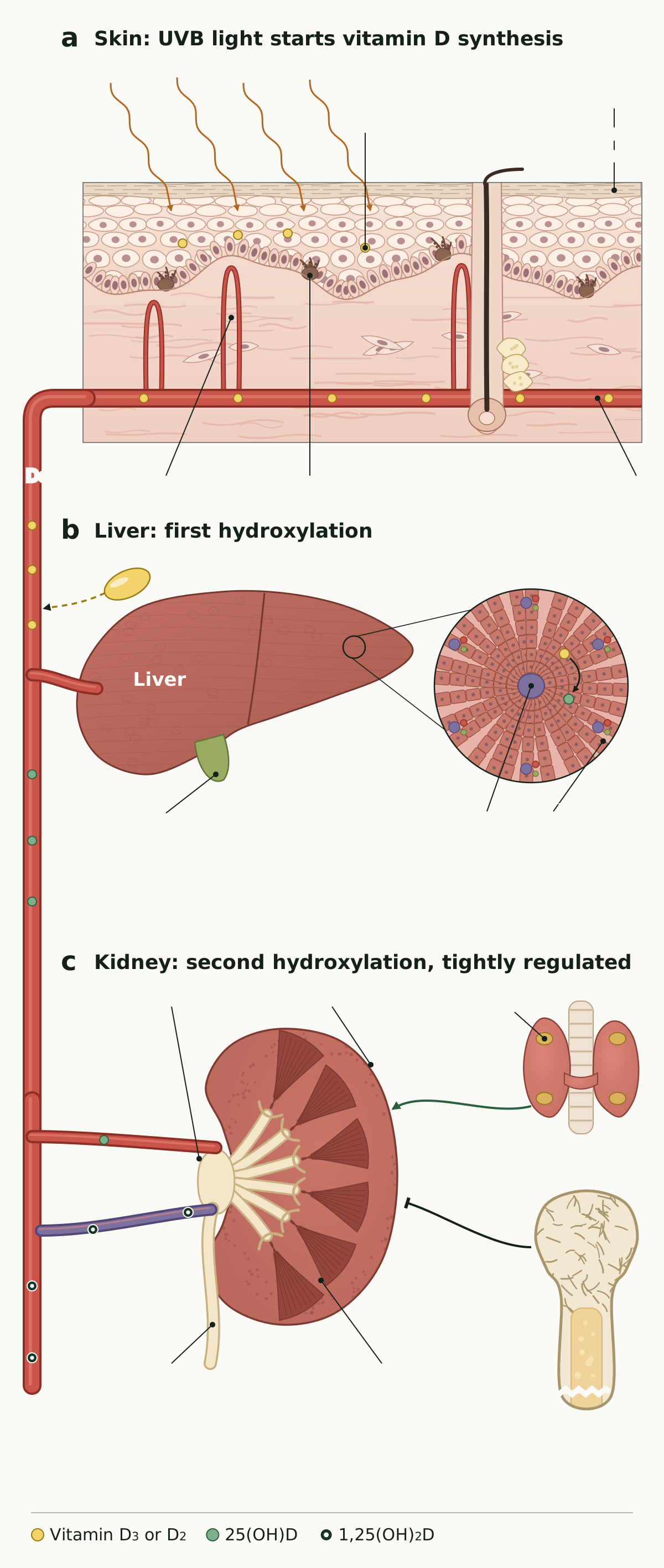
Ultraviolet B light, at wavelengths of about 290 to 320 nanometers, converts 7-dehydrocholesterol in the skin to previtamin D3, which becomes vitamin D3.15 Season, time of day, cloud cover, sunscreen and skin pigmentation all change how much is made, and older people and people with dark skin make less.15 Vitamin D2, which is derived from the plant sterol ergosterol, and vitamin D3 also come from food and supplements.16
Neither form is active. In the liver, the enzyme CYP2R1 converts vitamin D to 25-hydroxyvitamin D, or 25(OH)D, which circulates with a half-life of about 15 days and is the form measured in a blood test.1615 In the kidney, CYP27B1 converts 25(OH)D to 1,25-dihydroxyvitamin D, the hormonal form that binds the vitamin D receptor.16 That second step is tightly controlled: parathyroid hormone stimulates it, while fibroblast growth factor 23 (FGF23) and 1,25-dihydroxyvitamin D itself inhibit it, and the enzyme CYP24A1 breaks both forms down.16 Because the active hormone lasts only hours and is held within a narrow range, it does not usually fall until deficiency is severe, which is why 25(OH)D is used to judge vitamin D status.15
What did the large trials test?
Four trials enrolled thousands of older adults who were not selected for low vitamin D and followed them for years.
| Trial | Participants | Dose | Follow-up | Vitamin D status at entry | Main result |
|---|---|---|---|---|---|
| VITAL (US)1 | 25,871 men 50 or older and women 55 or older | 2,000 IU of D3 a day | Median 5.3 years | Mean 30.8 ng/mL; 12.7% below 20 ng/mL | No effect on invasive cancer or major cardiovascular events |
| D-Health (Australia)4 | 21,315 adults aged 60 to 84 | 60,000 IU of D3 a month | 5 years | Not screened; placebo group averaged 77 nmol/L (about 31 ng/mL) during the trial | No effect on deaths from any cause |
| ViDA (New Zealand)17 | 5,108 adults aged 50 to 84 | 200,000 IU, then 100,000 IU a month | Median 3.3 years | Mean 26.5 ng/mL; 24.9% below 20 ng/mL | No effect on cardiovascular disease |
| DO-HEALTH18 | 2,157 adults 70 or older without major health events in the prior 5 years | 2,000 IU of D3 a day | About 3 years | Not given in the trial abstract | No effect on blood pressure, physical function, cognition, nonvertebral fractures or infections |
In VITAL, the vitamin D group’s average 25(OH)D rose from 29.8 to 41.8 ng/mL after one year, while the placebo group’s barely changed.1 In D-Health, the vitamin D group averaged 115 nmol/L and the placebo group 77 nmol/L.4 So the trials did raise blood levels; what they tested was whether raising levels from a mostly adequate starting point changes health.
Does vitamin D prevent fractures and falls?
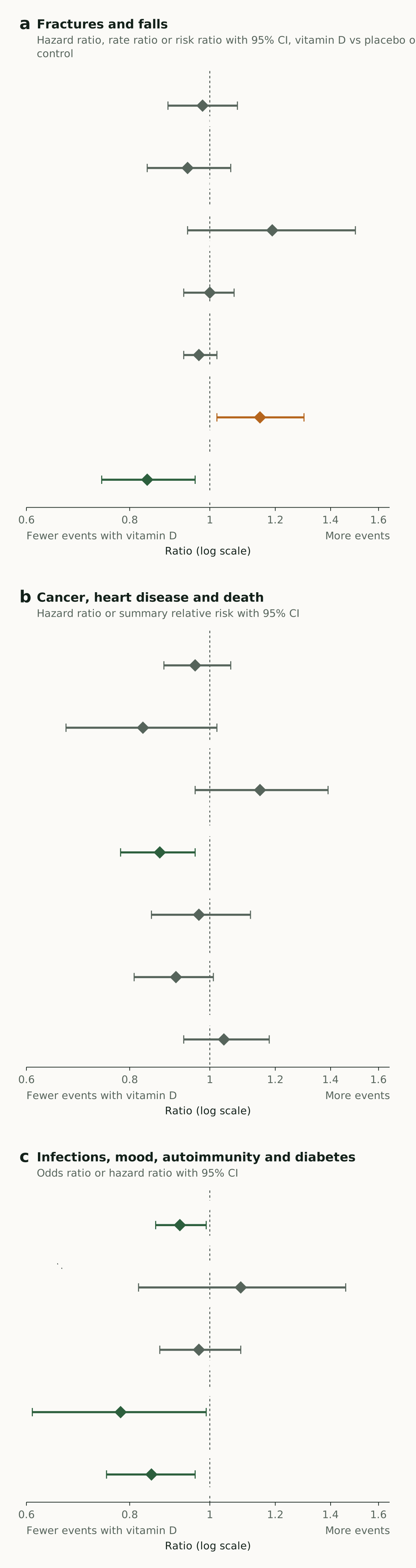
Vitamin D on its own does not appear to, in people who are not deficient. In VITAL, fractures were confirmed by medical record review in 1,551 participants. Vitamin D did not change the risk of total fractures (hazard ratio 0.98, 95% CI 0.89 to 1.08), nonvertebral fractures (0.97) or hip fractures (1.01), and the result did not differ by baseline 25(OH)D level, age, sex, race or body-mass index.2 In D-Health, monthly vitamin D did not change the rate of fractures over a median of 5.1 years (hazard ratio 0.94, 0.84 to 1.06); the authors noted that the ratio appeared to fall with longer follow-up.5 In ViDA, monthly bolus doses did not prevent falls (hazard ratio 0.99) or nonvertebral fractures (1.19, 0.94 to 1.50).6
A meta-analysis by Bolland and colleagues pooled 81 randomized trials with 53,537 participants.7 Vitamin D had no effect on total fractures (relative risk 1.00, 0.93 to 1.07; 36 trials), hip fractures (1.11, 0.97 to 1.26) or falls (0.97, 0.93 to 1.02), and results were similar for doses above 800 IU a day. A trial sequential analysis indicated that the pooled evidence was enough to rule out a reduction of 15% or more in total fractures or falls.7 A 2014 Cochrane review rated as high quality the evidence that vitamin D alone is unlikely to prevent hip fractures or any new fracture in older people.19
Vitamin D combined with calcium is a different question. In the same Cochrane review, vitamin D plus calcium reduced hip fractures slightly (risk ratio 0.84, 0.74 to 0.96; 9 trials, 49,853 participants).19 The reviewers estimated about 1 fewer hip fracture per 1,000 older adults a year in the community and 9 fewer per 1,000 in institutions, where the baseline risk is higher. A 2019 meta-analysis found the same pattern: no reduction with vitamin D alone, and a 16% lower risk of hip fracture with daily vitamin D and calcium.20 An influential early trial gave 800 IU of D3 with 1.2 g of calcium a day, or a double placebo, to 3,270 healthy ambulatory women with a mean age of 84; after 18 months, hip fractures were 43% lower among those who completed the study.21 That population was far older than the participants in VITAL or D-Health.
Does vitamin D prevent cancer or heart disease?
The trials found no effect on the risk of developing either. In VITAL, invasive cancer was diagnosed in 793 people given vitamin D and 824 given placebo (hazard ratio 0.96, 0.88 to 1.06), and major cardiovascular events occurred in 396 and 409 (0.97, 0.85 to 1.12).1 In ViDA, cardiovascular disease occurred in 11.8% and 11.5% (adjusted hazard ratio 1.02).17 A Cochrane review of 18 trials with 50,623 participants found no effect on cancer incidence (risk ratio 1.00, 0.94 to 1.06; moderate-quality evidence), and meta-analyses that added the newer high-dose trials agreed.2223
D-Health is the exception for heart disease. Major cardiovascular events occurred in 6.0% of the vitamin D group and 6.6% of the placebo group (hazard ratio 0.91, 0.81 to 1.01), a difference of 5.8 events per 1,000 people over five years that the authors described as small and consistent with no effect.24
Cancer deaths are less clear. In VITAL, death from cancer was a secondary end point, and the hazard ratio was 0.83 (0.67 to 1.02).1 In an analysis that excluded the first two years of follow-up, which was not specified in the protocol, it was 0.75 (0.59 to 0.96).1 D-Health, with monthly dosing, pointed the other way: the hazard ratio for cancer death was 1.15 (0.96 to 1.39) overall and 1.24 (1.01 to 1.54) after excluding the first two years, which the authors called exploratory.4 Meta-analyses report about 13% to 16% fewer cancer deaths with vitamin D (Zhang, risk ratio 0.84; Keum, 0.87), with the benefit concentrated in trials that gave daily doses rather than large intermittent ones.25239 The Cochrane reviewers rated their own similar finding as low quality and warned that it could be a chance result.22 Vitamin D did not lower deaths from all causes in D-Health (hazard ratio 1.04), in VITAL (0.99), or across 52 trials with 75,454 participants (risk ratio 0.98).4125
Does vitamin D prevent colds, flu and other respiratory infections?
It may, by a small amount. Jolliffe and colleagues, in 2021, pooled 43 double-blind trials with 48,488 participants.8 The proportion who had at least one acute respiratory infection was 61.3% with vitamin D and 62.3% with placebo (odds ratio 0.92, 0.86 to 0.99). Protection appeared with daily doses, with daily equivalents of 400 to 1,000 IU, in trials lasting 12 months or less, and in children aged 1 to 15, although none of these subgroup differences was a statistically significant interaction, and the effect did not differ by baseline 25(OH)D concentration.8 An earlier analysis of individual participant data from 25 trials had found that, among people given daily or weekly doses, the effect was much larger in those starting below 25 nmol/L (odds ratio 0.30) than in those above it (0.75).26
Later trials in adults have not found a benefit. In DO-HEALTH, vitamin D did not lower the rate of infections over three years in people aged 70 or older.18 In CORONAVIT, 6,200 UK adults were randomized to an offer of a finger-prick test, with 800 or 3,200 IU a day for six months for anyone below 75 nmol/L, or to no offer. Respiratory infections occurred in 5.7% and 5.0% of the two treatment groups and 4.6% of the control group, with no significant difference.27
Does vitamin D help depression?
As prevention, it does not appear to. VITAL-DEP followed 18,353 participants aged 50 or older who did not have clinically relevant depressive symptoms at the start.3 Over a median of 5.3 years, depression or clinically relevant symptoms occurred at a rate of 12.9 per 1,000 person-years with vitamin D and 13.3 with placebo (hazard ratio 0.97, 0.87 to 1.09), and mood scores did not change.3 The authors concluded that the results do not support vitamin D to prevent depression in adults.
For symptoms, the evidence is weaker. Mikola and colleagues, in 2023, pooled 41 placebo-controlled trials with 53,235 participants from general and clinical populations and found a small reduction in depressive symptoms (Hedges g −0.32, 95% CI −0.41 to −0.23).28 Heterogeneity was very high (I² 88%), risk of bias was a concern in most trials, and the certainty of the evidence was rated very low. The authors suggested that doses of at least 2,000 IU a day appeared to help and called for trials of vitamin D added to standard treatment in clinical depression.28 Depression should be assessed and treated by a health care provider; no trial shows that vitamin D can replace antidepressants or psychotherapy.
Does vitamin D lower the risk of diabetes or autoimmune disease?
In people with prediabetes, the trials suggest a modest effect. The D2d trial randomized 2,423 adults with prediabetes, not selected for low vitamin D, to 4,000 IU a day or placebo; their mean 25(OH)D at the start was 27.7 ng/mL.29 Diabetes developed in 293 people given vitamin D and 323 given placebo over a median of 2.5 years (hazard ratio 0.88, 0.75 to 1.04), which was not statistically significant. When individual data from D2d and two similar trials were combined, vitamin D reduced the risk of diabetes by 15% (hazard ratio 0.85, 0.75 to 0.96), an absolute reduction of 3.3 percentage points over three years.10 Those trials compared vitamin D with placebo. They did not compare it with lifestyle programs or diabetes medicines, and anyone with prediabetes should discuss prevention with their clinician.
In VITAL, 123 participants given vitamin D and 155 given placebo developed a confirmed autoimmune disease, such as rheumatoid arthritis, psoriasis or autoimmune thyroid disease (hazard ratio 0.78, 0.61 to 0.99, P=0.05).30 The result comes from a single trial, at the margin of statistical significance.
What vitamin D level is deficient, and should you be tested?
Expert bodies disagree on where the line falls. The 2011 Institute of Medicine (now National Academies) committee concluded that a 25(OH)D level of at least 20 ng/mL (50 nmol/L) meets the needs of at least 97.5% of the population, and that the prevalence of inadequacy in North America had been overestimated.31 Its framework places the risk of deficiency below 12 ng/mL (30 nmol/L), a possible risk of inadequacy between 12 and 20 ng/mL, and possible adverse effects above 50 ng/mL (125 nmol/L).15 Results also vary with the assay and the laboratory, so a single value can be falsely low or falsely high.15 Blood levels are reported in two units: 1 ng/mL equals 2.5 nmol/L.15
The US Preventive Services Task Force found that no single cutpoint defines deficiency and that the evidence was insufficient to judge the benefits and harms of screening adults without symptoms.13 In 2024, the Endocrine Society found no trial evidence for routine testing in the general population, including people with obesity or dark skin, and no clear target level for preventing disease; it suggested against routine testing.14 These recommendations apply to people without symptoms or conditions that call for testing. The NIH Office of Dietary Supplements lists groups at higher risk of low vitamin D: breastfed infants, older adults, people with little sun exposure or dark skin, people with obesity or a history of gastric bypass, and people with conditions that limit fat absorption, such as celiac disease, Crohn’s disease, ulcerative colitis, cystic fibrosis and some liver diseases.15
The same Endocrine Society guideline suggested empiric vitamin D, without testing, for children and adolescents aged 1 to 18, adults aged 75 or older, people who are pregnant and people with high-risk prediabetes, and suggested against doses above the recommended intake for healthy adults under 75.14 For nonpregnant people older than 50 for whom vitamin D is indicated, the panel preferred daily doses to large intermittent ones.14 The recommended dietary allowance is 600 IU a day for adults up to age 70 and 800 IU a day after that.3115
Is it safe to take vitamin D?
At usual doses, vitamin D appears safe. VITAL found no excess of hypercalcemia, kidney stones or gastrointestinal symptoms at 2,000 IU a day, and the 2021 infection meta-analysis found no increase in serious adverse events.18 The Cochrane fracture review did find more hypercalcemia, usually mild, in people given vitamin D or its analogues, along with small increases in gastrointestinal symptoms, mainly with vitamin D plus calcium, and in kidney disease; the Cochrane cancer review found more kidney stones with vitamin D3 plus calcium.1922
Very large intermittent doses carry a specific risk. In a trial of 2,256 women aged 70 or older at high risk of fracture, Sanders and colleagues gave 500,000 IU of D3 once a year for three to five years. The vitamin D group had 15% more falls (rate ratio 1.15, 1.02 to 1.30) and 26% more fractures (1.26, 1.00 to 1.59), and the excess in falls was greatest in the three months after each dose.11 In a one-year trial of 200 people aged 70 or older who had already fallen, 60,000 IU a month led to more falls than 24,000 IU a month (66.9% versus 47.9% of participants) without improving leg function.12 D-Health’s monthly 60,000 IU did not increase fractures.5
High daily doses do not seem to help bone either. In a three-year trial in Calgary, 311 healthy adults aged 55 to 70 took 400, 4,000 or 10,000 IU a day. Bone density at the wrist fell more with 4,000 IU (−2.4%) and 10,000 IU (−3.5%) than with 400 IU (−1.2%), with no difference in bone strength.32 The study was funded by the Pure North S’Energy Foundation, which had no role in its design or analysis.32
The tolerable upper intake level for adults is 4,000 IU a day.15 Vitamin D toxicity, almost always from supplements, causes high blood calcium and, in extreme cases, kidney failure, soft-tissue calcification and heart rhythm problems.15 Vitamin D supplements may interact with several drugs, including orlistat, statins, steroids and thiazide diuretics, and people who take regular medicines should discuss supplements with their health care provider.15
How good is the evidence, and who paid for it?
For fractures, falls, cancer incidence and cardiovascular events, the evidence is unusually strong for a supplement: several placebo-controlled trials with more than 5,000 participants each and consistent results.14177 Its main limitation is the population. Most participants were aged 50 or older and few were deficient, so the trials say little about people with very low levels.12 D-Health and ViDA gave monthly doses, which may act differently from daily dosing.914
The large trials were mainly publicly funded. VITAL was funded by the US National Institutes of Health; Pharmavite donated the vitamin D and matching placebo, and Quest Diagnostics measured 25(OH)D at no cost.1 D-Health was funded by Australia’s National Health and Medical Research Council, and ViDA by the Health Research Council of New Zealand and the Accident Compensation Corporation.46 DO-HEALTH was funded by the European Commission and the University of Zurich, with additional funding from DSM Nutritional Products, Roche, Nestec, Pfizer and Streuli.18 CORONAVIT’s funders included Barts Charity, the UK National Institute for Health and Care Research and several supplement companies, among them Pharma Nord, which supplied the capsules.27 The Cochrane cancer review judged that most of its included trials were at risk of for-profit bias.22
What remains uncertain?
It is not known whether daily vitamin D lowers cancer deaths, since the signal rests on secondary end points and pooled analyses.19 The respiratory infection benefit is small and may depend on dose, schedule and age.8 The large trials enrolled few people with low levels: in VITAL, 2,001 of the participants with a measured level were below 20 ng/mL, and the cancer estimate in that group was imprecise (hazard ratio 0.97, 0.68 to 1.39).1 The Endocrine Society called for research to define optimal 25(OH)D levels for specific outcomes.14 The autoimmune finding from VITAL needs confirmation.30
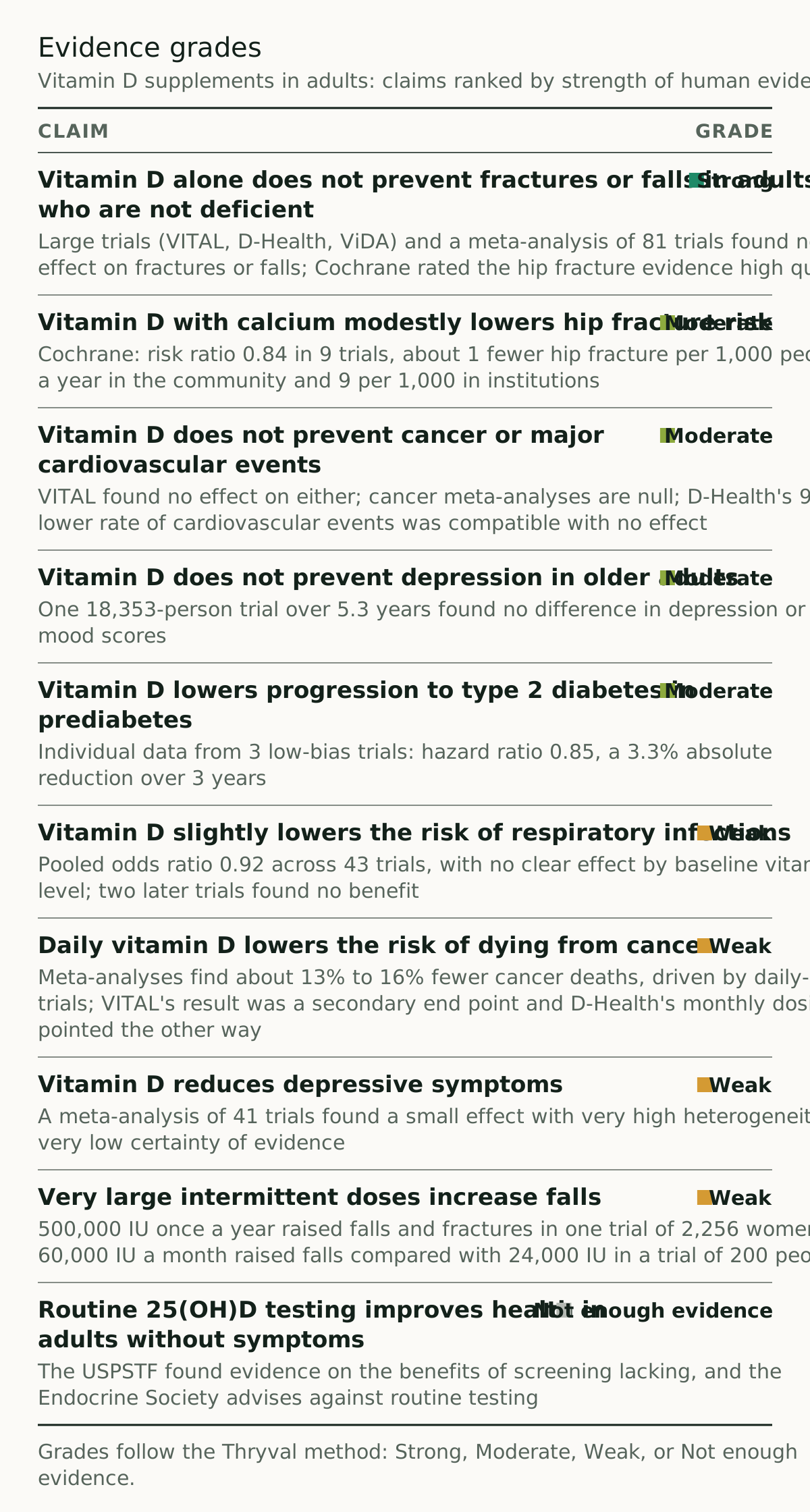
Evidence grades
The grades below are Thryval editorial judgments based on the studies cited in this article. The grading rules are set out on our Research page.
Frequently asked questions
Should I take vitamin D if my levels are normal?
In large trials of adults who were mostly not deficient, vitamin D did not prevent fractures, falls, cancer, heart disease or depression.1237 The Endocrine Society suggests against doses above the recommended intake for healthy adults under 75, and suggests supplementation for adults 75 or older, people who are pregnant and people with high-risk prediabetes.14
What vitamin D level counts as deficient?
The National Academies place the risk of deficiency below 12 ng/mL (30 nmol/L) and consider 20 ng/mL (50 nmol/L) or more sufficient for most people; levels above 50 ng/mL (125 nmol/L) may cause adverse effects.1531 The USPSTF found that no single cutpoint defines deficiency.13
Should I get my vitamin D level tested?
Routine testing of healthy adults without symptoms is not supported by trial evidence, and the Endocrine Society suggests against it.1314 Testing may be reasonable for people with symptoms or with conditions that raise the risk of deficiency, such as those that limit fat absorption; that decision belongs with a health care provider.15
Does vitamin D prevent colds and flu?
Pooled trials show a small reduction in acute respiratory infections, mainly with daily doses of 400 to 1,000 IU, but two later trials in adults found no benefit.81827
Does vitamin D help with depression?
In a trial of 18,353 adults aged 50 or older, vitamin D did not prevent depression.3 Trials of depressive symptoms show a small effect with very low certainty.28 Anyone who may have depression should see a health care provider.
How much vitamin D is too much?
The tolerable upper intake level for adults is 4,000 IU a day.15 Single doses of 500,000 IU a year and 60,000 IU a month increased falls in two trials, and 4,000 to 10,000 IU a day for three years lowered wrist bone density compared with 400 IU.111232
Implications for patients and clinicians
For most adults who are not deficient, the large trials give little reason to take vitamin D to prevent fractures, cancer, heart disease or depression.1237 People with risk factors for deficiency, adults aged 75 or older and people who are pregnant are in a different position, and the Endocrine Society guideline addresses them separately.14 Where vitamin D is used, daily doses within the recommended range are better supported than large annual or monthly doses, which raised falls in two trials.111214 Vitamin D is not a substitute for osteoporosis medicines that a clinician has prescribed, and none of the trials reviewed here tested it as one. Routine 25(OH)D testing of healthy adults is not supported by trial evidence.1314 Clinicians should ask about high-dose products: in 2013–2014, an estimated 3.2% of US adults took supplements containing 4,000 IU or more of vitamin D.15 Readers interested in the omega-3 arm of VITAL can find it in our article on omega-3 supplements and depression.
References
-
Manson JE, Cook NR, Lee IM, et al. Vitamin D supplements and prevention of cancer and cardiovascular disease. N Engl J Med. 2019;380(1):33–44. Randomized controlled trial (VITAL), n=25,871; NIH-funded, vitamin D and placebo donated by Pharmavite. PMC6425757 · PubMed 30415629 ↩↩↩↩↩↩↩↩↩↩↩↩↩↩↩↩↩
-
LeBoff MS, Chou SH, Ratliff KA, et al. Supplemental vitamin D and incident fractures in midlife and older adults. N Engl J Med. 2022;387(4):299–309. Ancillary study of a randomized controlled trial (VITAL), n=25,871; NIH-funded. PMC9716639 · PubMed 35939577 ↩↩↩↩↩↩
-
Okereke OI, Reynolds CF 3rd, Mischoulon D, et al. Effect of long-term vitamin D3 supplementation vs placebo on risk of depression or clinically relevant depressive symptoms and on change in mood scores: a randomized clinical trial. JAMA. 2020;324(5):471–480. Randomized controlled trial (VITAL-DEP), n=18,353. PMC7403921 · PubMed 32749491 ↩↩↩↩↩↩↩↩
-
Neale RE, Baxter C, Romero BD, et al. The D-Health Trial: a randomised controlled trial of the effect of vitamin D on mortality. Lancet Diabetes Endocrinol. 2022;10(2):120–128. Randomized controlled trial, n=21,315; funded by the National Health and Medical Research Council. PubMed 35026158 ↩↩↩↩↩↩↩↩
-
Waterhouse M, Ebeling PR, McLeod DSA, et al. The effect of monthly vitamin D supplementation on fractures: a tertiary outcome from the population-based, double-blind, randomised, placebo-controlled D-Health trial. Lancet Diabetes Endocrinol. 2023;11(5):324–332. Randomized controlled trial, n=20,326 analyzed. PubMed 37011645 ↩↩↩↩↩
-
Khaw KT, Stewart AW, Waayer D, et al. Effect of monthly high-dose vitamin D supplementation on falls and non-vertebral fractures: secondary and post-hoc outcomes from the randomised, double-blind, placebo-controlled ViDA trial. Lancet Diabetes Endocrinol. 2017;5(6):438–447. Randomized controlled trial, n=5,108; funded by the Health Research Council of New Zealand and the Accident Compensation Corporation. PubMed 28461159 ↩↩↩↩
-
Bolland MJ, Grey A, Avenell A. Effects of vitamin D supplementation on musculoskeletal health: a systematic review, meta-analysis, and trial sequential analysis. Lancet Diabetes Endocrinol. 2018;6(11):847–858. Systematic review and meta-analysis: 81 randomized trials, 53,537 participants. PubMed 30293909 ↩↩↩↩↩↩↩
-
Jolliffe DA, Camargo CA Jr, Sluyter JD, et al. Vitamin D supplementation to prevent acute respiratory infections: a systematic review and meta-analysis of aggregate data from randomised controlled trials. Lancet Diabetes Endocrinol. 2021;9(5):276–292. Systematic review and meta-analysis: 43 trials with primary-outcome data, 48,488 participants. PubMed 33798465 ↩↩↩↩↩↩↩
-
Keum N, Chen QY, Lee DH, Manson JE, Giovannucci E. Vitamin D supplementation and total cancer incidence and mortality by daily vs. infrequent large-bolus dosing strategies: a meta-analysis of randomised controlled trials. Br J Cancer. 2022;127(5):872–878. Meta-analysis of randomized trials. PMC9427835 · PubMed 35676320 ↩↩↩↩↩
-
Pittas AG, Kawahara T, Jorde R, et al. Vitamin D and risk for type 2 diabetes in people with prediabetes: a systematic review and meta-analysis of individual participant data from 3 randomized clinical trials. Ann Intern Med. 2023;176(3):355–363. Individual participant data meta-analysis: 3 trials. PubMed 36745886 ↩↩↩
-
Sanders KM, Stuart AL, Williamson EJ, et al. Annual high-dose oral vitamin D and falls and fractures in older women: a randomized controlled trial. JAMA. 2010;303(18):1815–1822. Randomized controlled trial, n=2,256. PubMed 20460620 ↩↩↩↩↩
-
Bischoff-Ferrari HA, Dawson-Hughes B, Orav EJ, et al. Monthly high-dose vitamin D treatment for the prevention of functional decline: a randomized clinical trial. JAMA Intern Med. 2016;176(2):175–183. Randomized controlled trial, n=200. PubMed 26747333 ↩↩↩↩↩
-
US Preventive Services Task Force; Krist AH, Davidson KW, Mangione CM, et al. Screening for vitamin D deficiency in adults: US Preventive Services Task Force recommendation statement. JAMA. 2021;325(14):1436–1442. Recommendation statement (I statement). PubMed 33847711 ↩↩↩↩↩↩
-
Demay MB, Pittas AG, Bikle DD, et al. Vitamin D for the prevention of disease: an Endocrine Society clinical practice guideline. J Clin Endocrinol Metab. 2024;109(8):1907–1947. Clinical practice guideline (GRADE). PubMed 38828931 ↩↩↩↩↩↩↩↩↩↩↩↩↩
-
NIH Office of Dietary Supplements. Vitamin D: fact sheet for health professionals. Updated June 27, 2025. ods.od.nih.gov ↩↩↩↩↩↩↩↩↩↩↩↩↩↩↩↩↩
-
Bikle DD. Vitamin D metabolism, mechanism of action, and clinical applications. Chem Biol. 2014;21(3):319–329. Review. PMC3968073 · PubMed 24529992 ↩↩↩↩
-
Scragg R, Stewart AW, Waayer D, et al. Effect of monthly high-dose vitamin D supplementation on cardiovascular disease in the Vitamin D Assessment Study: a randomized clinical trial. JAMA Cardiol. 2017;2(6):608–616. Randomized controlled trial (ViDA), n=5,108. PMC5815022 · PubMed 28384800 ↩↩↩
-
Bischoff-Ferrari HA, Vellas B, Rizzoli R, et al. Effect of vitamin D supplementation, omega-3 fatty acid supplementation, or a strength-training exercise program on clinical outcomes in older adults: the DO-HEALTH randomized clinical trial. JAMA. 2020;324(18):1855–1868. Randomized controlled trial, n=2,157; funded by the European Commission, the University of Zurich, DSM Nutritional Products, Roche, Nestec, Pfizer and Streuli. PMC7656284 · PubMed 33170239 ↩↩↩↩↩
-
Avenell A, Mak JC, O’Connell D. Vitamin D and vitamin D analogues for preventing fractures in post-menopausal women and older men. Cochrane Database Syst Rev. 2014;(4):CD000227. Systematic review and meta-analysis: 53 trials, 91,791 participants. PMC7032685 · PubMed 24729336 ↩↩↩↩↩
-
Yao P, Bennett D, Mafham M, et al. Vitamin D and calcium for the prevention of fracture: a systematic review and meta-analysis. JAMA Netw Open. 2019;2(12):e1917789. Systematic review and meta-analysis of observational studies and randomized trials. PMC6991219 · PubMed 31860103 ↩↩
-
Chapuy MC, Arlot ME, Duboeuf F, et al. Vitamin D3 and calcium to prevent hip fractures in elderly women. N Engl J Med. 1992;327(23):1637–1642. Randomized controlled trial, n=3,270. PubMed 1331788 ↩
-
Bjelakovic G, Gluud LL, Nikolova D, et al. Vitamin D supplementation for prevention of cancer in adults. Cochrane Database Syst Rev. 2014;(6):CD007469. Systematic review and meta-analysis (GRADE): 18 trials, 50,623 participants. PMC11285304 · PubMed 24953955 ↩↩↩↩↩
-
Keum N, Lee DH, Greenwood DC, Manson JE, Giovannucci E. Vitamin D supplementation and total cancer incidence and mortality: a meta-analysis of randomized controlled trials. Ann Oncol. 2019;30(5):733–743. Meta-analysis of randomized trials. PMC6821324 · PubMed 30796437 ↩↩
-
Thompson B, Waterhouse M, English DR, et al. Vitamin D supplementation and major cardiovascular events: D-Health randomised controlled trial. BMJ. 2023;381:e075230. Randomized controlled trial, n=21,315. PMC10302209 · PubMed 37380191 ↩↩
-
Zhang Y, Fang F, Tang J, et al. Association between vitamin D supplementation and mortality: systematic review and meta-analysis. BMJ. 2019;366:l4673. Systematic review and meta-analysis: 52 trials, 75,454 participants. PMC6689821 · PubMed 31405892 ↩↩↩
-
Martineau AR, Jolliffe DA, Hooper RL, et al. Vitamin D supplementation to prevent acute respiratory tract infections: systematic review and meta-analysis of individual participant data. BMJ. 2017;356:i6583. Individual participant data meta-analysis: 25 trials, 11,321 participants. PMC5310969 · PubMed 28202713 ↩
-
Mikola T, Marx W, Lane MM, et al. The effect of vitamin D supplementation on depressive symptoms in adults: a systematic review and meta-analysis of randomized controlled trials. Crit Rev Food Sci Nutr. 2023;63(33):11784–11801. Systematic review and meta-analysis (GRADE): 41 trials, 53,235 participants. PubMed 35816192 ↩↩↩↩
-
Pittas AG, Dawson-Hughes B, Sheehan P, et al. Vitamin D supplementation and prevention of type 2 diabetes. N Engl J Med. 2019;381(6):520–530. Randomized controlled trial (D2d), n=2,423. PMC6993875 · PubMed 31173679 ↩↩
-
Hahn J, Cook NR, Alexander EK, et al. Vitamin D and marine omega 3 fatty acid supplementation and incident autoimmune disease: VITAL randomized controlled trial. BMJ. 2022;376:e066452. Randomized controlled trial, n=25,871. PMC8791065 · PubMed 35082139 ↩↩
-
Ross AC, Manson JE, Abrams SA, et al. The 2011 report on dietary reference intakes for calcium and vitamin D from the Institute of Medicine: what clinicians need to know. J Clin Endocrinol Metab. 2011;96(1):53–58. Expert committee report summary. PMC3046611 · PubMed 21118827 ↩↩↩
-
Burt LA, Billington EO, Rose MS, et al. Effect of high-dose vitamin D supplementation on volumetric bone density and bone strength: a randomized clinical trial. JAMA. 2019;322(8):736–745. Randomized controlled trial, n=311; funded by the Pure North S’Energy Foundation. PMC6714464 · PubMed 31454046 ↩↩↩