

Psyllium and soluble fiber for IBS: what the trials show
Psyllium husk is the most studied fiber supplement in irritable bowel syndrome. Randomized trials show a modest benefit for overall symptoms. Wheat bran has not shown a benefit and is poorly tolerated by some patients.
The grade ModerateSoluble fiber (psyllium) for global IBS symptoms
In brief. Soluble fiber, most of it tested as psyllium (ispaghula husk), reduces the chance that IBS symptoms persist, but the effect is modest: in a meta-analysis of randomized trials the relative risk of remaining symptomatic was 0.83, and about seven patients needed treatment for one to benefit.12 Wheat bran showed no significant benefit.1 The American College of Gastroenterology and the British Society of Gastroenterology both advise soluble rather than insoluble fiber, and an American Gastroenterological Association expert review describes soluble fiber as efficacious for global IBS symptoms.234
Our review of dietary fiber, the microbiota and inflammation found that soluble fiber had the best trial evidence of any fiber outcome in irritable bowel syndrome (IBS). This article looks at that evidence in more detail: what psyllium does in the bowel, how large the benefit is, how it compares with other fibers, and what the guidelines conclude.
What is psyllium, and how does it differ from other fibers?
Fibers are usually classified by whether they dissolve in water, how viscous they become and how readily colonic bacteria ferment them. The 2021 American College of Gastroenterology (ACG) guideline lists psyllium, oat bran, barley and beans as sources of soluble fiber, and wheat bran, whole grains and some vegetables as sources of insoluble fiber.2 The same guideline notes that fibers with a laxative effect tend to increase stool water and resist fermentation, whereas fibers that are fermented lose their water-holding capacity and produce gas that can worsen bloating and flatulence.2 Psyllium is also called ispaghula husk, and the ACG guideline describes it as a soluble, viscous, poorly fermentable fiber.2
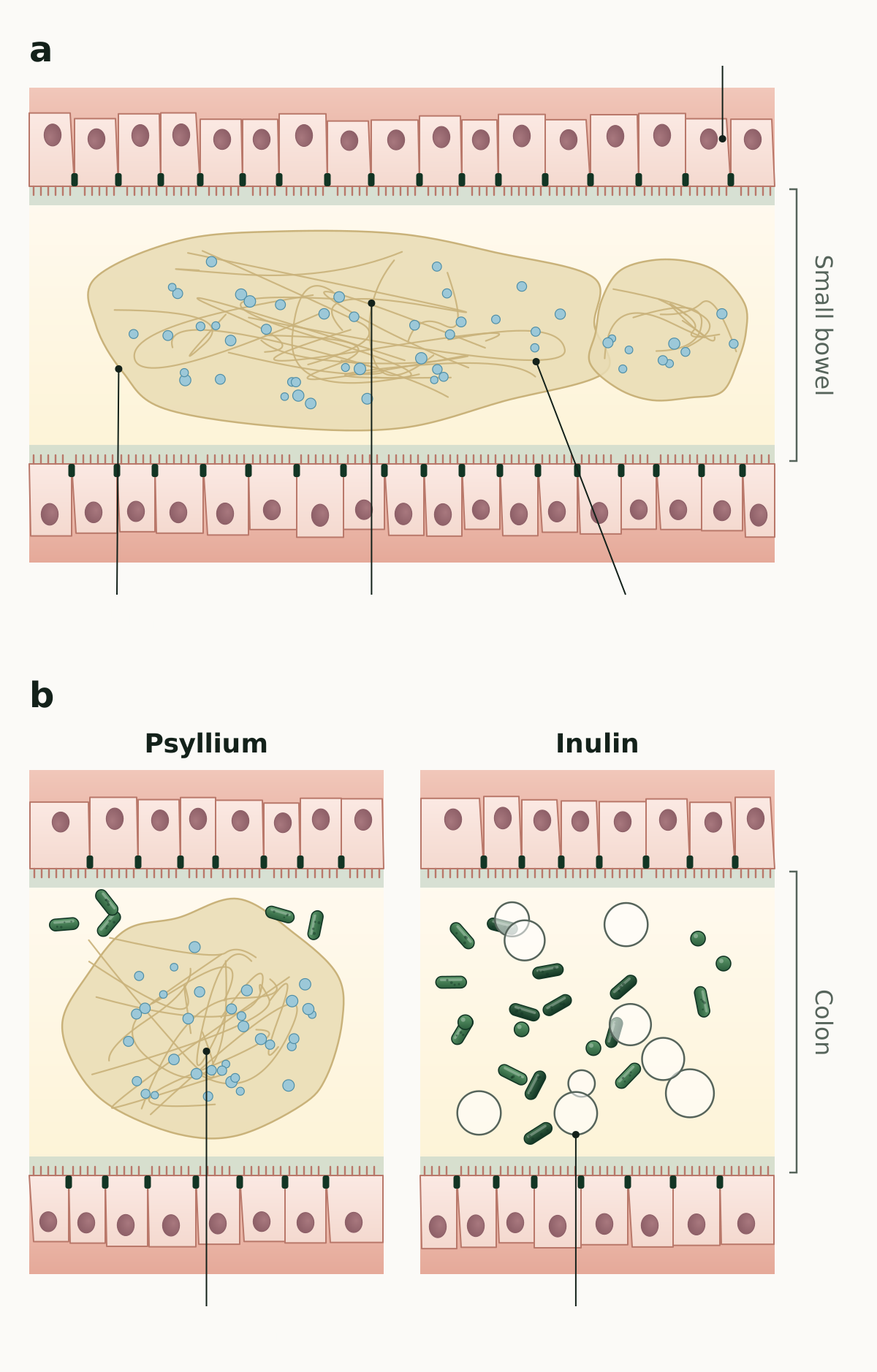
In a review of fiber supplements, McRorie and McKeown describe two mechanisms by which fiber has a laxative effect in the large bowel. Coarse insoluble particles such as wheat bran mechanically irritate the mucosa and stimulate secretion of water and mucus. Gel-forming soluble fiber such as psyllium has a high water-holding capacity and resists dehydration. Both require the fiber to resist fermentation and remain in the stool, and both increase stool water content. Soluble fibers that are readily fermented, such as inulin, fructooligosaccharides and wheat dextrin, did not have a laxative effect in the studies they reviewed.6
Magnetic resonance imaging (MRI) has allowed these effects to be measured directly. In two small randomized crossover studies, Major and colleagues gave psyllium or a maltodextrin placebo for six days to 9 adults without constipation and 20 adults with chronic constipation. Psyllium 7 g three times a day increased small bowel water after a meal and increased fasting colonic volume, from a median of 372 mL to 578 mL in the controls and from 831 mL to 1,104 mL in the patients.7 In a later crossover trial in 19 patients with IBS, Gunn and colleagues gave test drinks containing 20 g of inulin, 20 g of psyllium husk powder, both, or a dextrose placebo. Inulin alone produced the largest rise in colonic gas on MRI, and that adding psyllium to inulin reduced it to a level that did not differ significantly from placebo. In vitro, psyllium did not directly inhibit fermentation.5 The authors attribute psyllium’s laxative effect to an open network of polymers that traps water in the small bowel and increases water content in the colon.5
Does psyllium help IBS symptoms?
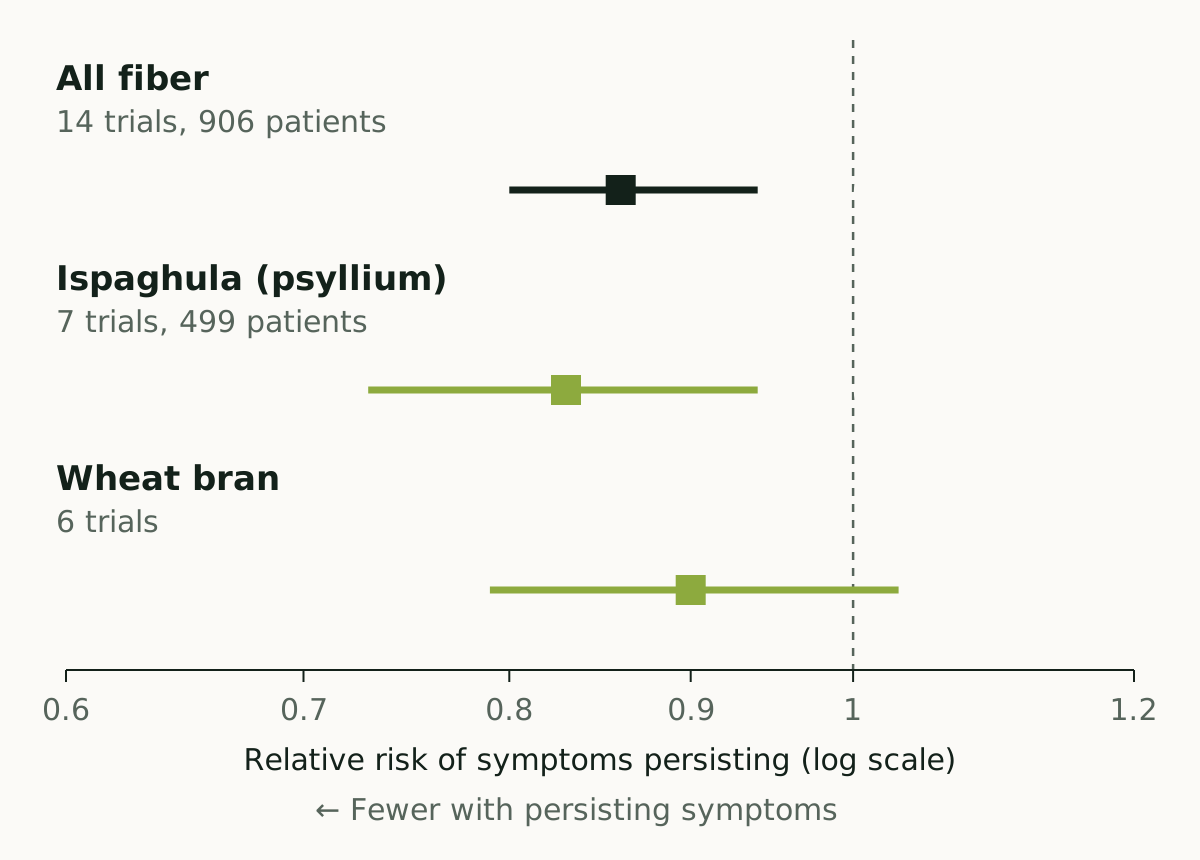
The most widely cited analysis is a 2014 systematic review and meta-analysis by Moayyedi and colleagues, which pooled 14 randomized controlled trials involving 906 adults with IBS. Fiber reduced the risk of remaining symptomatic (relative risk 0.86, 95% CI 0.80 to 0.94; number needed to treat 10). The benefit was confined to soluble fiber (relative risk 0.83, 95% CI 0.73 to 0.94; number needed to treat 7), and bran had no significant effect (relative risk 0.90, 95% CI 0.79 to 1.03).1 In its summary of this analysis, the ACG guideline identifies the soluble-fiber trials as seven studies of ispaghula husk in 499 patients, and the bran trials as six studies.2
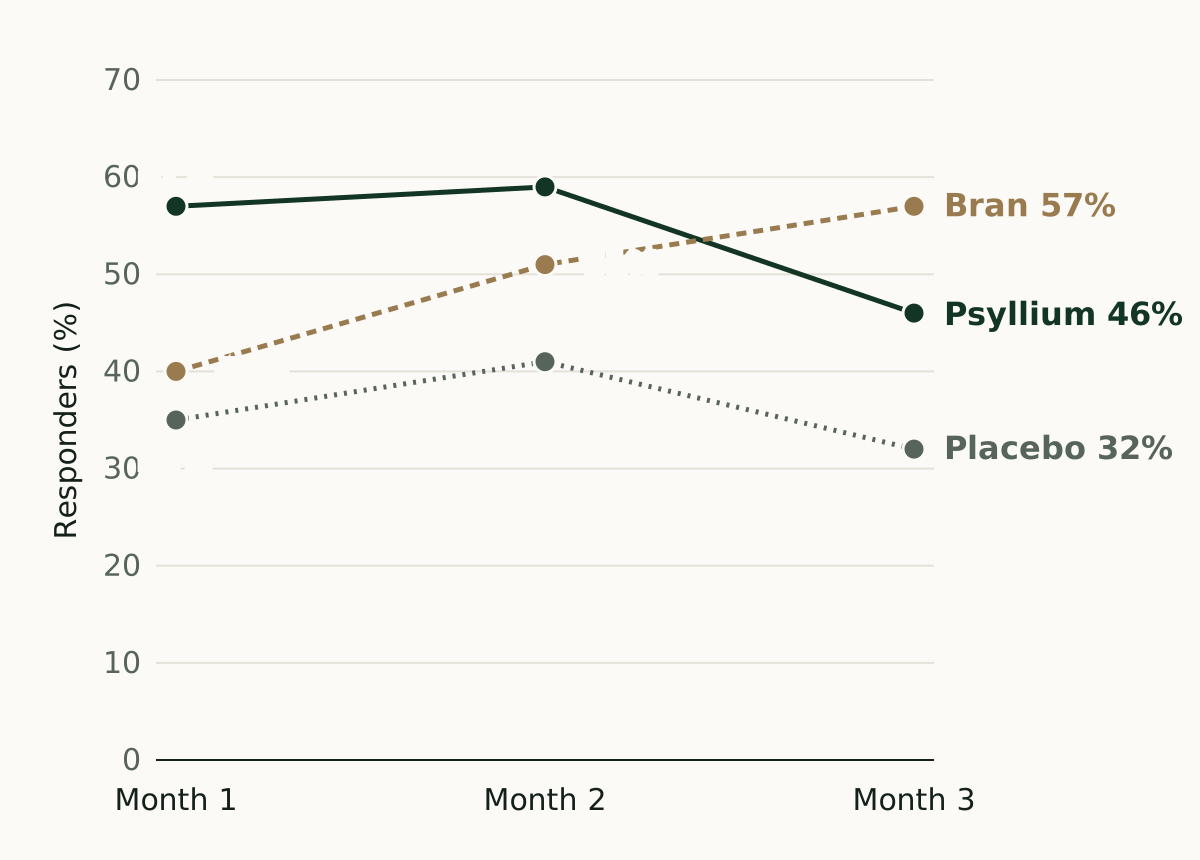
A trial in Dutch general practice tested psyllium and bran against placebo. Bijkerk and colleagues randomized 275 adults with IBS to 10 g of psyllium, 10 g of bran or 10 g of rice flour placebo daily for 12 weeks. The primary end point was adequate relief of symptoms in at least two of the previous four weeks.8 In the first month, 57% of the psyllium group responded compared with 35% of the placebo group (relative risk 1.60, 95% CI 1.13 to 2.26), and in the second month 59% compared with 41% (1.44, 1.02 to 2.06). By the third month the difference was no longer significant (46% compared with 32%; 1.36, 0.90 to 2.04). After three months, the IBS symptom severity score had fallen by 90 points with psyllium and by 49 points with placebo.8 Abdominal pain and quality of life did not differ between groups.8
The trial also illustrates a practical problem with fiber studies. Only 64% of the psyllium group, 56% of the bran group and 60% of the placebo group completed the three months of treatment.8 The ACG guideline adds that the trials in the meta-analysis used highly variable end points that did not follow modern regulatory guidance, and that most identified participants by a clinical diagnosis or by symptom-based criteria supplemented by negative investigations.2
How does psyllium compare with bran and other fibers?
On the available evidence, yes. In the meta-analysis, the pooled effect of bran did not reach significance.1 In the Bijkerk trial, bran was better than placebo only in the third month (57% compared with 32%), and this result did not hold in the worst-case analysis; early withdrawal was most common in the bran group, mainly because IBS symptoms worsened.8 The British Society of Gastroenterology (BSG) guideline advises that insoluble fiber such as wheat bran should be avoided in IBS because it may exacerbate symptoms.3
The comparison with other soluble fibers is less complete. Inulin, a highly fermentable fiber, often triggers symptoms in patients with IBS and increases colonic gas,5 and the ACG guideline notes that gas from fermented fibers can aggravate bloating and flatulence.2 The trial evidence for a benefit in IBS rests mainly on ispaghula. Apart from the ispaghula and bran trials, the ACG summary lists only three studies, of “concentrated fiber”, linseeds and rice bran.2
What do the ACG, BSG and AGA guidelines recommend?
The three guidance documents reach a similar conclusion, but by different methods.
The 2021 ACG guideline states: “We suggest that soluble, but not insoluble, fiber be used to treat global IBS symptoms.” It grades this as a strong recommendation based on moderate-quality evidence, and notes that the evidence for fiber specifically in IBS with constipation is weak.2
The BSG guideline, also published in 2021, concludes that “soluble fibre, such as ispaghula, is an effective treatment for global symptoms and abdominal pain in IBS,” again as a strong recommendation with moderate-quality evidence. It advises starting at 3–4 g/day and increasing gradually to avoid bloating.3
The American Gastroenterological Association (AGA) addressed the question in a 2022 expert review of diet in IBS, which states that “soluble fiber is efficacious in treating global symptoms of IBS.” This was not a systematic review, and the authors did not formally rate the quality of the evidence.4
How much psyllium is used, and what are the side effects?
The Bijkerk trial used 10 g of psyllium a day.8 The BSG guideline recommends starting with 3–4 g of soluble fiber a day and building up, as tolerated, to 20–30 g/day, because soluble fiber increases colonic water content and volume, which can aggravate pain and bloating.3
Adverse events were not clearly more common with fiber in the trials that reported them. In the ACG summary, 36% of 355 patients receiving fiber and 25.1% of 251 receiving placebo reported an adverse event, a difference that was not statistically significant (relative risk 1.06, 95% CI 0.92 to 1.22). The data were insufficient to compare types of fiber.2 In the Bijkerk trial, rates of diarrhea and constipation with psyllium and bran were comparable to those with placebo, and no serious adverse events were reported.8
What remains uncertain?
The trials of fiber in IBS used highly variable end points that do not follow current regulatory guidance.2 Whether psyllium works differently in IBS with constipation, IBS with diarrhea or mixed bowel habit has not been settled. In the Bijkerk trial, a prespecified subgroup with constipation-predominant IBS showed a result similar to the trial as a whole,8 but the ACG guideline regards the evidence for this subtype as weak.2 Gunn and colleagues state that whether adding psyllium makes fermentable fibers easier to tolerate in IBS needs further study; their trial measured gas over six hours, not symptoms over weeks.5
The BSG guideline also notes that increased intestinal permeability correlates with visceral sensitivity and symptom severity in post-infection IBS and IBS with diarrhea, while findings in IBS with constipation are inconsistent.3 Our review of intestinal permeability covers what barrier tests can and cannot show.
Evidence grades
Frequently asked questions
Which fiber supplement has the best evidence for IBS?
Psyllium (ispaghula husk). It accounts for most of the soluble-fiber trials in the main meta-analysis, and both the ACG and BSG guidelines recommend soluble fiber over insoluble fiber.23
Is psyllium the same as ispaghula?
They are two names for the same fiber. The ACG guideline’s count of ispaghula husk trials includes trials that described their product as psyllium.2
Does psyllium cause gas or bloating?
It can, particularly at higher starting doses, which is why the BSG guideline advises starting at 3–4 g/day and increasing gradually.3 Psyllium itself is poorly fermented and produced less gas than inulin in an MRI study in patients with IBS.5
How long did the trials last?
The Bijkerk trial ran for 12 weeks, and the benefit over placebo was significant in the first two months.8 The BSG guideline suggests reviewing the effect of an IBS treatment after three months and stopping it if there has been no response.3
Implications for patients and clinicians
The evidence supports soluble fiber, in practice psyllium, as a first-line option for IBS, which is how both the ACG and BSG guidelines place it.23 Expectations should be modest. In the meta-analysis about seven patients needed treatment for one additional patient to benefit,1 and the outcome in trials was relief of symptoms, not their disappearance. Bran is not a substitute. Because the trials used varied end points, the true size of the benefit is uncertain, and trials using current end points would help.
References
-
Moayyedi P, Quigley EM, Lacy BE, et al. The effect of fiber supplementation on irritable bowel syndrome: a systematic review and meta-analysis. Am J Gastroenterol. 2014;109(9):1367–1374. Systematic review and meta-analysis: 14 randomized trials, 906 patients. doi.org/10.1038/ajg.2014.195 · PubMed 25070054 ↩↩↩↩↩↩↩
-
Lacy BE, Pimentel M, Brenner DM, et al. ACG clinical guideline: management of irritable bowel syndrome. Am J Gastroenterol. 2021;116(1):17–44. Clinical practice guideline (GRADE). doi.org/10.14309/ajg.0000000000001036 · PubMed 33315591 ↩↩↩↩↩↩↩↩↩↩↩↩↩↩↩↩↩↩
-
Vasant DH, Paine PA, Black CJ, et al. British Society of Gastroenterology guidelines on the management of irritable bowel syndrome. Gut. 2021;70(7):1214–1240. Clinical practice guideline (GRADE). doi.org/10.1136/gutjnl-2021-324598 · PubMed 33903147 ↩↩↩↩↩↩↩↩↩↩
-
Chey WD, Hashash JG, Manning L, Chang L. AGA clinical practice update on the role of diet in irritable bowel syndrome: expert review. Gastroenterology. 2022;162(6):1737–1745.e5. Expert review. doi.org/10.1053/j.gastro.2021.12.248 · PubMed 35337654 ↩↩
-
Gunn D, Abbas Z, Harris HC, et al. Psyllium reduces inulin-induced colonic gas production in IBS: MRI and in vitro fermentation studies. Gut. 2022;71(5):919–927. Randomized crossover trial, n=19. doi.org/10.1136/gutjnl-2021-324784 · PubMed 34353864 ↩↩↩↩↩↩
-
McRorie JW, McKeown NM. Understanding the physics of functional fibers in the gastrointestinal tract: an evidence-based approach to resolving enduring misconceptions about insoluble and soluble fiber. J Acad Nutr Diet. 2017;117(2):251–264. Review. doi.org/10.1016/j.jand.2016.09.021 · PubMed 27863994 ↩
-
Major G, Murray K, Singh G, et al. Demonstration of differences in colonic volumes, transit, chyme consistency, and response to psyllium between healthy and constipated subjects using magnetic resonance imaging. Neurogastroenterol Motil. 2018;30(9):e13400. Two randomized crossover studies, n=9 and n=20. doi.org/10.1111/nmo.13400 · PubMed 30062794 ↩↩
-
Bijkerk CJ, de Wit NJ, Muris JW, Whorwell PJ, Knottnerus JA, Hoes AW. Soluble or insoluble fibre in irritable bowel syndrome in primary care? Randomised placebo controlled trial. BMJ. 2009;339:b3154. Randomized controlled trial, n=275. doi.org/10.1136/bmj.b3154 · PubMed 19713235 ↩↩↩↩↩↩↩↩↩↩↩