
Does L-theanine reduce stress and anxiety? What the trials show
L-theanine, an amino acid from tea, is sold for calm, sleep and focus. Small, short trials, many run or paid for by companies that make theanine or sell tea, suggest a modest effect on reaction time and attention, most clearly with caffeine. Evidence for stress, anxiety and sleep is weak.
The grade WeakL-theanine for stress, anxiety and sleep
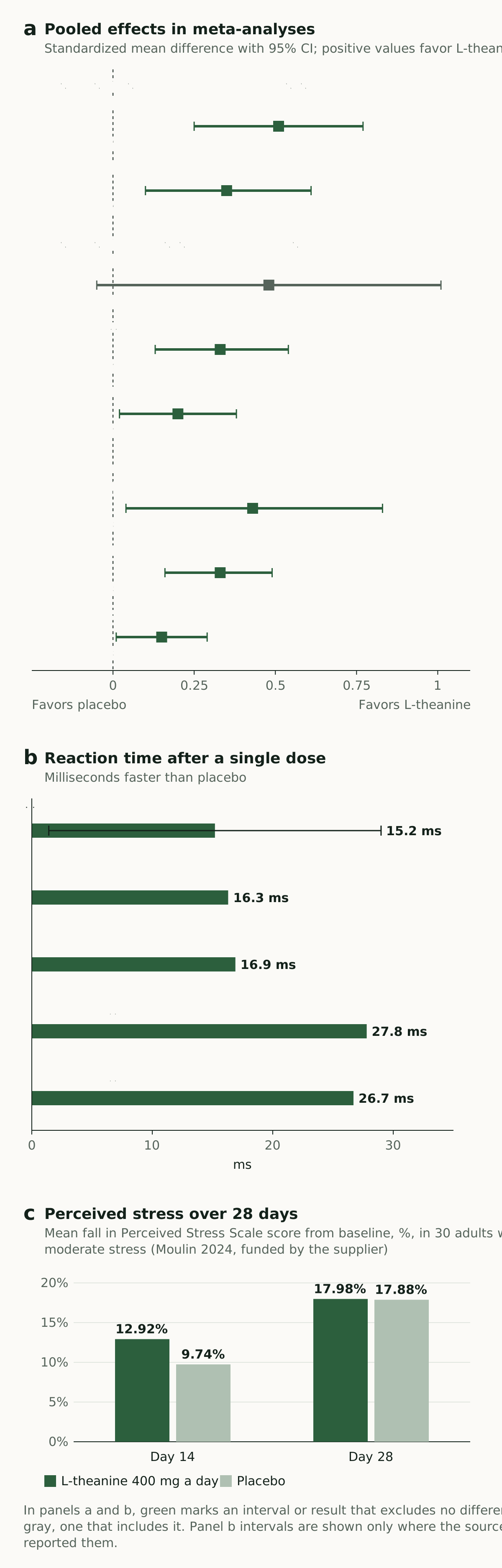
In brief. The most consistent finding for L-theanine is a small, short-lived improvement in attention. In a 2026 meta-analysis of 31 randomized trials, a single 200 mg dose improved choice reaction time compared with placebo (standardized mean difference [SMD] 0.51, 95% CI 0.25 to 0.77).1 Taken with caffeine, it produced small gains in attention-switching accuracy and vigilance in the second hour after a dose, mostly in small crossover studies, several of them run by tea companies.21820 The effect on stress was modest (SMD 0.31) and came largely from trials at high risk of bias, and effects on anxiety were inconsistent and not significant.1 Self-reported sleep quality improved in a meta-analysis of 18 trials, many of which tested L-theanine combined with other ingredients.3 The only placebo-controlled trial we found in generalized anxiety disorder showed no benefit.9 L-theanine appears well tolerated over weeks, but it has not been tested as a replacement for treatment of anxiety disorders or insomnia.
L-theanine (γ-glutamylethylamide) is an amino acid found in the leaves of the tea plant, Camellia sinensis. It is sold as a supplement, often under the Suntheanine or AlphaWave brands, and added to drinks and “focus” products that also contain caffeine. This article reviews what the human trials measured, how large the effects were, who paid for the research, and what is known about safety.
What is L-theanine, and how much is in tea?
A cup of black tea contains roughly 20 mg of L-theanine.30 The 200 mg dose used in many trials corresponds to about eight cups.24 In 12 healthy adults given 100 mg, plasma L-theanine peaked about 0.8 hours after a capsule (24.3 µmol/L) or after green tea (26.5 µmol/L), and the body appeared to break it down into ethylamine and glutamate.31 Absorption from capsules and from tea was comparable.31
How might L-theanine act in the brain?
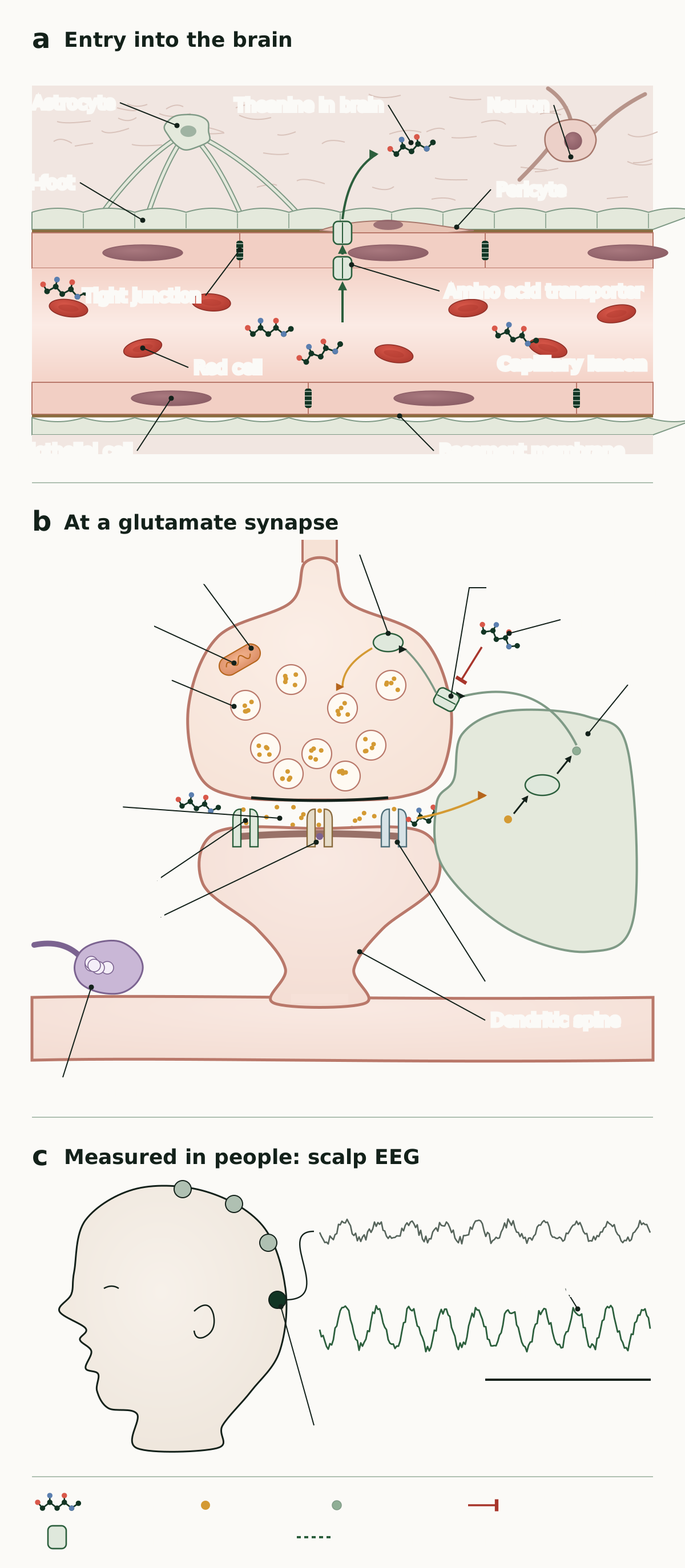
Most of what is known about mechanism comes from rats and cultured cells. In rats given theanine by stomach tube, it entered the brain through the blood–brain barrier by a leucine-preferring amino acid transport system.32 Theanine is structurally similar to glutamate and binds to AMPA, kainate and NMDA glutamate receptors in rat cortical neurons, but with 80 to 30,000 times less potency than glutamate, so its affinity for these receptors is very low.3334 It also inhibits a glutamine transporter, which would reduce the glutamine that neurons convert to glutamate.34 In microdialysis studies of rat striatum, theanine increased extracellular glycine and dopamine, and antagonists of glycine receptors and of AMPA receptors reduced these effects.35 None of these mechanisms has been confirmed directly in the human brain.
What can be measured in people is brain electrical activity. In a conference report from Unilever’s research institute, 50 mg of L-theanine increased alpha activity (8 to 14 Hz) in the resting EEG of young adults compared with placebo.30 In a crossover trial of an L-theanine drink in 34 adults, posterior alpha activity on magnetoencephalography was greater two hours after the active drink, but only in participants with higher trait anxiety, and the change did not correlate with any change in stress.14 During attention tasks the findings differ: 100 mg of L-theanine combined with 50 mg of caffeine lowered tonic alpha power, and theanine alone did not change alpha activity during a two-hour vigilance task.2223 Alpha changes are a marker of brain state; they are not, on their own, evidence of a clinical benefit.
Does L-theanine reduce stress and anxiety?
Gerolymos and colleagues, in 2026, pooled 31 randomized placebo-controlled trials with 1,168 participants.1 The primary outcome was the effect of a single dose on stress in healthy adults. The reduction was modest (SMD 0.31) and, in the authors’ words, “largely influenced by studies with a high risk of bias.” Effects on anxiety were inconsistent and not significant, except in one trial of anxiety in people with schizophrenia.1 Excluding one outlying study, a single dose reduced depressive symptom scores in healthy people (SMD 0.69, 0.13 to 1.25), a finding the authors said needs confirmation.1
The individual studies are small. In a Japanese laboratory study of 12 people doing mental arithmetic, 200 mg of L-theanine reduced the rise in heart rate and in salivary immunoglobulin A compared with placebo.15 In an Australian study of 16 volunteers tested with an anticipatory anxiety task, neither 200 mg of L-theanine nor 1 mg of alprazolam reduced anxiety compared with placebo, although L-theanine had a small relaxing effect at rest.16 In a crossover trial of 34 adults, an L-theanine-based drink funded by its maker, Neurobrands, reduced subjective stress one hour after a multitasking stressor and reduced the cortisol response three hours after the dose.14
Trials of daily use are few. Hidese and colleagues gave 30 Japanese adults 200 mg of L-theanine or placebo at bedtime for four weeks each, in random order. Depression, trait anxiety and sleep scores fell during the L-theanine period, but salivary and serum cortisol did not change.12 The trial was funded by Taiyo Kagaku, which makes Suntheanine and supplied the tablets, and two authors were Taiyo employees.12 In a 28-day trial of 30 stressed adults funded by Ethical Naturals, the maker of AlphaWave L-theanine, Perceived Stress Scale scores fell 17.98% with 400 mg a day and 17.88% with placebo, and salivary cortisol did not differ between groups.13
Can L-theanine treat an anxiety disorder or depression?
Sarris and colleagues randomized 46 adults with generalized anxiety disorder, all already taking a stable antidepressant, to add L-theanine (450 to 900 mg a day) or placebo for 8 weeks.9 L-theanine did not outperform placebo on the Hamilton Anxiety Rating Scale (P=0.73) or the Insomnia Severity Index (P=0.35). Participants taking it reported greater sleep satisfaction on one item of that index (P=0.015).9 The trial lists Australia’s National Health and Medical Research Council as a funder.
Other trials added L-theanine to psychiatric drugs. In an Israeli trial of 60 patients with schizophrenia or schizoaffective disorder, 400 mg a day added to antipsychotic treatment for 8 weeks reduced anxiety scores (P=.015) and positive symptoms; 40 patients completed it, and effect sizes were 0.09 to 0.39.10 In an Iranian trial of 60 people with major depressive disorder, 200 mg a day added to sertraline for 6 weeks produced greater improvement in depression scores than sertraline plus placebo; 50 completed the study.11 These are single trials of add-on treatment. They do not test L-theanine against standard treatment or as a substitute for it.
Does L-theanine improve sleep?
Bulman and colleagues, in 2025, pooled randomized trials in people of all ages and health status: 19 articles with 897 participants, 18 of them in the meta-analysis.3 L-theanine improved overall self-reported sleep quality (SMD 0.43, 0.04 to 0.83; 12 studies), daytime dysfunction (SMD 0.33, 0.16 to 0.49; 9 studies) and self-reported time to fall asleep (SMD 0.15, 0.01 to 0.29; 10 studies). The authors noted the lack of studies of “pure” L-theanine, since many trials tested it combined with other ingredients.3 A second review, of 13 trials of L-theanine alone in 550 people, concluded that 200 to 450 mg a day may support sleep; its authors work for a subsidiary of British American Tobacco that sells L-theanine products.6 A third meta-analysis, limited to healthy participants and funded in part by Lipton Teas and Infusions, found the evidence on sleep inconclusive.2
Objective measurements are limited. In 98 boys aged 8 to 12 with attention-deficit/hyperactivity disorder, 400 mg a day of Suntheanine for 6 weeks increased sleep percentage and sleep efficiency on wrist actigraphy, but sleep latency did not change and parents’ questionnaires did not track the actigraphy results.17 In the 28-day AlphaWave trial, the L-theanine group had less light sleep on a wearable device but also less time asleep.13 We found no placebo-controlled trial of L-theanine alone in adults with diagnosed insomnia.
Does L-theanine with caffeine improve focus?
Many trials of attention combined L-theanine with caffeine, the two main psychoactive constituents of tea. Camfield and colleagues, in 2014, found moderate effect sizes favoring the combination for self-rated alertness and attention-switching accuracy in the first two hours after a dose, and noted that the effect size tracked the caffeine dose more than the theanine dose.5 Payne and colleagues, in 2025, pooled data from randomized trials in healthy people. Compared with placebo, the combination improved attention-switching accuracy (SMD 0.33, 0.13 to 0.54) and digit vigilance accuracy (SMD 0.20, 0.02 to 0.38) in the second hour, while the effect on choice reaction time in the first hour was uncertain (SMD −0.48, −1.01 to 0.05).2 None of the included trials was judged at low risk of bias, and 25 were judged at high risk.2 Two of the authors are employees of Lipton Teas and Infusions and Unilever.2
Several of the original trials came from Unilever’s research laboratories. In 27 volunteers, 100 mg of L-theanine plus 50 mg of caffeine improved speed and accuracy on an attention-switching task at 60 minutes; caffeine alone improved accuracy only at 90 minutes.18 Two later studies by Unilever scientists tested 97 mg of L-theanine with 40 mg of caffeine. In 44 young adults it improved task-switching accuracy and self-rated alertness, with no effect on visual search, choice reaction time or mental rotation.20 In a second sample it improved switching but not intersensory attention or alertness.21
Independent trials give a mixed picture of whether L-theanine adds anything to caffeine. Haskell and colleagues found that 250 mg of L-theanine plus 150 mg of caffeine improved several measures that caffeine alone did not, but L-theanine alone increased headache ratings and reduced correct answers on serial subtractions.19 Kahathuduwa and colleagues gave 20 men 200 mg of L-theanine, 160 mg of caffeine, both, a cup of black tea or water. Recognition reaction time improved with L-theanine (P=0.019), caffeine (P=0.043) and the combination (P=0.001), but not with the tea, and there was no interaction between theanine and caffeine.24 In a two-hour vigilance task, 100 mg of L-theanine and 50 mg of caffeine each reduced errors, and the combination added nothing.23 At doses close to one or two cups of tea, 50 mg of L-theanine added to 75 mg of caffeine removed the effects of caffeine on cognition, mood and cerebral blood flow.27 In 48 adults, 200 mg of L-theanine blunted the rise in blood pressure caused by 250 mg of caffeine but did not change jitteriness or alertness.28
Does L-theanine alone improve attention?
The pooled evidence for L-theanine without caffeine is narrower. In the 2026 meta-analysis, a single 200 mg dose taken 30 to 60 minutes before testing improved choice reaction time (SMD 0.51, 0.25 to 0.77), and the authors described this as a “robust short-term benefit on attention.”1 Payne and colleagues found a smaller effect on choice reaction time in the first hour (SMD −0.35, −0.61 to −0.10, where negative means faster).2 Mátyus and colleagues pooled five trials in 148 healthy adults: L-theanine shortened recognition reaction time by 15.20 ms (95% CI 1.41 to 28.99), but had no significant effect on simple reaction time or Stroop test performance.4
Dose-ranging work from Sri Lanka points in the same direction. In 32 young adults, 100 mg and 200 mg of L-theanine shortened simple reaction time by 16.3 and 16.9 ms compared with placebo, but no dose improved sustained attention or inhibitory control once the placebo change was accounted for.26 In an fMRI study of 9 men, 200 mg shortened responses to targets by 27.8 ms.25 In 50- to 69-year-old Japanese adults, a single dose shortened reaction time on part of a Stroop test in a trial sponsored by the tea company Ito En, which also supplied the test product.29 Effects of 15 to 30 ms are measurable in a laboratory; whether they matter in everyday tasks has not been studied.
Who funded the L-theanine trials?
Many of the trials had commercial sponsors. Taiyo Kagaku, which makes Suntheanine, funded the four-week Japanese trial and supplied its tablets, and Suntheanine was the product in the trial in boys with ADHD.1217 Ethical Naturals funded the AlphaWave trial, Neurobrands funded the drink trial, and Ito En sponsored the trial in older adults.131429 Several of the L-theanine and caffeine trials were conducted by Unilever scientists, and the 2025 meta-analysis of those trials was funded in part by Lipton Teas and Infusions.182021302 Two recent reviews favorable to L-theanine for sleep and cognition were written by employees of a British American Tobacco subsidiary that sells products containing it.67 One author of the 2026 meta-analysis founded a company that sells dietary supplements.1 Dashwood and Visioli, who declared no conflicts, noted that many studies come “from one geographical area, and from one commercial/proprietary source of l-theanine.”8 Some trials were publicly funded, including the Australian anxiety trial and the Sri Lankan attention trial.924 Industry funding does not make a result wrong, but independent replication with larger samples is limited.
Is L-theanine safe, and does it interact with medicines?
No serious adverse events were reported across the 31 trials in the 2026 meta-analysis, and the authors compared dropout rates between groups as their safety measure.1 The four-week Japanese trial had no dropouts and no adverse events.12 Trials of daily use have lasted up to 12 weeks, at doses up to 900 mg a day.299 In one trial, 250 mg of L-theanine alone increased self-rated headache.19 In rats fed Suntheanine for 13 weeks at up to 4,000 mg/kg of body weight a day, no consistent adverse effects were found.36 In the United States, FDA had “no questions” in 2007 about Taiyo’s notice that L-theanine is generally recognized as safe for use in specified foods at up to 250 mg per serving.37 That concerns its use as a food ingredient, not its effect on stress or sleep. In the European Union, a proposed health claim linking theanine to attention was refused, a decision Dashwood and Visioli endorsed.8
Interaction data in people are sparse. Memorial Sloan Kettering’s integrative medicine service advises people taking sleep medicines such as lorazepam, diazepam or zolpidem to talk with their clinician, because combined use may increase drowsiness, notes additive effects with midazolam in animal models of unknown clinical relevance, and lists pregnancy and breastfeeding as contraindications.38 L-theanine counteracted the blood pressure rise from caffeine in one trial.28 In two add-on trials, one with an antipsychotic and one with sertraline, side effects were similar with L-theanine and placebo, but both trials were small and short.1011
What remains uncertain?
The main gaps are the size of any effect on stress and anxiety once trials at high risk of bias are set aside, and whether the effects on sleep hold for L-theanine alone, measured objectively, in people with diagnosed insomnia.13 Most trials tested single doses in fewer than 50 people, often in crossover designs, with outcomes measured within two hours.2 Whether L-theanine adds to the effect of caffeine, rather than simply accompanying it, remains unsettled.232724 Long-term safety, use in pregnancy, and interactions with sedatives and psychiatric drugs have not been studied in adequate trials.38
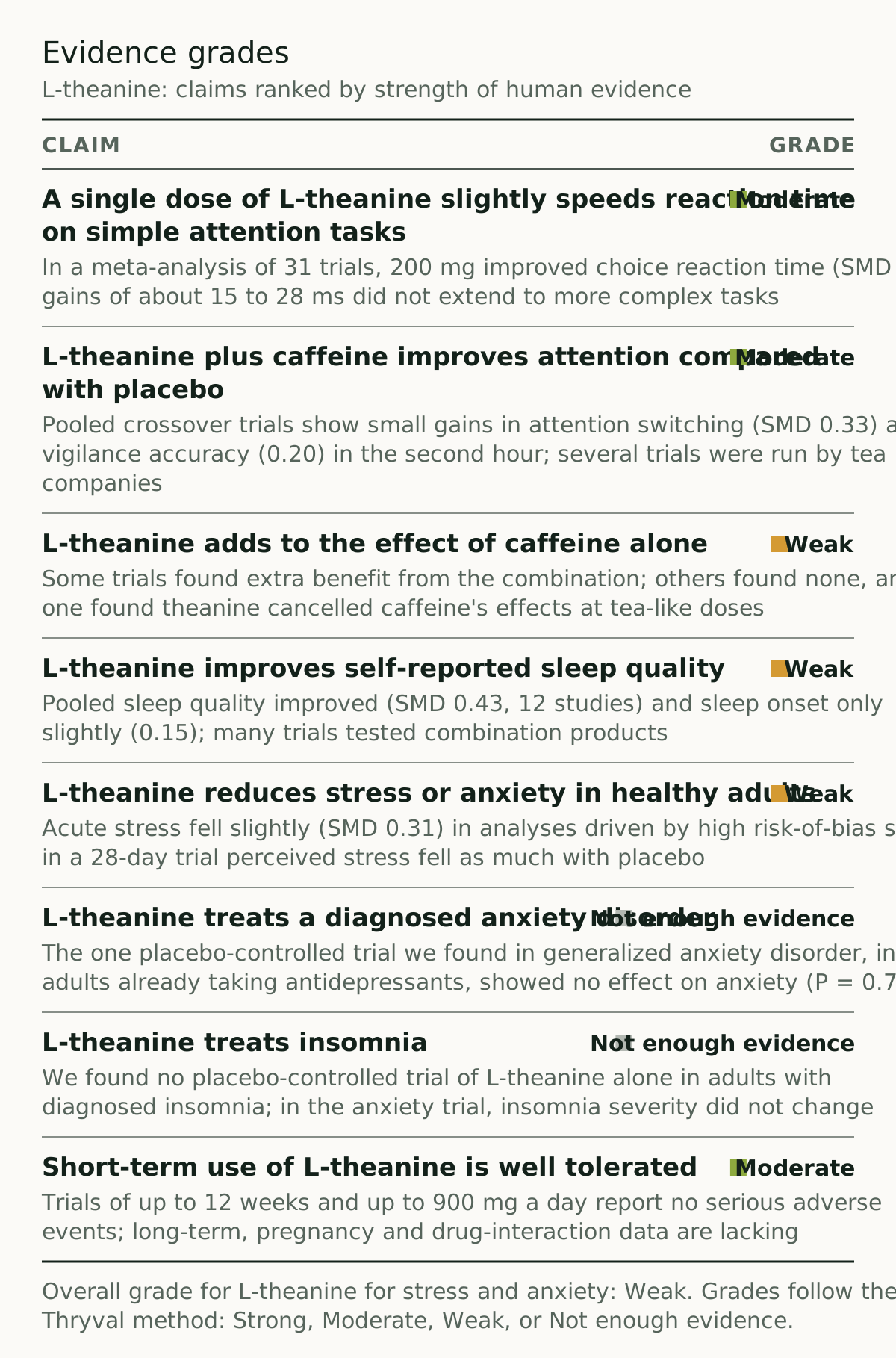
Evidence grades
The grades below are Thryval editorial judgments based on the studies cited in this article. The grading rules are set out on our Research page.
Frequently asked questions
Does L-theanine help with stress?
Pooled trials show a modest reduction in acute stress after a single dose, but the result depends heavily on studies at high risk of bias.1 In a 28-day trial in stressed adults, perceived stress fell by the same amount with L-theanine and with placebo.13
Does L-theanine help anxiety?
Effects on anxiety were inconsistent and not significant in a 2026 meta-analysis of 31 trials.1 In the one placebo-controlled trial we found in generalized anxiety disorder, adding L-theanine to an antidepressant did not reduce anxiety.9 People treated for an anxiety disorder should not stop or change their medication without talking to their prescriber.
Does L-theanine help you sleep?
A meta-analysis found small improvements in self-reported sleep quality and in time to fall asleep, but many of the trials tested L-theanine combined with other ingredients.3 It has not been tested as a treatment for diagnosed insomnia in adults, and it is not a substitute for insomnia treatment.
Why is L-theanine combined with caffeine?
Trials of the two together found small improvements in attention switching and vigilance for an hour or two compared with placebo.2 Whether L-theanine adds to what caffeine does on its own is unclear, because trials disagree.192327
How much L-theanine is in a cup of tea?
About 20 mg in a cup of black tea, so the 200 mg dose used in many trials equals about eight cups.3024
Is L-theanine safe to take?
In trials lasting up to 12 weeks, no serious adverse events were reported.129 Long-term safety and use in pregnancy have not been studied, and people who take sedatives or sleep medicines should check with a clinician first.38
Implications for patients and clinicians
For healthy adults, the trials suggest that a single dose of L-theanine, alone or with caffeine, may slightly improve performance on simple attention tasks for an hour or two.12 The evidence that it relieves stress, anxiety or poor sleep is weak, and much of it comes from small trials funded by companies that make or sell L-theanine or tea.138 The trials cannot be used to choose L-theanine over established treatment for an anxiety disorder, depression or insomnia, because they did not make that comparison; the psychiatric trials tested it only as an add-on.91011 Clinicians should ask about L-theanine in patients taking sedatives, and people who are pregnant or breastfeeding were advised against it in the sources reviewed here.38
References
-
Gerolymos C, Saddier E, Boyer L, Fond G. Cognitive and affective effects of L-theanine: a systematic review and meta-analysis of 31 randomized trials. Mol Psychiatry. 2026;31(11):6592–6602. Systematic review and meta-analysis: 31 randomized trials, 1,168 participants; one author founded a dietary supplement company. PubMed 42410082 ↩↩↩↩↩↩↩↩↩↩↩↩↩↩↩↩↩
-
Payne ER, Aceves-Martins M, Dubost J, et al. Effects of tea (Camellia sinensis) or its bioactive compounds l-theanine or l-theanine plus caffeine on cognition, sleep, and mood in healthy participants: a systematic review and meta-analysis of randomized controlled trials. Nutr Rev. 2025;83(10):1873–1891. Systematic review and meta-analysis: 50 randomized trials, 15 in meta-analyses; partly funded by Lipton Teas and Infusions. PMC12422004 · PubMed 40314930 ↩↩↩↩↩↩↩↩↩↩↩↩
-
Bulman A, D’Cunha NM, Marx W, et al. The effects of L-theanine consumption on sleep outcomes: a systematic review and meta-analysis. Sleep Med Rev. 2025;81:102076. Systematic review and meta-analysis: 19 articles, 897 participants. PubMed 40056718 ↩↩↩↩↩↩↩↩
-
Mátyus RO, Szikora Z, Bodó D, et al. Promising, but not completely conclusive: the effect of l-theanine on cognitive performance based on the systematic review and meta-analysis of randomized placebo-controlled clinical trials. J Clin Med. 2025;14(21):7710. Systematic review and meta-analysis: 5 randomized trials, 148 participants. PMC12609247 · PubMed 41227106 ↩↩
-
Camfield DA, Stough C, Farrimond J, Scholey AB. Acute effects of tea constituents L-theanine, caffeine, and epigallocatechin gallate on cognitive function and mood: a systematic review and meta-analysis. Nutr Rev. 2014;72(8):507–522. Systematic review and meta-analysis: 11 randomized trials. PubMed 24946991 ↩↩
-
Cotter J, Caddick CE, Harper JL, Ebajemito JK. Examining the effect of L-theanine on sleep: a systematic review of dietary supplementation trials. Nutr Neurosci. 2026;29(2):224–238. Systematic review: 13 trials, 550 participants; authors affiliated with The Water Street Collective and British American Tobacco. PubMed 41176609 ↩↩
-
Cotter J, Kilpatrick HE. Effects of L-theanine on cognition, mood and sleep: evidence from human trials. Front Nutr. 2026;13:1922819. Review; authors employed by The Water Street Collective, a British American Tobacco subsidiary that sells L-theanine products. PMC13587617 · PubMed 42761839 ↩
-
Dashwood R, Visioli F. l-theanine: from tea leaf to trending supplement. Does the science match the hype for brain health and relaxation? Nutr Res. 2025;134:39–48. Review. PMC12892352 · PubMed 39854799 ↩↩↩
-
Sarris J, Byrne GJ, Cribb L, et al. L-theanine in the adjunctive treatment of generalized anxiety disorder: a double-blind, randomised, placebo-controlled trial. J Psychiatr Res. 2019;110:31–37. Randomized controlled trial, n=46. PubMed 30580081 ↩↩↩↩↩↩↩↩↩↩
-
Ritsner MS, Miodownik C, Ratner Y, et al. L-theanine relieves positive, activation, and anxiety symptoms in patients with schizophrenia and schizoaffective disorder: an 8-week, randomized, double-blind, placebo-controlled, 2-center study. J Clin Psychiatry. 2011;72(1):34–42. Randomized controlled trial, n=60. PubMed 21208586 ↩↩↩
-
Shamabadi A, Kafi F, Arab Bafrani M, et al. l-theanine adjunct to sertraline for major depressive disorder: a randomized, double-blind, placebo-controlled clinical trial. J Affect Disord. 2023;333:38–43. Randomized controlled trial, n=60. PubMed 37084960 ↩↩↩
-
Hidese S, Ogawa S, Ota M, et al. Effects of L-theanine administration on stress-related symptoms and cognitive functions in healthy adults: a randomized controlled trial. Nutrients. 2019;11(10):2362. Randomized crossover trial, n=30; funded by Taiyo Kagaku. PMC6836118 · PubMed 31623400 ↩↩↩↩
-
Moulin M, Crowley DC, Xiong L, et al. Safety and efficacy of AlphaWave L-theanine supplementation for 28 days in healthy adults with moderate stress: a randomized, double-blind, placebo-controlled trial. Neurol Ther. 2024;13(4):1135–1153. Randomized controlled trial, n=30; funded by Ethical Naturals. PMC11263523 · PubMed 38758503 ↩↩↩↩↩
-
White DJ, de Klerk S, Woods W, et al. Anti-stress, behavioural and magnetoencephalography effects of an L-theanine-based nutrient drink: a randomised, double-blind, placebo-controlled, crossover trial. Nutrients. 2016;8(1):53. Randomized crossover trial, n=34; funded by Neurobrands. PMC4728665 · PubMed 26797633 ↩↩↩
-
Kimura K, Ozeki M, Juneja LR, Ohira H. L-theanine reduces psychological and physiological stress responses. Biol Psychol. 2007;74(1):39–45. Randomized crossover study, n=12. PubMed 16930802 ↩
-
Lu K, Gray MA, Oliver C, et al. The acute effects of L-theanine in comparison with alprazolam on anticipatory anxiety in humans. Hum Psychopharmacol. 2004;19(7):457–465. Randomized crossover study, n=16. PubMed 15378679 ↩
-
Lyon MR, Kapoor MP, Juneja LR. The effects of L-theanine (Suntheanine) on objective sleep quality in boys with attention deficit hyperactivity disorder (ADHD): a randomized, double-blind, placebo-controlled clinical trial. Altern Med Rev. 2011;16(4):348–354. Randomized controlled trial, n=98; product from Taiyo Kagaku. PubMed 22214254 ↩↩↩
-
Owen GN, Parnell H, De Bruin EA, Rycroft JA. The combined effects of L-theanine and caffeine on cognitive performance and mood. Nutr Neurosci. 2008;11(4):193–198. Randomized crossover trial, n=27; Unilever Research and Development. PubMed 18681988 ↩↩↩↩
-
Haskell CF, Kennedy DO, Milne AL, Wesnes KA, Scholey AB. The effects of L-theanine, caffeine and their combination on cognition and mood. Biol Psychol. 2008;77(2):113–122. Randomized crossover trial, n=24. PubMed 18006208 ↩↩↩↩
-
Giesbrecht T, Rycroft JA, Rowson MJ, De Bruin EA. The combination of L-theanine and caffeine improves cognitive performance and increases subjective alertness. Nutr Neurosci. 2010;13(6):283–290. Randomized crossover trial, n=44; Unilever R&D. PubMed 21040626 ↩↩↩↩
-
Einöther SJ, Martens VE, Rycroft JA, De Bruin EA. L-theanine and caffeine improve task switching but not intersensory attention or subjective alertness. Appetite. 2010;54(2):406–409. Randomized crossover trial; Unilever R&D. PubMed 20079786 ↩↩
-
Kelly SP, Gomez-Ramirez M, Montesi JL, Foxe JJ. L-theanine and caffeine in combination affect human cognition as evidenced by oscillatory alpha-band activity and attention task performance. J Nutr. 2008;138(8):1572S–1577S. Randomized crossover study. PubMed 18641209 ↩
-
Foxe JJ, Morie KP, Laud PJ, et al. Assessing the effects of caffeine and theanine on the maintenance of vigilance during a sustained attention task. Neuropharmacology. 2012;62(7):2320–2327. Randomized crossover study, n=27. PubMed 22326943 ↩↩↩↩↩
-
Kahathuduwa CN, Dassanayake TL, Amarakoon AMT, Weerasinghe VS. Acute effects of theanine, caffeine and theanine-caffeine combination on attention. Nutr Neurosci. 2017;20(6):369–377. Randomized crossover trial, n=20; funded by a National Research Council grant, Sri Lanka. PubMed 26869148 ↩↩↩↩↩↩
-
Kahathuduwa CN, Dhanasekara CS, Chin SH, et al. l-Theanine and caffeine improve target-specific attention to visual stimuli by decreasing mind wandering: a human functional magnetic resonance imaging study. Nutr Res. 2018;49:67–78. Randomized crossover study, n=9. PubMed 29420994 ↩
-
Dassanayake TL, Wijesundara D, Kahathuduwa CN, Weerasinghe VS. Dose-response effect of L-theanine on psychomotor speed, sustained attention, and inhibitory control: a double-blind, placebo-controlled, crossover study. Nutr Neurosci. 2023;26(11):1138–1146. Randomized crossover trial, n=32. PubMed 36263942 ↩↩
-
Dodd FL, Kennedy DO, Riby LM, Haskell-Ramsay CF. A double-blind, placebo-controlled study evaluating the effects of caffeine and L-theanine both alone and in combination on cerebral blood flow, cognition and mood. Psychopharmacology (Berl). 2015;232(14):2563–2576. Randomized crossover study, n=24. PMC4480845 · PubMed 25761837 ↩↩↩↩
-
Rogers PJ, Smith JE, Heatherley SV, Pleydell-Pearce CW. Time for tea: mood, blood pressure and cognitive performance effects of caffeine and theanine administered alone and together. Psychopharmacology (Berl). 2008;195(4):569–577. Randomized controlled trial, n=48. PubMed 17891480 ↩↩
-
Baba Y, Inagaki S, Nakagawa S, et al. Effects of l-theanine on cognitive function in middle-aged and older subjects: a randomized placebo-controlled study. J Med Food. 2021;24(4):333–341. Randomized controlled trial; sponsored by Ito En. PMC8080935 · PubMed 33751906 ↩↩↩↩↩
-
Nobre AC, Rao A, Owen GN. L-theanine, a natural constituent in tea, and its effect on mental state. Asia Pac J Clin Nutr. 2008;17(Suppl 1):167–168. Conference report of two placebo-controlled EEG studies; Unilever Food and Health Research Institute. PubMed 18296328 ↩↩↩↩
-
Scheid L, Ellinger S, Alteheld B, et al. Kinetics of L-theanine uptake and metabolism in healthy participants are comparable after ingestion of L-theanine via capsules and green tea. J Nutr. 2012;142(12):2091–2096. Randomized crossover pharmacokinetic study, n=12. PubMed 23096008 ↩↩
-
Yokogoshi H, Kobayashi M, Mochizuki M, Terashima T. Effect of theanine, r-glutamylethylamide, on brain monoamines and striatal dopamine release in conscious rats. Neurochem Res. 1998;23(5):667–673. Animal study. PubMed 9566605 ↩
-
Kakuda T, Nozawa A, Sugimoto A, Niino H. Inhibition by theanine of binding of [3H]AMPA, [3H]kainate, and [3H]MDL 105,519 to glutamate receptors. Biosci Biotechnol Biochem. 2002;66(12):2683–2686. Laboratory study in rat cortical neurons. PubMed 12596867 ↩
-
Kakuda T. Neuroprotective effects of theanine and its preventive effects on cognitive dysfunction. Pharmacol Res. 2011;64(2):162–168. Review. PubMed 21477654 ↩↩
-
Yamada T, Terashima T, Kawano S, et al. Theanine, gamma-glutamylethylamide, a unique amino acid in tea leaves, modulates neurotransmitter concentrations in the brain striatum interstitium in conscious rats. Amino Acids. 2009;36(1):21–27. Animal study. PubMed 18196445 ↩
-
Borzelleca JF, Peters D, Hall W. A 13-week dietary toxicity and toxicokinetic study with l-theanine in rats. Food Chem Toxicol. 2006;44(7):1158–1166. Animal toxicology study. PubMed 16759779 ↩
-
US Food and Drug Administration. GRAS Notice No. 209: L-theanine (notifier Taiyo International). Closed February 5, 2007; FDA’s letter: “FDA has no questions.” Regulatory record. fda.gov ↩
-
Memorial Sloan Kettering Cancer Center. L-theanine. About Herbs, integrative medicine database. Web page. mskcc.org ↩↩↩↩↩