
What does testosterone therapy do for men with low testosterone? What the trials show
In men with two low morning testosterone results and symptoms, testosterone treatment improves sexual desire and activity by a moderate amount, corrects mild anemia and raises bone density. It does little for energy, walking or memory, did not prevent fractures, and raises hematocrit.
The grade ModerateTestosterone treatment in men with confirmed low testosterone and symptoms
In brief. In men with symptoms and consistently low testosterone, the best trials show a moderate improvement in sexual desire and sexual activity, which lasted at least two years in the largest trial.13 Erectile function improved slightly in one trial and not at all in the other.13 Testosterone corrected mild anemia more often than placebo and increased spine bone density by about 7%, yet in a trial of 5,204 men fractures were more frequent with testosterone than with placebo, not less frequent.4567 Its effects on mood and energy were small, and it did not improve walking in men with limited mobility, memory, or progression from prediabetes to diabetes.18910 It raises hemoglobin and hematocrit, sometimes beyond safe limits, and needs regular blood tests.111 The large trials were funded in part by testosterone manufacturers.11211
Testosterone prescriptions are written for two quite different groups of men. One group has a recognized disease of the testes or pituitary, in which treatment replaces a hormone the body cannot make. The other, much larger group consists of middle-aged and older men whose testosterone is low for their age, often alongside obesity, diabetes or other illness, and who report tiredness, low libido or low mood. For the second group, the benefits of raising testosterone were not established by randomized trials until the last decade.118 This article reviews what those trials found. Later articles in this series cover cardiovascular and prostate safety, how low testosterone is diagnosed, fertility, and over-the-counter testosterone boosters.
How does the body control testosterone, and what does treatment change?
Testosterone production is regulated by a feedback loop between the brain and the testes. The hypothalamus releases gonadotropin-releasing hormone (GnRH) in pulses, and the anterior pituitary responds by secreting luteinizing hormone (LH) and follicle-stimulating hormone (FSH) into the blood.19 In the testis, LH drives Leydig cells, which lie between the seminiferous tubules, to make testosterone. Sperm production in the tubules depends on regular pulses of both gonadotropins and on a testosterone concentration inside the testis that is much higher than in blood.19 Testosterone in the circulation feeds back to suppress the GnRH pulse generator.19 With age, the number of Leydig cells falls and their response to LH declines.19
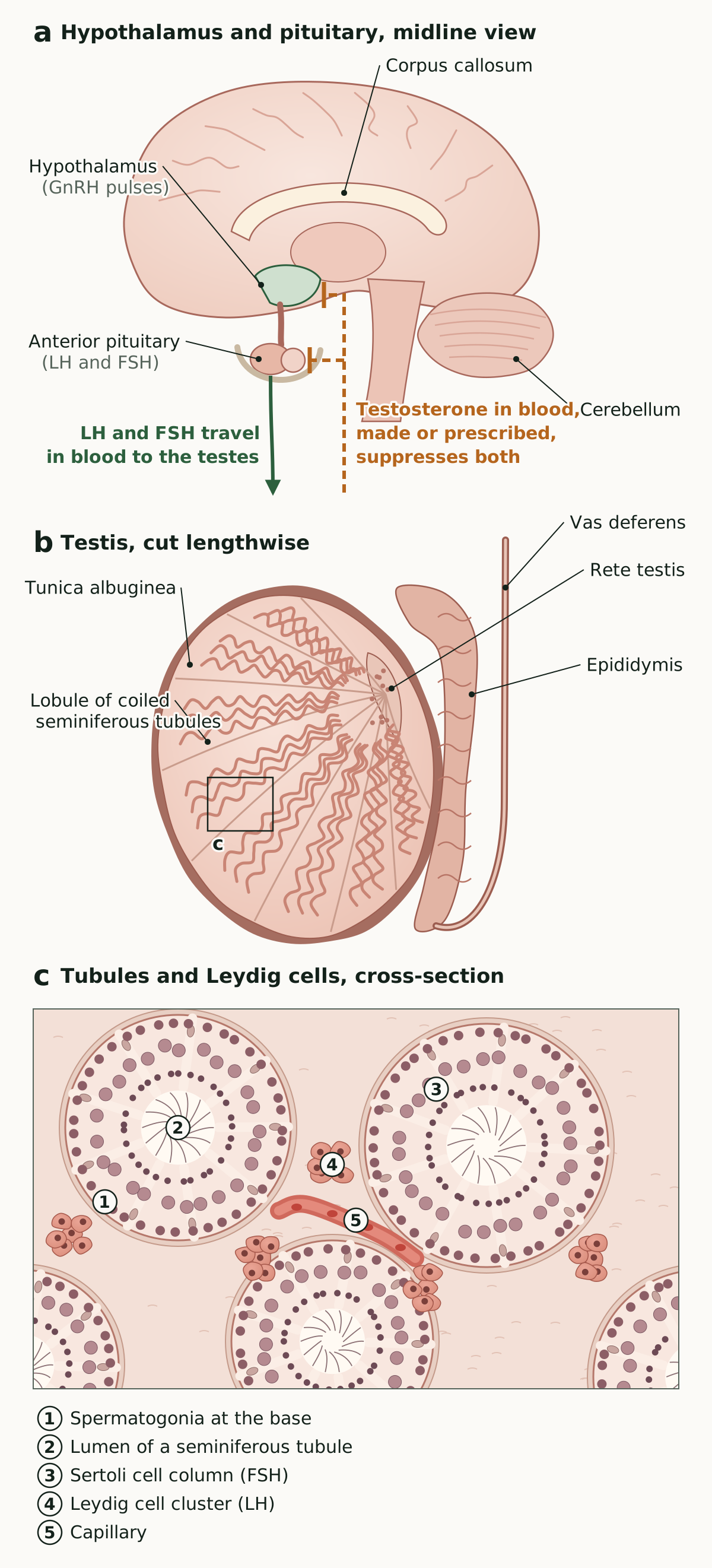
Prescribed testosterone raises the level in the blood, which is what relieves symptoms, but it also switches off the pituitary signal. The testes then make less testosterone of their own, testosterone inside the testis falls and sperm production drops.2019 This is why testosterone therapy is not a fertility treatment, and why the Endocrine Society advises against starting it in men who plan to father a child soon.16 Fertility is the subject of a later article in this series.
Who was treated in the major trials?
Three trial programs supply most of the evidence.
The Testosterone Trials (TTrials) enrolled 790 men aged 65 or older at 12 US academic centers. Each man had an average of two morning testosterone results below 275 ng/dL and low libido, limited walking or low vitality. Men applied testosterone gel or placebo gel for one year, with the dose adjusted to keep testosterone in the normal range for young men.1 Men with a high estimated risk of prostate cancer, recent heart attack or stroke, severe heart failure or severe depression were excluded.1 The trials were funded mainly by the US National Institute on Aging, and AbbVie, which makes the gel, provided funding and donated the gel and placebo.1 The same men took part in seven coordinated trials of sexual function, physical function, vitality, cognition, anemia, bone and coronary plaque.2
TRAVERSE enrolled 5,246 men aged 45 to 80 at 316 US sites. They had two fasting testosterone levels below 300 ng/dL, symptoms of low testosterone, and either cardiovascular disease or a high risk of it.1213 Men used a 1.62% testosterone gel, adjusted to a level of 350 to 750 ng/dL, or placebo gel. The mean duration of treatment was 21.7 months.12 The trial was designed to test cardiovascular safety and was funded by a consortium of testosterone manufacturers led by AbbVie; substudies examined sexual function, depression, anemia, fractures and diabetes.1213
T4DM enrolled 1,007 Australian men aged 50 to 74 with a large waist, a testosterone level of 14.0 nmol/L (about 400 ng/dL) or lower and impaired glucose tolerance or newly diagnosed type 2 diabetes. Men with disease of the testes or pituitary were excluded.11 All took part in a lifestyle program and received injections of testosterone undecanoate or placebo every three months for two years. Funders included the Australian National Health and Medical Research Council, Bayer, Eli Lilly and WW (formerly Weight Watchers).11
Does testosterone therapy improve sex drive and sexual function?
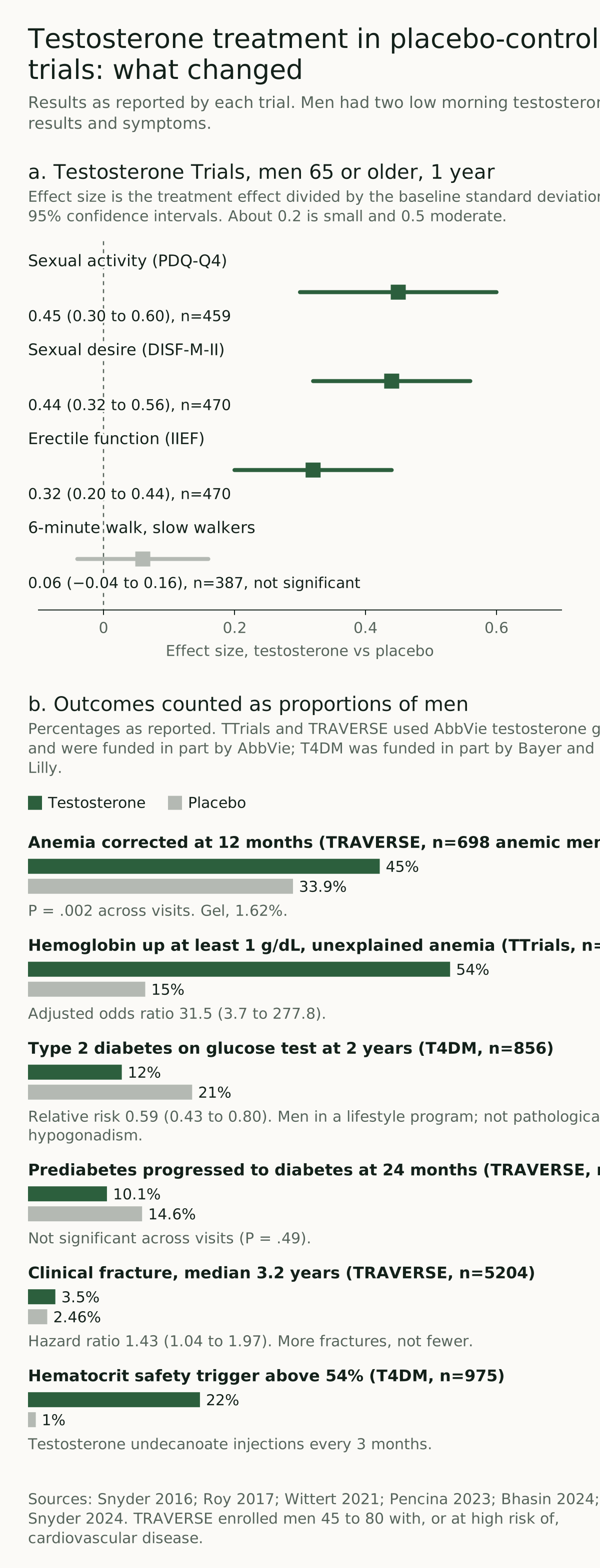
Sexual function is where the evidence is most consistent. In the TTrials Sexual Function Trial, testosterone increased sexual activity, measured by a daily diary, more than placebo (treatment effect 0.58 points on a 0 to 12 scale; effect size 0.45, 95% CI 0.30 to 0.60). It also increased sexual desire (effect size 0.44) and erectile function (effect size 0.32).1 An effect size is the difference between groups divided by the spread of scores at baseline; around 0.2 is conventionally small and 0.5 moderate. The response was somewhat smaller at 12 months than at earlier visits.1
TRAVERSE tested the question for longer in 1,161 men with low libido. Testosterone increased sexual activity by 0.49 acts per day at 6 months and 0.47 at 12 months more than placebo, the effect was maintained at 24 months, and sexual desire and symptoms of low testosterone improved. Erectile function did not differ from placebo.3
The American College of Physicians reviewed the evidence in 2020 and its only recommendation in favor of treating age-related low testosterone concerns sexual function. It suggests that clinicians discuss treatment with men who want to improve sexual function, reassess symptoms within 12 months, and stop treatment if sexual function has not improved.17 The guideline rated its own evidence as low certainty.17
Does it help energy, mood or physical function?
The TTrials Vitality Trial found no significant effect on its primary outcome, the proportion of men with a meaningful improvement in fatigue scores (odds ratio 1.23, P = 0.30).1 Testosterone produced small improvements in mood and depressive symptoms; on the 27-point PHQ-9 depression scale the difference was 0.72 points, and all the effect sizes were below 0.20.1 In TRAVERSE, half of the men (2,643 of 5,204) had significant depressive symptoms, but only 49 met strict criteria for the persistent low-grade depressive disorder once called dysthymia. Among those 49 men, testosterone made no difference. In the larger groups, it was associated with “modest” improvements in mood and energy and none in sleep quality or cognition.8
For physical function, the TTrials Physical Function Trial enrolled men with slow walking speed. The proportion who walked at least 50 meters further in 6 minutes did not differ between groups (odds ratio 1.42, P = 0.20).1 When all TTrials participants were combined, 20.5% of men on testosterone and 12.6% on placebo reached that threshold, but this was a secondary analysis and the average difference from placebo was 6.7 meters.1 The ACP guideline suggests that clinicians not start testosterone to improve energy, vitality, physical function or cognition.17
Does testosterone improve memory?
No benefit was found. In the TTrials Cognitive Function Trial, 493 men with low testosterone and age-associated memory impairment were followed for a year. Delayed recall of a paragraph improved by the same amount on testosterone and placebo (adjusted difference −0.07, 95% CI −0.92 to 0.79), and there were no differences in visual memory, executive function or spatial ability.9 TRAVERSE also found no effect on cognition in men with depressive symptoms.8
Does it correct anemia?
Low testosterone causes mild anemia, and treatment raises hemoglobin. In the TTrials Anemia Trial, 126 of 788 men were anemic and 62 had no other identifiable cause. After 12 months, hemoglobin had risen by at least 1.0 g/dL in 54% of men with unexplained anemia on testosterone and 15% on placebo, and 58.3% versus 22.2% were no longer anemic.4 TRAVERSE confirmed the effect in 815 anemic men: anemia was corrected in 45.0% of the testosterone group and 33.9% of the placebo group at 12 months, and fewer men without anemia at the start developed it.5 The authors of the TTrials anemia paper note that the overall health benefit of correcting this mild anemia has not been established.4
The same effect is the main laboratory hazard of treatment. In the TTrials, 7 men on testosterone and none on placebo reached a hemoglobin of 17.5 g/dL or more.1 In T4DM, a safety trigger for hematocrit above 54% was reached in 22% of men on testosterone injections and 1% on placebo, and the authors wrote that increases in hematocrit “might be treatment limiting.”11 Hematocrit and erythrocytosis are covered in more detail in the next article in this series.
Testosterone also raises blood pressure slightly. In TRAVERSE, mean systolic pressure rose by 1.0 mm Hg on testosterone and fell by 0.5 mm Hg on placebo, and since 2025 the FDA has required a blood pressure warning on all testosterone products.2122 Gels and other skin products can pass testosterone to other people through skin contact. Their labels carry a boxed warning that children have developed male characteristics after secondary exposure, and children should avoid contact with unwashed or unclothed application sites.23 The AUA guideline asks clinicians to discuss this risk with every man using a gel or cream (strong recommendation).24
Does it strengthen bones or prevent fractures?
Testosterone increased bone density, but the one trial large enough to count fractures found more of them. In 211 men in the TTrials Bone Trial, one year of testosterone increased spine trabecular volumetric bone density by 7.5% compared with 0.8% on placebo, a treatment effect of 6.8%, and estimated spine bone strength by a treatment effect of 8.5%, measured by quantitative CT.6 The increases were smaller at the hip.6
TRAVERSE then recorded and adjudicated every reported fracture in 5,204 men. After a median of 3.19 years, a clinical fracture had occurred in 3.50% of men on testosterone and 2.46% on placebo (hazard ratio 1.43, 95% CI 1.04 to 1.97), and the incidence appeared higher with testosterone for every other fracture end point.7 On this evidence, preventing fractures is not a reason to use testosterone.718
Can testosterone prevent or reverse type 2 diabetes?
The two trials point in different directions. In T4DM, after two years, type 2 diabetes on an oral glucose tolerance test was present in 12% of men on testosterone and 21% on placebo (relative risk 0.59, 95% CI 0.43 to 0.80), on top of a lifestyle program.11 Prespecified serious adverse events were more common with testosterone (10.9% versus 7.4%).11 In TRAVERSE, among 1,175 men with prediabetes, progression to diabetes did not differ significantly between testosterone and placebo at any visit, and among men who already had diabetes, testosterone did not increase the rate of remission or improve glucose or hemoglobin A1c.10 The TRAVERSE authors concluded that testosterone “alone should not be used” to prevent or treat diabetes in men with low testosterone.10 The trials differed in formulation, dose and population, and T4DM enrolled men without disease of the testes or pituitary.11
Is testosterone therapy safe for the heart and prostate?
TRAVERSE was designed to answer the cardiovascular question. A major adverse cardiac event, defined as cardiovascular death, nonfatal heart attack or nonfatal stroke, occurred in 7.0% of men on testosterone and 7.3% on placebo (hazard ratio 0.96, 95% CI 0.78 to 1.17), which met the trial’s test for noninferiority. Atrial fibrillation, acute kidney injury and pulmonary embolism were more common in the testosterone group.12 In the smaller TTrials Cardiovascular Trial, one year of testosterone increased the volume of noncalcified coronary plaque on CT angiography compared with placebo (estimated difference 41 mm³), although no major cardiac events occurred in either group.14 For the prostate, TRAVERSE enrolled men screened to exclude those at high risk of prostate cancer, and rates of high-grade or any prostate cancer, urinary retention and other prostate events were low and did not differ between the two groups, although there were too few cancers to show that the risks were the same. Prostate-specific antigen (PSA) rose more with testosterone in the first year.15 These findings, and their limits, are the subject of the next article in this series.
Who should not take testosterone, and how is treatment monitored?
Testosterone is a prescription medicine, and the decision to start, adjust or stop it belongs to a man and his clinician. The Endocrine Society recommends diagnosing low testosterone only in men with symptoms and signs of deficiency and with unequivocally and consistently low testosterone. The level should be measured in the morning, fasting, with an accurate assay, then confirmed with a repeat test, and the cause should be investigated.16
The same guideline recommends against starting testosterone in men who are planning fertility in the near term or who have any of the following:16
- breast or prostate cancer, or a palpable prostate nodule or induration
- PSA above 4 ng/mL, or above 3 ng/mL in men at higher risk of prostate cancer, such as Black men and men with a first-degree relative with prostate cancer, without further urological evaluation
- elevated hematocrit
- untreated severe obstructive sleep apnea
- severe lower urinary tract symptoms
- uncontrolled heart failure
- heart attack or stroke within the last 6 months
- thrombophilia
When treatment is started, the guideline suggests aiming for testosterone in the mid-normal range. It recommends a standardized monitoring plan that includes symptoms, adverse effects and adherence, measurement of testosterone and hematocrit, and evaluation of prostate cancer risk during the first year.16 The ACP adds that men treated for sexual function should be reassessed within 12 months and periodically after that.17
How good is the evidence, and who paid for it?
The core trials are randomized, double-blind and placebo-controlled, with prespecified outcomes, and TRAVERSE is large. That is stronger than the evidence behind most treatments sold for the same symptoms. Important limits remain. The TTrials lasted one year and each of its trials was modest in size. TRAVERSE enrolled only men with cardiovascular disease or high risk of it, and treatment was often shorter than follow-up, with a mean treatment duration of 21.7 months against a mean follow-up of 33.0 months.12 More than 80% of TTrials participants were white.414
Manufacturer funding runs through all three programs. AbbVie, which makes the gels used, co-funded the TTrials and donated the drug, and it led the consortium of manufacturers that funded TRAVERSE; several TTrials investigators reported fees from testosterone manufacturers.112 T4DM was co-funded by Bayer and Eli Lilly.11 In the TTrials, AbbVie did not take part in the design, analysis or reporting before submission.1 The results that went against testosterone, including the null vitality, walking, memory and diabetes outcomes and the higher fracture rate in TRAVERSE, were published by the same investigators.
What remains uncertain?
It is not known whether the moderate gains in sexual function persist beyond two years, or how they compare with those of other treatments for low libido. The trials did not show whether correcting mild anemia makes men feel or function better.4 TRAVERSE did not establish why fractures were more common with testosterone.7 None of these trials studied younger men with borderline levels or men whose testosterone is already normal. A 2024 review by T4DM investigators concluded that for men with an intact hypothalamic-pituitary-testicular axis, testosterone is a “pharmacological intervention” that still needs justification from high-quality trials.18
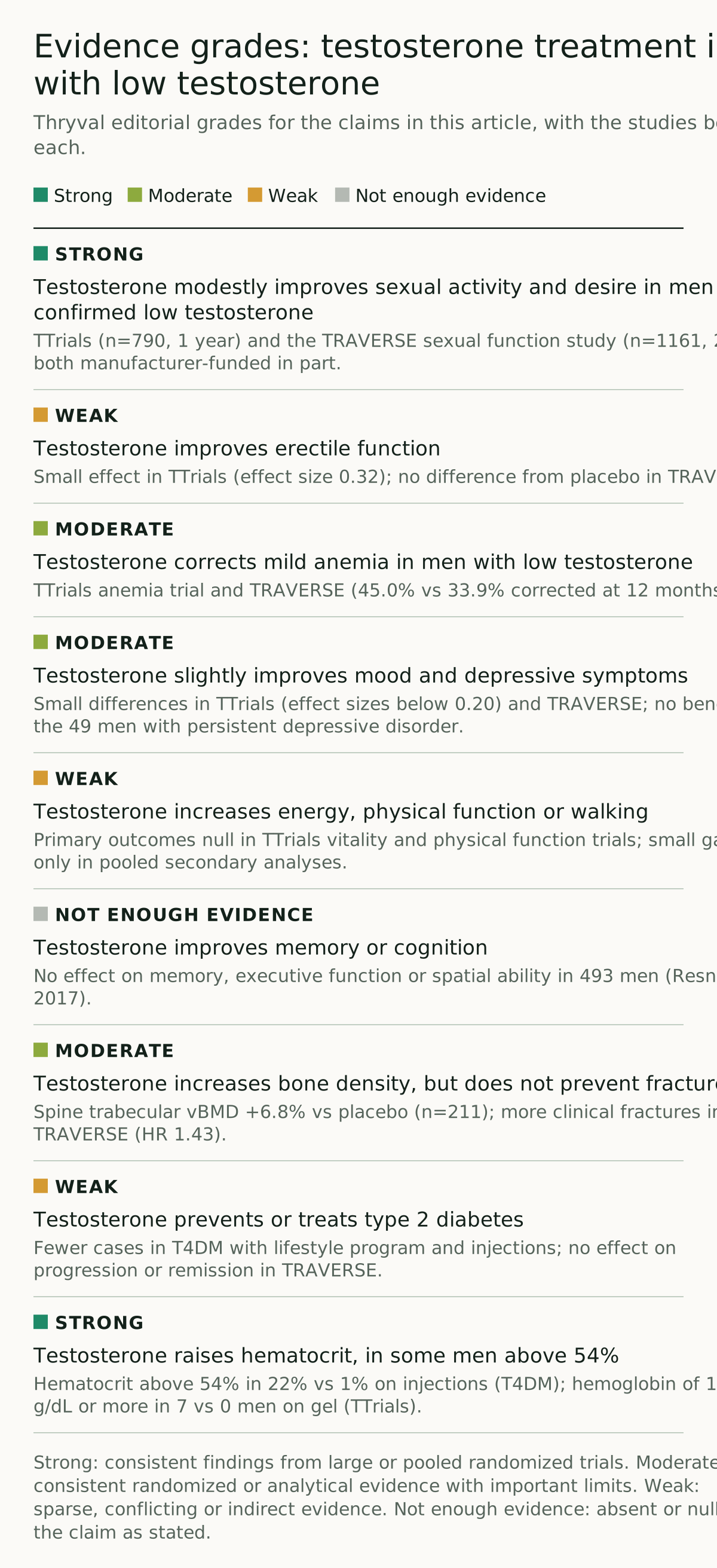
Evidence grades
The grades below are Thryval editorial judgments based on the studies cited in this article. The grading rules are set out on our Research page.
Frequently asked questions
What are the proven benefits of testosterone replacement therapy?
In men with symptoms and consistently low testosterone, randomized trials show moderate improvements in sexual desire and activity, correction of mild anemia in more men than placebo, and higher bone density.1346 Effects on mood are small.8
Does TRT give you more energy?
Not reliably. The TTrials Vitality Trial found no significant effect on its primary fatigue outcome, and TRAVERSE reported only modest improvements in energy.18 The ACP suggests not starting testosterone for energy or vitality.17
Does testosterone therapy help erectile dysfunction?
Only slightly, if at all. Erectile function scores improved a little in the TTrials and did not differ from placebo in TRAVERSE.13
Does TRT increase the risk of heart attack or stroke?
In TRAVERSE, men with or at high risk of cardiovascular disease had similar rates of cardiovascular death, heart attack and stroke on testosterone and placebo, but more atrial fibrillation, acute kidney injury and pulmonary embolism.12 Safety is covered in the next article in this series.
What blood tests are needed during testosterone therapy?
The Endocrine Society recommends a standardized monitoring plan that includes testosterone and hematocrit measurements and evaluation of prostate cancer risk during the first year of treatment.16
Does testosterone therapy affect fertility?
Yes. Prescribed testosterone suppresses LH and FSH, lowers testosterone inside the testis and reduces sperm production. The Endocrine Society advises against starting it in men planning fertility in the near term.2016
Implications for patients and clinicians
For a man with symptoms of low testosterone, the first step is a confirmed diagnosis: two morning fasting measurements with an accurate assay and a search for the cause.16 If he is treated, the trials support realistic expectations. Sexual desire and activity are the outcomes most likely to improve. Anemia, if present, may correct. Energy, walking and memory are unlikely to change much, and diabetes or fracture prevention are not reasons to start.19710 Treatment raises hematocrit, blood pressure and PSA, suppresses sperm production, and with gels can expose children and partners through skin contact, so it needs a monitoring plan agreed with the prescribing clinician, and the guideline contraindications apply.1611152123 Any decision to start, change or stop testosterone should be made with that clinician.
This article is for education and is not medical advice.
References
-
Snyder PJ, Bhasin S, Cunningham GR, et al; Testosterone Trials Investigators. Effects of testosterone treatment in older men. N Engl J Med. 2016;374(7):611–624. Coordinated randomized controlled trials, n=790, testosterone gel for 1 year; funded by the National Institute on Aging and others, with funding and donated gel from AbbVie; several authors reported fees from testosterone manufacturers. PMC5209754 · PubMed 26886521 ↩↩↩↩↩↩↩↩↩↩↩↩↩↩↩↩↩↩↩↩↩↩↩↩↩↩↩
-
Snyder PJ, Bhasin S, Cunningham GR, et al. Lessons from the Testosterone Trials. Endocr Rev. 2018;39(3):369–386. Review of the seven TTrials by their investigators. PMC6287281 · PubMed 29522088 ↩
-
Pencina KM, Travison TG, Cunningham GR, et al. Effect of testosterone replacement therapy on sexual function and hypogonadal symptoms in men with hypogonadism. J Clin Endocrinol Metab. 2024;109(2):569–580. Randomized substudy of TRAVERSE, n=1161 men with low libido; TRAVERSE was funded by AbbVie. PubMed 37589949 ↩↩↩↩↩↩↩
-
Roy CN, Snyder PJ, Stephens-Shields AJ, et al. Association of testosterone levels with anemia in older men: a controlled clinical trial. JAMA Intern Med. 2017;177(4):480–490. Randomized controlled trial within the TTrials, n=788 (126 anemic); funded by the National Institute on Aging and AbbVie. PMC5433757 · PubMed 28241237 ↩↩↩↩↩↩↩
-
Pencina KM, Travison TG, Artz AS, et al. Efficacy of testosterone replacement therapy in correcting anemia in men with hypogonadism: a randomized clinical trial. JAMA Netw Open. 2023;6(10):e2340030. Randomized substudy of TRAVERSE, n=5204 (815 anemic); TRAVERSE was funded by AbbVie, and one author was an AbbVie employee. PMC10611996 · PubMed 37889486 ↩↩↩
-
Snyder PJ, Kopperdahl DL, Stephens-Shields AJ, et al. Effect of testosterone treatment on volumetric bone density and strength in older men with low testosterone: a controlled clinical trial. JAMA Intern Med. 2017;177(4):471–479. Randomized controlled trial within the TTrials, n=211; first author reported grants and nonfinancial support from AbbVie. PMC5433755 · PubMed 28241231 ↩↩↩↩↩
-
Snyder PJ, Bauer DC, Ellenberg SS, et al. Testosterone treatment and fractures in men with hypogonadism. N Engl J Med. 2024;390(3):203–211. Randomized substudy of TRAVERSE, n=5204; funded by AbbVie and others. PubMed 38231621 ↩↩↩↩↩↩
-
Bhasin S, Seidman S, Travison TG, et al. Depressive syndromes in men with hypogonadism in the TRAVERSE trial: response to testosterone-replacement therapy. J Clin Endocrinol Metab. 2024;109(7):1814–1826. Randomized substudy of TRAVERSE, n=5204; TRAVERSE was funded by AbbVie. PubMed 38205962 ↩↩↩↩↩↩↩↩
-
Resnick SM, Matsumoto AM, Stephens-Shields AJ, et al. Testosterone treatment and cognitive function in older men with low testosterone and age-associated memory impairment. JAMA. 2017;317(7):717–727. Randomized controlled trial within the TTrials, n=493 with memory impairment; funded by the National Institute on Aging and AbbVie. PMC5433758 · PubMed 28241356 ↩↩↩↩
-
Bhasin S, Lincoff AM, Nissen SE, et al. Effect of testosterone on progression from prediabetes to diabetes in men with hypogonadism: a substudy of the TRAVERSE randomized clinical trial. JAMA Intern Med. 2024;184(4):353–362. Randomized substudy of TRAVERSE, n=1175 with prediabetes and 3880 with diabetes; TRAVERSE was funded by AbbVie. PMC10845044 · PubMed 38315466 ↩↩↩↩↩
-
Wittert G, Bracken K, Robledo KP, et al. Testosterone treatment to prevent or revert type 2 diabetes in men enrolled in a lifestyle programme (T4DM): a randomised, double-blind, placebo-controlled, 2-year, phase 3b trial. Lancet Diabetes Endocrinol. 2021;9(1):32–45. Randomized controlled trial, n=1007, testosterone undecanoate injections; funded by the National Health and Medical Research Council, Bayer, Eli Lilly, the University of Adelaide and WW. PubMed 33338415 ↩↩↩↩↩↩↩↩↩↩↩↩
-
Lincoff AM, Bhasin S, Flevaris P, et al; TRAVERSE Study Investigators. Cardiovascular safety of testosterone-replacement therapy. N Engl J Med. 2023;389(2):107–117. Randomized noninferiority trial, n=5246; funded by AbbVie and others. PubMed 37326322 ↩↩↩↩↩↩↩↩
-
Bhasin S, Lincoff AM, Basaria S, et al; TRAVERSE Study Investigators. Effects of long-term testosterone treatment on cardiovascular outcomes in men with hypogonadism: rationale and design of the TRAVERSE study. Am Heart J. 2022;245:41–50. Trial design paper. PubMed 34871580 ↩↩
-
Budoff MJ, Ellenberg SS, Lewis CE, et al. Testosterone treatment and coronary artery plaque volume in older men with low testosterone. JAMA. 2017;317(7):708–716. Randomized controlled trial within the TTrials, n=170 (138 analyzed); funded by the National Institute on Aging and AbbVie. PMC5465430 · PubMed 28241355 ↩↩
-
Bhasin S, Thompson IM. Prostate risk and monitoring during testosterone replacement therapy. J Clin Endocrinol Metab. 2024;109(8):1975–1983. Narrative review drawing mainly on TRAVERSE prostate safety data. PubMed 38753865 ↩↩
-
Bhasin S, Brito JP, Cunningham GR, et al. Testosterone therapy in men with hypogonadism: an Endocrine Society clinical practice guideline. J Clin Endocrinol Metab. 2018;103(5):1715–1744. Clinical practice guideline using GRADE methods. PubMed 29562364 ↩↩↩↩↩↩↩↩
-
Qaseem A, Horwitch CA, Vijan S, et al; Clinical Guidelines Committee of the American College of Physicians. Testosterone treatment in adult men with age-related low testosterone: a clinical guideline from the American College of Physicians. Ann Intern Med. 2020;172(2):126–133. Clinical guideline based on a systematic review, endorsed by the American Academy of Family Physicians. PubMed 31905405 ↩↩↩↩↩
-
Yeap BB, Tran C, Douglass CM, McNeil JJ. Beyond T-Trials, T4DM and TRAVERSE: the next large testosterone randomized controlled trial. Curr Opin Endocrinol Diabetes Obes. 2024;31(6):222–229. Narrative review. PubMed 39291749 ↩↩↩
-
Hashimi MA, Pinggera GM, Shah R, Agarwal A. Clinician’s guide to the management of azoospermia induced by exogenous testosterone or anabolic-androgenic steroids. Asian J Androl. 2025;27(3):330–341. Narrative review. PMC12112917 · PubMed 39820213 ↩↩↩↩↩
-
Crosnoe LE, Grober E, Ohl D, Kim ED. Exogenous testosterone: a preventable cause of male infertility. Transl Androl Urol. 2013;2(2):106–113. Narrative literature review; authors declared no conflicts of interest. PMC4708215 · PubMed 26813847 ↩↩
-
US Food and Drug Administration. AVEED (testosterone undecanoate) injection, prescribing information, revised 07/2025, including the class-wide TRAVERSE adverse reaction summary (sections 5.3, 5.4, 5.6 and 6.1). FDA label PDF ↩↩
-
US Food and Drug Administration. FDA issues class-wide labeling changes for testosterone products. Feb 28, 2025. FDA page ↩
-
Endo USA. TESTIM (testosterone gel) 1%, prescribing information, boxed warning: secondary exposure to testosterone. DailyMed set ID 9f2aae1f-898d-4955-be31-678e0cf85395, effective Jul 15, 2025. DailyMed ↩↩
-
Mulhall JP, Trost LW, Brannigan RE, et al. Evaluation and management of testosterone deficiency: AUA guideline. J Urol. 2018;200(2):423–432. Clinical guideline based on a systematic review; guideline statement 26 on transference. PubMed 29601923 ↩