
Do testosterone booster supplements work? What the trials show
Supplements sold to raise testosterone usually combine plant extracts, amino acids, vitamins and minerals. A few ingredients have small trials reporting modest rises in blood testosterone, most of them short and paid for or supplied by the extract maker. None has been shown to treat diagnosed low testosterone, and products in this market have been found to contain undeclared steroids and drugs.
The grade WeakOver-the-counter testosterone booster supplements (tongkat ali, fenugreek, D-aspartic acid, ashwagandha and boron) for raising testosterone in men
In brief. In an analysis of 50 products sold online as testosterone boosters, 90% claimed to raise testosterone, but only 24.8% of their 109 ingredients had any published study showing a rise, and 61.5% had no data on testosterone at all.1 Among the ingredients that have been tested in randomized trials, tongkat ali (Eurycoma longifolia), fenugreek and ashwagandha have produced modest increases in total testosterone in some studies.51325 Those trials were small and short, used different populations and outcomes, and were often funded, supplied or co-authored by the companies that make the extracts.6132726 D-aspartic acid raised testosterone in one 12-day study but not in three trials in resistance-trained men, one of which found a fall at the higher dose.20212223 Evidence for boron is limited to two small studies with opposite results, and in randomized trials vitamin D has not clearly raised testosterone: one small trial in deficient men reported a rise, but two larger 12-week trials and a 2026 meta-analysis found no clear effect.323347363748 No trial has shown that any of these supplements treats diagnosed low testosterone or can stand in for prescribed treatment. Products sold for muscle building and sexual enhancement have repeatedly been found to contain undeclared anabolic steroids or prescription drugs, and bodybuilding supplements and ashwagandha have both been linked to liver injury.38394229
The first article in this series covers what prescribed testosterone does for symptoms, the second covers heart, prostate and blood safety, the third covers how low testosterone is diagnosed, and the fourth covers fertility. This last article looks at the supplements sold over the counter as an alternative: what is in them, what the human trials measured, who paid for those trials, and what is known about their safety. It does not cover prescription drugs such as clomiphene, which the fourth article describes.
What are testosterone boosters, and what is in them?
“Testosterone booster” is a marketing term with no regulatory definition. In the United States these products are sold as dietary supplements, which the FDA does not review for safety or effectiveness before they reach the market.40 Researchers at the University of Southern California found 50 such products through a Google search and catalogued their labels. The products contained 109 different ingredients, a mean of 8.3 per product. The most common were zinc, fenugreek, vitamin B6, Tribulus, magnesium, boron, diindolylmethane, Eurycoma longifolia and maca. Ninety percent claimed to boost testosterone, 50% to improve libido and 48% to make users feel stronger. When the authors searched PubMed for each ingredient, 24.8% had data showing a rise in testosterone, 10.1% had data showing a fall, 18.3% had data showing no change, and 61.5% had none. Many products contained vitamins far above the recommended daily allowance, with a median of 1,291% for vitamin B12 and 272% for zinc, and 13 exceeded an FDA upper intake level for zinc, niacin or magnesium. The authors reported no conflicts of interest.1
A team at Baylor College of Medicine looked at the five top-ranked testosterone boosters on Amazon in July 2018. Of 191 studies on their 10 most common ingredients, 19% were in humans and 53% in animals. Of the 37 human studies, 30% found a rise in testosterone, 3% a fall, 46% no effect, and 22% were indeterminate. When the authors screened the products’ customer reviews with an online service that flags untrustworthy reviews, reports of increased libido fell by 91%. The senior author was supported by an NIH career development award.2 A 2024 systematic review of 52 studies of 27 proposed boosters concluded that most failed to increase total testosterone. It rated Eurycoma longifolia as possibly effective in men with late-onset hypogonadism, and Eurycoma and ashwagandha (Withania somnifera) as possibly effective in healthy men.3 A 2021 systematic review of 32 randomized trials of single herbs found statistically significant rises in testosterone in 9, judged only 6 to be at low risk of bias, and noted that half the trials enrolled men younger than 40.4
How are these supplements supposed to raise testosterone?
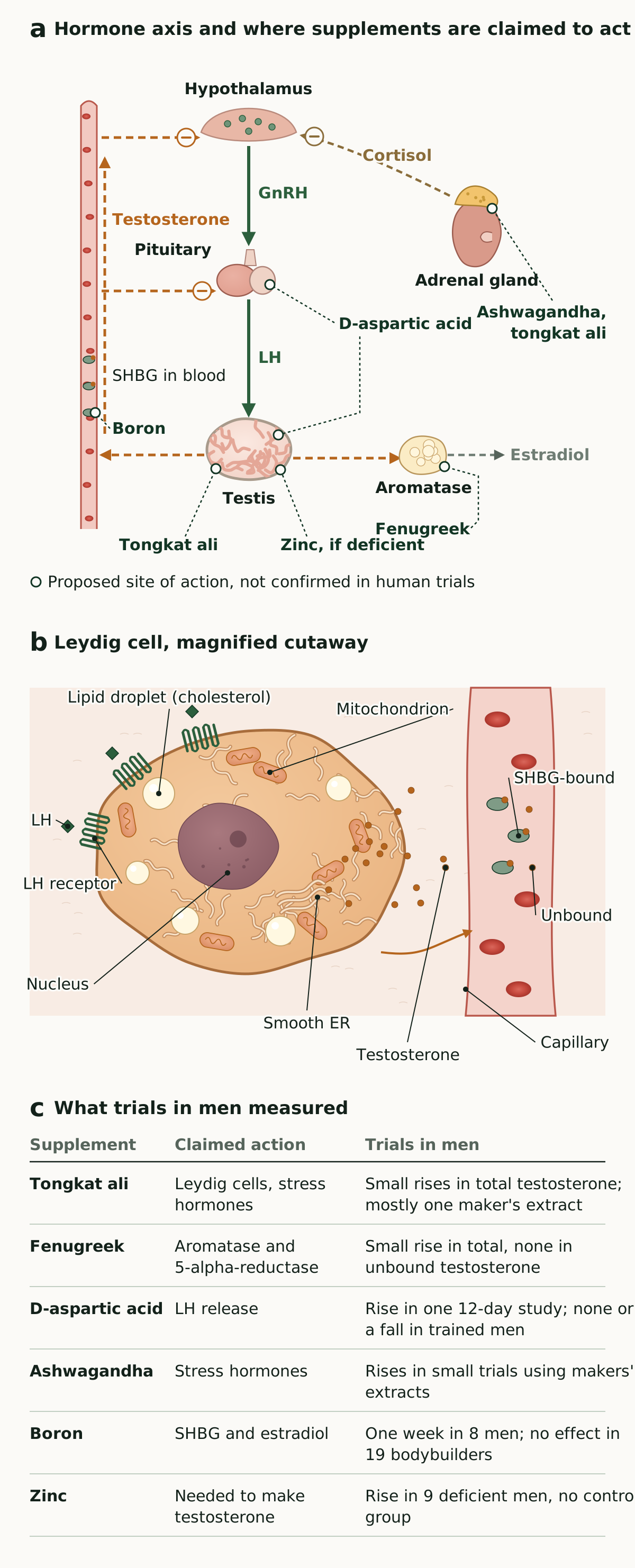
Testosterone is made by Leydig cells in the testis in response to luteinizing hormone (LH) from the pituitary, which is itself driven by gonadotropin-releasing hormone (GnRH) from the hypothalamus. Testosterone feeds back to dampen both.46 Most testosterone in blood is bound to sex hormone-binding globulin (SHBG) or albumin, and about 2% circulates unbound.45 Some testosterone is converted to estradiol by the enzyme aromatase.45 The proposed actions of the supplements map onto this system. D-aspartic acid is said to increase LH release and testosterone synthesis, a mechanism worked out mainly in rats.20 Fenugreek extracts have been tested as purported inhibitors of aromatase and 5-alpha-reductase.1813 Boron has been proposed to lower SHBG and estradiol.32 Tongkat ali and ashwagandha have been proposed to act through the hypothalamic-pituitary-gonadal axis or through stress hormones such as cortisol.727 Zinc is needed for normal testosterone production, and deficiency lowers it.35 None of these mechanisms has been confirmed in human trials.
Does tongkat ali raise testosterone?
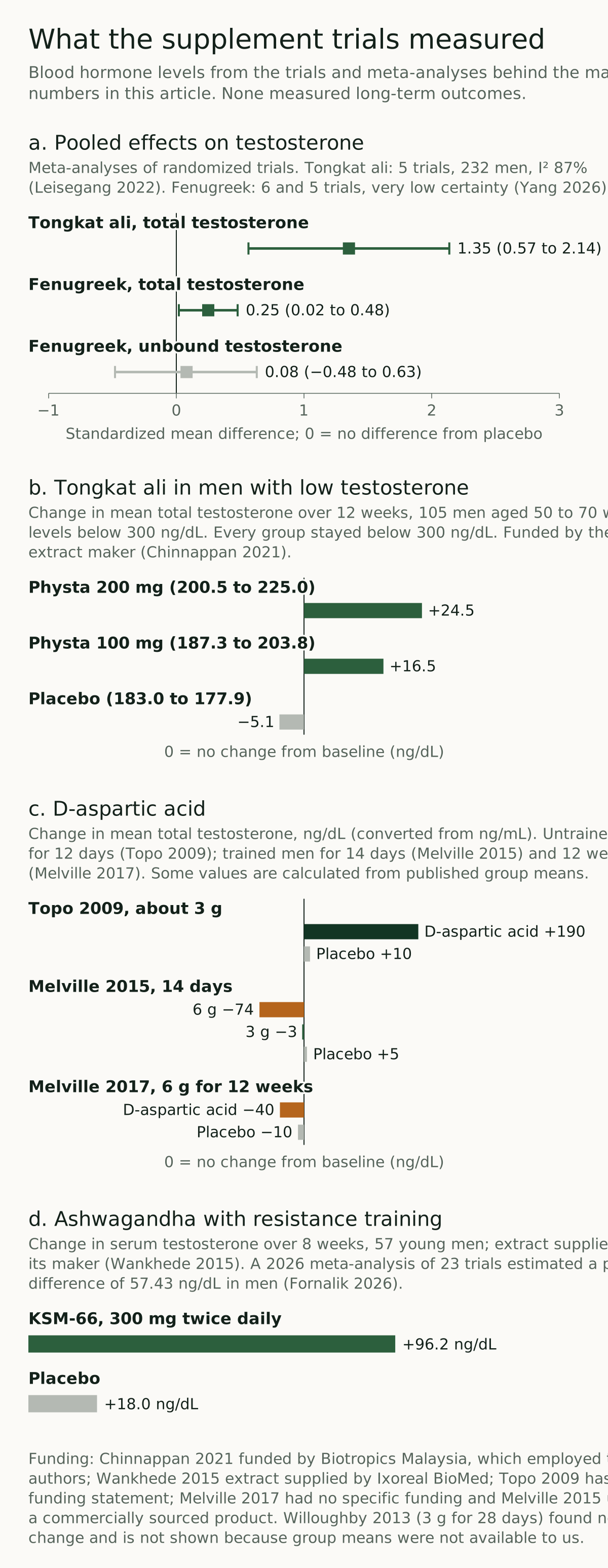
Tongkat ali, the root of Eurycoma longifolia, is the ingredient with the most trials. A 2022 meta-analysis pooled five randomized trials with 232 men and reported a large standardized increase in total testosterone (standardized mean difference 1.35, 95% CI 0.57 to 2.14). The trials were highly inconsistent with one another (I² 87%), and seven of the nine studies in the review used the same commercial water extract, Physta, made by Biotropics Malaysia.5 The review also listed two 12-week randomized trials of that extract in healthy men with normal testosterone that found no significant change.5 The meta-analysis authors declared no conflicts and received no external funding.5
The largest single trial randomized 105 men aged 50 to 70 with total testosterone below 300 ng/dL at sites in India to 100 mg or 200 mg of Physta or placebo for 12 weeks. Mean total testosterone rose from 200.5 to 225.0 ng/dL with 200 mg and from 187.3 to 203.8 ng/dL with 100 mg, and fell from 183.0 to 177.9 ng/dL with placebo; the differences from placebo were statistically significant. There was no significant difference between groups in unbound testosterone. Scores on the Aging Males’ Symptoms scale and a fatigue scale improved more with the extract.6 The average level in every group stayed below the 300 ng/dL cutoff the American Urological Association (AUA) uses for low testosterone.645 Biotropics Malaysia funded the trial, and two of the five authors were company employees.6
The other human studies are smaller or less well controlled. In 32 young men given 600 mg a day or placebo for two weeks, testosterone, unbound testosterone and estradiol rose with the extract while LH and FSH did not change; the study was supported by a University of Malaya postgraduate grant.7 A Brazilian trial randomized 45 men aged about 47 with symptoms of androgen deficiency to placebo or 200 mg of extract, with or without exercise training, for six months, and reported the largest improvement in erectile function with the combination of training and extract.8 Earlier reports that 76 men with late-onset hypogonadism had higher testosterone after a month of extract, and that 13 older men had higher testosterone after five weeks, had no control group.910 A trial in 63 moderately stressed men and women found 37% higher salivary testosterone and 16% lower salivary cortisol after four weeks; it was funded by Biotropics, one author was a Biotropics employee, and another worked for a company that sells a tongkat ali product.11 Neither of the US testosterone guidelines uses saliva tests for diagnosis.4445
Does fenugreek raise testosterone or libido?
Fenugreek (Trigonella foenum-graecum) seed extracts were the second most common ingredient in the product survey.1 The most recent meta-analysis, published in 2026, included 13 randomized placebo-controlled trials in men. Six contributed to a pooled estimate for total testosterone, which showed a small effect (standardized mean difference 0.25, 95% CI 0.02 to 0.48), and five to an estimate for unbound testosterone, which showed no clear effect (0.08, 95% CI −0.48 to 0.63). None of the 13 trials was judged at low risk of bias, the certainty of the evidence was rated very low, and the authors noted that industry funding or company involvement was common. They concluded that the evidence does not support testosterone-boosting claims.13 A 2023 meta-analysis limited to athletes found a similarly small effect on total testosterone in men (0.32, 95% CI 0.09 to 0.55).14
The individual trials show the range. An Australian trial randomized 120 healthy men aged 43 to 70 to 600 mg a day of Testofen, a branded extract, or placebo for 12 weeks; total and unbound testosterone and scores on the Aging Males’ Symptoms scale improved more with the extract, as did the number of morning erections and the frequency of sexual activity.15 The 2026 meta-analysis lists Gencor Pacific, which sells Testofen, as the funder.13 A Norwegian trial gave 95 men aged 40 to 80 three doses of a different extract or a placebo for 12 weeks. Plasma total testosterone rose 9.0% more than with placebo, a difference that was not statistically significant (P=0.122); salivary testosterone rose 37.2% more (P=0.042). The men reported no subjective effects. The trial was funded by Vitas, the contract laboratory where it was run, and two authors held stock in Vitas.16 An Indian trial of a fenugreek glycoside fraction in 60 men doing resistance training reported gains in testosterone and loss of body fat; it was supported by Indus Biotech, the extract’s maker, which employed two of the three authors.17
Claims about libido rest on two trials of Testofen. Besides the 120-man trial above, a six-week trial in 60 men aged 25 to 52 found improvements in subscales of sexual arousal and orgasm with a formulation that combined the extract with magnesium, zinc and vitamin B6, while testosterone stayed within the reference range.1915 We could not find a funding statement for the six-week trial in the records we could access. The NIH’s National Center for Complementary and Integrative Health notes that fenugreek can cause digestive upset and allergic reactions, that large doses may cause a harmful drop in blood sugar, and that it is not safe in pregnancy in amounts above those in food.43
Does D-aspartic acid raise testosterone?
D-aspartic acid is an amino acid found in the pituitary and testes. The claim that it raises testosterone comes largely from a 2009 Italian report. In it, 23 men aged 27 to 37 took a D-aspartate drink (DADAVIT) every morning for 12 days and 20 men took a placebo. Mean testosterone rose from 4.5 to 6.4 ng/mL (450 to 640 ng/dL), a 42% increase, and LH rose from 4.2 to 5.6 mIU/mL; neither changed in the placebo group. The report does not describe how men were assigned to the groups or whether anyone was blinded. Most of the paper concerns experiments in rats.20 The paper has no funding statement; the authors, based at the Anton Dohrn Zoological Station, a Naples research foundation and the hospital’s IVF unit, declared no competing interests. The drink, made by an Italian company, also contained vitamins B6, B12 and folic acid.20
Three later trials in resistance-trained men did not reproduce the result. At Baylor University, 3 g a day for 28 days with resistance training did not change total or unbound testosterone, LH, GnRH or estradiol.21 At Western Sydney University, 24 trained men were randomized to placebo, 3 g or 6 g a day for 14 days. The 3 g dose had no effect, and with 6 g total testosterone fell from 5.85 to 5.12 ng/mL (585 to 512 ng/dL), with unbound testosterone also lower than with placebo.22 The same group then randomized 22 trained men to 6 g a day or placebo for 12 weeks and found no change in total or unbound testosterone, a 16% fall in estradiol, and similar gains in strength and muscle size in the two groups.23 The Western Sydney authors bought their supplement commercially and declared no competing interests.2223 A 2017 systematic review found four human studies with inconsistent results and called the evidence sparse and of poor quality.24
Does ashwagandha raise testosterone?
Ashwagandha is covered in detail in our article on stress, anxiety and sleep. For testosterone, a 2026 meta-analysis of 23 randomized placebo-controlled trials of hormone outcomes, with 1,706 participants, reported a pooled rise in testosterone in men of 57.43 ng/dL compared with placebo, with no effect in women; it also found lower cortisol and a small rise in the thyroid hormone T4. The authors noted heterogeneity and limited data for some outcomes, and declared no conflicts of interest.25
The trials in men are small and mostly used branded extracts supplied or funded by their makers. In an Indian trial, 57 young men starting resistance training took 300 mg of the root extract KSM-66 twice a day or placebo for 8 weeks. Serum testosterone rose by 96.2 ng/dL with ashwagandha and by 18.0 ng/dL with placebo, and strength and muscle size increased more with the extract. Ixoreal BioMed, which makes KSM-66, and Shri Kartikeya Pharma supplied the extract; the authors declared no conflicts.26 In an Australian crossover trial, 57 overweight men aged 40 to 70 with mild fatigue took an extract called Shoden or placebo for 8 weeks each. Salivary testosterone rose 14.7% more and DHEA-S 18% more with ashwagandha, but fatigue, vigor and sexual well-being did not differ from placebo. The trial was funded by Arjuna Natural, the extract’s maker.27 A pilot trial in 46 men with low sperm counts reported a 167% rise in sperm concentration from baseline after 90 days of KSM-66, with minimal change on placebo.28
Ashwagandha also carries safety concerns. Liver injury has been reported in case series from Iceland, the United States and India, including three deaths among people with existing chronic liver disease.2930 The NIH Office of Dietary Supplements notes that ashwagandha might interact with thyroid hormone, diabetes and blood pressure medicines, immunosuppressants and sedatives, and that because it might raise testosterone, experts say it might not be safe for men with hormone-sensitive prostate cancer.31 Denmark has banned its sale in foods and supplements, as described in the ashwagandha article.
Do boron, zinc or vitamin D raise testosterone?
Boron appears in many products, and the human evidence consists of two small studies.1 In an Iranian study, 8 healthy men took 10 mg of boron a day for a week. Mean unbound testosterone rose and estradiol fell; there was no separate control group.32 In a US trial, 19 male bodybuilders aged 20 to 27 were randomized to 2.5 mg of boron a day or placebo for 7 weeks. Testosterone, lean mass and strength rose in both groups with training, and boron made no difference to any of them. That trial, reported in two papers, was funded by the Florida State University Foundation.3334 We could not find a funding statement for the Iranian study.
The zinc evidence comes from studies of deficiency. In a study at Wayne State University, restricting dietary zinc in four healthy young men for 20 weeks lowered mean testosterone from 39.9 to 10.6 nmol/L (about 1,150 to 306 ng/dL), and giving zinc to nine older men who were marginally deficient raised it from 8.3 to 16.0 nmol/L (about 239 to 461 ng/dL) over three to six months.35 Neither part had a control group, and the study, funded by NIH and FDA grants, did not test zinc in men with normal zinc levels.35 Studies in men who were not deficient have been negative. In a randomized trial of 42 resistance-trained men, 8 weeks of a zinc magnesium aspartate (ZMA) supplement did not change anabolic hormones compared with placebo, and in 14 men eating enough zinc, ZMA did not change total or unbound testosterone.4950 The product survey found that two boosters contained at least the upper intake level of zinc, 40 mg a day.1 Long-term intake above that level can cause copper deficiency, as described in our zinc article.
Vitamin D has been tested more rigorously. In two randomized placebo-controlled trials at the Medical University of Graz, men with 25-hydroxyvitamin D below 75 nmol/L took 20,000 IU of vitamin D3 a week or placebo for 12 weeks. Vitamin D had no effect on total testosterone in 98 healthy men with normal testosterone, nor in 94 men with total testosterone below 10.4 nmol/L (about 300 ng/dL).3637 An earlier analysis from a German weight-loss trial had pointed the other way. Among 54 overweight men who were vitamin D deficient at the start, total testosterone rose from 10.7 to 13.4 nmol/L over a year of 3,332 IU a day and did not change on placebo, although the comparison was within groups and the authors called for confirmatory trials.47 A 2026 meta-analysis of 11 randomized comparisons found no clear effect on total testosterone (mean difference 0.47 nmol/L, 95% CI −0.50 to 1.44), with low certainty.48 The second trial was funded by the Austrian National Bank’s research fund, and its authors declared no conflicts.37 Our vitamin D article covers what supplements do and do not do for people who are not deficient.
Tribulus terrestris, another of the most common ingredients, has not raised testosterone in men in controlled studies. In a randomized study of 21 healthy young men, 4 weeks of extract at two doses did not change testosterone, androstenedione or LH compared with placebo, and a 2014 systematic review of 11 studies concluded that it is ineffective for raising testosterone in humans and that marketing claims are unsubstantiated.5152
Are testosterone boosters safe?
The main documented hazard is undeclared ingredients. The FDA warns that some bodybuilding products marketed as supplements illegally contain steroids or steroid-like substances, and lists serious liver injury, testicular shrinkage, sexual dysfunction, mood changes, kidney damage, heart attack, stroke and blood clots among the reactions associated with them.40 An analysis by the California Department of Public Health of FDA warnings from 2007 to 2016 identified 776 adulterated supplements. Of the 92 marketed for muscle building, 82 (89.1%) contained synthetic steroids or steroid-like ingredients. Of the 353 marketed for sexual enhancement, 166 (47.0%) contained sildenafil, and 157 products overall contained more than one unapproved ingredient.38 In an international study, laboratory testing of 634 supplements that did not list any hormone found undeclared anabolic steroids in 94 (14.8%), including 9.6% of products from companies that did not sell steroid prohormones.39 These studies concern muscle-building and sexual enhancement products generally. We found no study that tested a representative sample of products sold specifically as testosterone boosters for hidden ingredients.
Liver injury has followed bodybuilding supplements. In the US Drug-Induced Liver Injury Network, 45 of 130 cases attributed to herbal and dietary supplements between 2004 and 2013 were caused by bodybuilding products; these patients were young men (median age 31) with prolonged jaundice, lasting a median of 91 days, although none died or needed a transplant.41 In a later report of 44 such men, 71% were hospitalized, and chemical analysis of the products often found anabolic steroids that were not on the label.42 Both reports were funded by the National Institute of Diabetes and Digestive and Kidney Diseases.4142 Ashwagandha has its own reports of liver injury, described above.2930
Interactions are less well studied. In a randomized crossover study in 14 healthy young men, taking 200 mg of a tongkat ali water extract with the blood pressure drug propranolol lowered propranolol exposure by 29% and its peak level by 42%; the drug’s effects were not changed in these healthy volunteers, but the authors advised caution when the two are combined.12 Ashwagandha’s possible interactions are listed by the NIH, and the NIH advises anyone taking medicines to talk with a clinician before using fenugreek or other herbal products.3143 Anyone taking prescribed testosterone or another medicine should tell the prescribing clinician about every supplement, and should not start, stop or change a medicine on the basis of a supplement label or this article.
Can a supplement replace testosterone therapy?
No supplement in this article has been shown to substitute for testosterone therapy or any other prescribed treatment, and none should be used that way. We found no trial that compared a supplement with prescribed testosterone, and the outcomes in the supplement trials were mostly hormone levels over a few weeks rather than the symptoms, bone, blood and sexual outcomes measured in the testosterone trials described in the first article in this series. Whether to start, stop or change testosterone or any other medicine is a decision for a man and his clinician.
For men with symptoms that suggest low testosterone, the guidelines describe a diagnostic workup. The Endocrine Society recommends diagnosing hypogonadism only in men with symptoms and signs of deficiency and unequivocally and consistently low testosterone, measured in the morning after fasting and confirmed with a repeat test, followed by LH and FSH to find the cause.44 The AUA uses a total testosterone below 300 ng/dL on two early-morning tests.45 The third article in this series explains the tests. Prescribed testosterone has contraindications, including breast or prostate cancer and planned fertility, and requires monitoring of hematocrit and PSA, as set out in the guidelines and in the second and fourth articles.4445 A supplement that does contain an anabolic steroid exposes the user to steroid effects, including the testicular shrinkage the FDA lists, without any of that oversight.4042
How good is the evidence, and who paid for it?
The evidence that these products raise testosterone is weak. The meta-analyses pool a handful of small trials each, with high inconsistency for tongkat ali and very low certainty for fenugreek.513 The randomized trials described here lasted 2 weeks to 6 months, half of the herbal trials in one review enrolled men younger than 40, several enrolled men who were also starting an exercise program, and several measured testosterone in saliva, which the guidelines do not use.784262744 Most of the randomized trials enrolled men whose testosterone was not low; among those described here, only the largest tongkat ali trial and the second vitamin D trial required low testosterone for entry, and the vitamin D trial was negative.637 The rises reported in men with low testosterone were small, about 25 ng/dL in the largest tongkat ali trial.6 For D-aspartic acid and boron, the better-controlled trials were negative.22232133
Manufacturer involvement is common. Biotropics Malaysia funded the largest tongkat ali trial and the stress trial and employed authors of both.611 Arjuna Natural funded the Shoden ashwagandha trial, both KSM-66 ashwagandha trials used Ixoreal BioMed’s extract, which the company supplied for the strength trial, Indus Biotech funded and employed authors of a fenugreek trial, the 2026 meta-analysis lists Gencor Pacific as the funder of the 120-man Testofen trial, and the Norwegian fenugreek trial was funded by the laboratory that ran it.272628171316 The negative D-aspartic acid trials from Western Sydney used a commercially bought product, and their authors declared no competing interests; the second reported no specific funding.2223 The second vitamin D trial was funded by the Austrian National Bank.37 We could not find funding statements for the Willoughby, Steels, Tambi, Henkel, Leitão, Naghii and Salman studies in the records we could access. Industry funding does not by itself invalidate a result, and independent replication is scarce for every ingredient here.
What remains uncertain?
Apart from vitamin D, which has been tested for a year or more, we found no trial longer than six months for any of these ingredients,47 no trial comparing them with prescribed testosterone, and no trial showing that a supplement improves the symptoms that lead men to seek treatment in men whose low testosterone has been confirmed by the guideline workup.5132544 Most trials tested a single branded extract, so results for one product may not apply to another, and multi-ingredient boosters have rarely been tested as sold.51 How often products sold specifically as testosterone boosters contain undeclared drugs is not known.3839 Long-term safety has not been studied for any of the herbal extracts.31
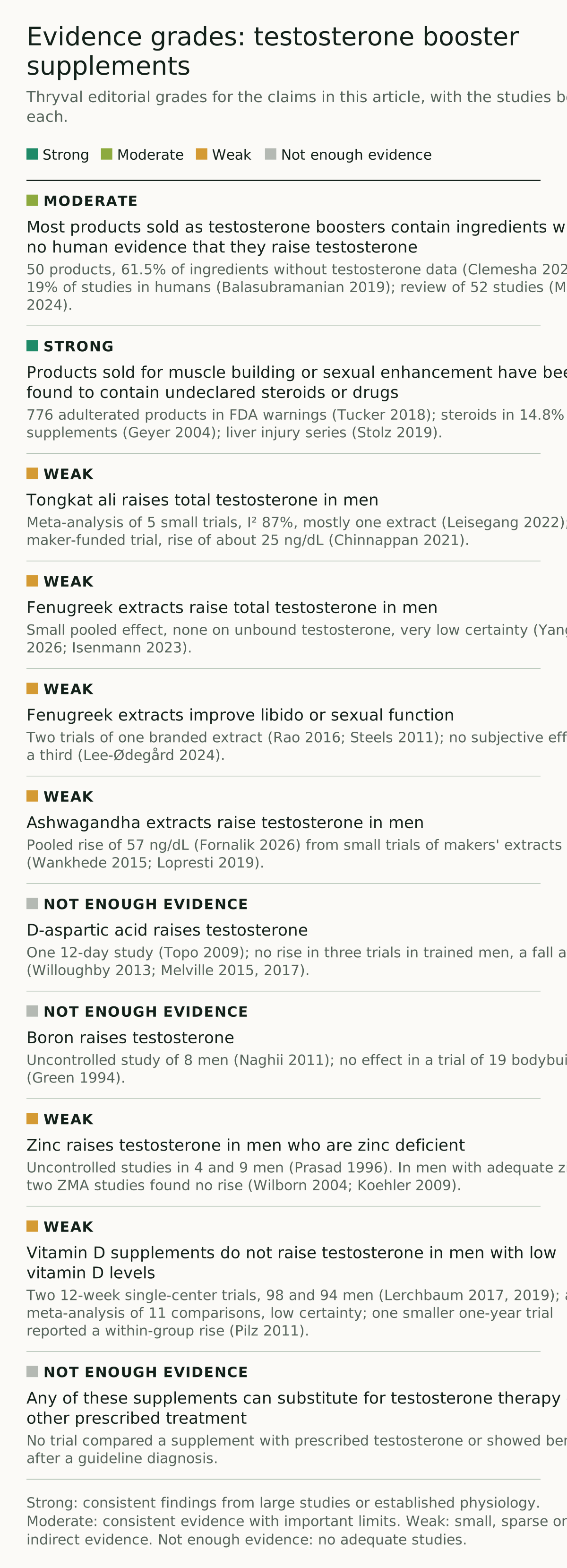
Evidence grades
The grades below are Thryval editorial judgments based on the studies cited in this article. The grading rules are set out on our Research page.
Frequently asked questions
Do testosterone boosters actually raise testosterone?
Most of their ingredients have never been shown to. In a survey of 50 products, 61.5% of ingredients had no published data on testosterone and only 24.8% had data showing a rise.1 Tongkat ali, fenugreek and ashwagandha have produced modest rises in small, often manufacturer-funded trials, and D-aspartic acid and boron have not held up in controlled trials.513252333
Does tongkat ali raise testosterone?
In pooled data from five small trials, total testosterone was higher with tongkat ali, but the trials disagreed widely and most tested one company’s extract.5 In the largest trial, in men aged 50 to 70 with low testosterone, the average rise was about 25 ng/dL and levels stayed below 300 ng/dL; the manufacturer funded it.6 Tongkat ali lowered the absorption of propranolol in one study.12
Does ashwagandha raise testosterone?
A meta-analysis of 23 trials reported a pooled rise of 57 ng/dL in men, from small trials that mostly used branded extracts.25 Ashwagandha has been linked to liver injury, may affect thyroid hormone levels and may interact with several medicines.2931
Can a supplement replace testosterone therapy?
No supplement has been shown to do so. No trial has compared a supplement with prescribed testosterone or shown that one treats diagnosed low testosterone.44 Testosterone therapy is a prescription treatment, and decisions to start, stop or change it, or any other medicine, belong with a man and his clinician.
Can testosterone boosters contain steroids or hidden drugs?
Products sold for muscle building and sexual enhancement have been found to. FDA warnings between 2007 and 2016 identified 776 adulterated supplements, and 89.1% of the muscle-building products among them contained synthetic steroids or steroid-like ingredients.38 Bodybuilding supplements containing undeclared anabolic steroids have caused prolonged jaundice in young men.4241
What should a man with symptoms of low testosterone do?
The Endocrine Society and the AUA recommend confirming low testosterone with two morning blood tests in men who have symptoms, and then looking for the cause.4445 The third article in this series describes the tests, and treatment decisions belong with the clinician who makes the diagnosis.
Implications for patients and clinicians
For a man considering a testosterone booster, the trials offer little to go on: modest rises in blood testosterone for a few ingredients, measured over weeks, in studies that were small and often paid for by the extract’s maker, and negative controlled trials for others.513252333 Symptoms that suggest low testosterone call for the guideline diagnostic workup, and no supplement is a substitute for testosterone therapy or any other prescribed treatment.4445 Clinicians assessing a man with jaundice, unexplained liver injury, testicular atrophy or suppressed LH and FSH should ask about bodybuilding and testosterone booster products, which have been found to contain undeclared anabolic steroids.423840
This article is for education and is not medical advice.
References
-
Clemesha CG, Thaker H, Samplaski MK. ‘Testosterone boosting’ supplements composition and claims are not supported by the academic literature. World J Mens Health. 2020;38(1):115–122. Analysis of 50 products and their 109 ingredients; the authors reported nothing to disclose. PMC6920068 · PubMed 31385468 ↩↩↩↩↩↩↩↩
-
Balasubramanian A, Thirumavalavan N, Srivatsav A, Yu J, Lipshultz LI, Pastuszak AW. Testosterone imposters: an analysis of popular online testosterone boosting supplements. J Sex Med. 2019;16(2):203–212. Analysis of the top 5 products on Amazon and 191 studies of their ingredients; NIH (NIDDK) K08 support. PMC6407704 · PubMed 30770069 ↩↩
-
Morgado A, Tsampoukas G, Sokolakis I, Schoentgen N, Urkmez A, Sarikaya S. Do “testosterone boosters” really increase serum total testosterone? A systematic review. Int J Impot Res. 2024;36(4):348–364. Systematic review of 52 studies of 27 proposed boosters. PubMed 37697053 ↩↩
-
Smith SJ, Lopresti AL, Teo SYM, Fairchild TJ. Examining the effects of herbs on testosterone concentrations in men: a systematic review. Adv Nutr. 2021;12(3):744–765. Systematic review of 32 randomized trials of 13 herbs. PMC8166567 · PubMed 33150931 ↩↩
-
Leisegang K, Finelli R, Sikka SC, Panner Selvam MK. Eurycoma longifolia (Jack) improves serum total testosterone in men: a systematic review and meta-analysis of clinical trials. Medicina (Kaunas). 2022;58(8):1047. Systematic review of 9 studies and meta-analysis of 5 randomized trials, n=232; no external funding; the authors declared no conflicts. PMC9415500 · PubMed 36013514 ↩↩↩↩↩↩↩↩↩↩↩
-
Chinnappan SM, George A, Pandey P, Narke G, Choudhary YK. Effect of Eurycoma longifolia standardised aqueous root extract (Physta) on testosterone levels and quality of life in ageing male subjects: a randomised, double-blind, placebo-controlled multicentre study. Food Nutr Res. 2021;65:5647. Randomized controlled trial, n=105, 12 weeks; funded by Biotropics Malaysia, which employed two authors. PMC8254464 · PubMed 34262417 ↩↩↩↩↩↩↩↩↩
-
Chan KQ, Stewart C, Chester N, Hamzah SH, Yusof A. The effect of Eurycoma longifolia on the regulation of reproductive hormones in young males. Andrologia. 2021;53(4):e14001. Placebo-controlled, double-blind, matched-pair study, n=32, 2 weeks; University of Malaya postgraduate grant. PubMed 33559971 ↩↩↩
-
Leitão AE, Vieira MCS, Pelegrini A, da Silva EL, Guimarães ACA. A 6-month, double-blind, placebo-controlled, randomized trial to evaluate the effect of Eurycoma longifolia (Tongkat Ali) and concurrent training on erectile function and testosterone levels in androgen deficiency of aging males (ADAM). Maturitas. 2021;145:78–85. Four-arm randomized trial, n=45. PubMed 33541567 ↩↩
-
Tambi MI, Imran MK, Henkel RR. Standardised water-soluble extract of Eurycoma longifolia, Tongkat ali, as testosterone booster for managing men with late-onset hypogonadism? Andrologia. 2012;44(Suppl 1):226–230. Uncontrolled study, n=76, 1 month. PubMed 21671978 ↩
-
Henkel RR, Wang R, Bassett SH, et al. Tongkat Ali as a potential herbal supplement for physically active male and female seniors: a pilot study. Phytother Res. 2014;28(4):544–550. Uncontrolled pilot study, 13 men and 12 women, 5 weeks. PubMed 23754792 ↩
-
Talbott SM, Talbott JA, George A, Pugh M. Effect of Tongkat Ali on stress hormones and psychological mood state in moderately stressed subjects. J Int Soc Sports Nutr. 2013;10(1):28. Placebo-controlled trial, 32 men and 31 women, 4 weeks; funded by Biotropics Malaysia, which employed one author. PMC3669033 · PubMed 23705671 ↩↩
-
Salman SA, Amrah S, Wahab MS, et al. Modification of propranolol’s bioavailability by Eurycoma longifolia water-based extract. J Clin Pharm Ther. 2010;35(6):691–696. Randomized single-blind crossover pharmacokinetic study, n=14. PubMed 21054461 ↩↩
-
Yang P, Niu Z, Guo J, Huang T, Chang D, Huang X. Effects of oral fenugreek-derived preparations on testosterone-related outcomes in adult men: a systematic review and meta-analysis of randomized placebo-controlled trials. Front Nutr. 2026;13:1903508. Systematic review of 13 trials, GRADE certainty very low; Table 1 lists trial funders; the authors declared no conflicts. PMC13534118 · PubMed 42688439 ↩↩↩↩↩↩↩↩↩↩↩
-
Isenmann E, Alisauskas P, Flenker U, Schalla J, Diel P. The anabolic effect of fenugreek: a systematic review with meta-analysis. Int J Sports Med. 2023;44(10):692–703. Meta-analysis of 7 studies, 449 participants; the authors declared no conflicts. PubMed 37253363 ↩↩
-
Rao A, Steels E, Inder WJ, Abraham S, Vitetta L. Testofen, a specialised Trigonella foenum-graecum seed extract reduces age-related symptoms of androgen decrease, increases testosterone levels and improves sexual function in healthy aging males in a double-blind randomised clinical study. Aging Male. 2016;19(2):134–142. Randomized controlled trial, n=120, 12 weeks. PubMed 26791805 ↩↩↩
-
Lee-Ødegård S, Gundersen TE, Drevon CA. Effect of a plant extract of fenugreek (Trigonella foenum-graecum) on testosterone in blood plasma and saliva in a double blind randomized controlled intervention study. PLoS One. 2024;19(9):e0310170. Randomized controlled trial, n=95 completed, 12 weeks; funded by Vitas Ltd, in which two authors held stock. PMC11407615 · PubMed 39288153 ↩↩↩
-
Wankhede S, Mohan V, Thakurdesai P. Beneficial effects of fenugreek glycoside supplementation in male subjects during resistance training: a randomized controlled pilot study. J Sport Health Sci. 2016;5(2):176–182. Randomized controlled pilot trial, n=60, 8 weeks; supported by Indus Biotech, which employed two authors. PMC6191980 · PubMed 30356905 ↩↩
-
Wilborn C, Taylor L, Poole C, Foster C, Willoughby D, Kreider R. Effects of a purported aromatase and 5α-reductase inhibitor on hormone profiles in college-age men. Int J Sport Nutr Exerc Metab. 2010;20(6):457–465. Randomized controlled trial, n=30, 8 weeks; the product is identified as a fenugreek extract in the 2026 meta-analysis. PubMed 21116018 ↩
-
Steels E, Rao A, Vitetta L. Physiological aspects of male libido enhanced by standardized Trigonella foenum-graecum extract and mineral formulation. Phytother Res. 2011;25(9):1294–1300. Randomized controlled trial, n=60, 6 weeks. PubMed 21312304 ↩↩
-
Topo E, Soricelli A, D’Aniello A, Ronsini S, D’Aniello G. The role and molecular mechanism of D-aspartic acid in the release and synthesis of LH and testosterone in humans and rats. Reprod Biol Endocrinol. 2009;7:120. Human study with a placebo group, n=43, 12 days, plus rat experiments; no funding statement; authors declared no competing interests; product (DADAVIT, Pharmaguida s.r.l.) also contained vitamins B6, B12 and folic acid. PMC2774316 · PubMed 19860889 ↩↩↩↩↩
-
Willoughby DS, Leutholtz B. D-aspartic acid supplementation combined with 28 days of heavy resistance training has no effect on body composition, muscle strength, and serum hormones associated with the hypothalamo-pituitary-gonadal axis in resistance-trained men. Nutr Res. 2013;33(10):803–810. Placebo-controlled trial, 28 days. PubMed 24074738 ↩↩↩↩
-
Melville GW, Siegler JC, Marshall PW. Three and six grams supplementation of d-aspartic acid in resistance trained men. J Int Soc Sports Nutr. 2015;12:15. Randomized trial, n=24, 14 days; supplement commercially sourced; no competing interests. PMC4384294 · PubMed 25844073 ↩↩↩↩↩↩
-
Melville GW, Siegler JC, Marshall PWM. The effects of d-aspartic acid supplementation in resistance-trained men over a three month training period: a randomised controlled trial. PLoS One. 2017;12(8):e0182630. Randomized controlled trial, n=22, 12 weeks; no specific funding; no competing interests. PMC5571970 · PubMed 28841667 ↩↩↩↩↩↩↩↩
-
Roshanzamir F, Safavi SM. The putative effects of D-aspartic acid on blood testosterone levels: a systematic review. Int J Reprod Biomed. 2017;15(1):1–10. Systematic review of 23 animal and 4 human studies; the authors declared no conflicts. PMC5340133 · PubMed 28280794 ↩
-
Fornalik M, Malkiewicz A, Adamczak D, et al. Hormonal modulation with Withania somnifera: systematic review and meta-analysis of randomized-controlled trials. Planta Med. 2026;92(8):790–805. Systematic review and meta-analysis: 23 trials, 1,706 participants; the authors declared no conflicts. PubMed 41740946 ↩↩↩↩↩↩↩
-
Wankhede S, Langade D, Joshi K, Sinha SR, Bhattacharyya S. Examining the effect of Withania somnifera supplementation on muscle strength and recovery: a randomized controlled trial. J Int Soc Sports Nutr. 2015;12:43. Randomized controlled trial, n=57, 8 weeks; extract supplied by Ixoreal BioMed and Shri Kartikeya Pharma; the authors declared no conflicts. PMC4658772 · PubMed 26609282 ↩↩↩↩↩
-
Lopresti AL, Drummond PD, Smith SJ. A randomized, double-blind, placebo-controlled, crossover study examining the hormonal and vitality effects of ashwagandha (Withania somnifera) in aging, overweight males. Am J Mens Health. 2019;13(2):1557988319835985. Randomized crossover trial, n=57, 8 weeks per period; funded by Arjuna Natural. PMC6438434 · PubMed 30854916 ↩↩↩↩↩↩
-
Ambiye VR, Langade D, Dongre S, Aptikar P, Kulkarni M, Dongre A. Clinical evaluation of the spermatogenic activity of the root extract of ashwagandha (Withania somnifera) in oligospermic males: a pilot study. Evid Based Complement Alternat Med. 2013;2013:571420. Randomized pilot trial, n=46, 90 days; extract from Ixoreal Biomed; the authors declared no conflicts. PMC3863556 · PubMed 24371462 ↩↩
-
Björnsson HK, Björnsson ES, Avula B, et al. Ashwagandha-induced liver injury: a case series from Iceland and the US Drug-Induced Liver Injury Network. Liver Int. 2020;40(4):825–829. Case series, n=5; NIH (NIDDK) support. PMC8041491 · PubMed 31991029 ↩↩↩↩
-
Philips CA, Valsan A, Theruvath AH, et al. Ashwagandha-induced liver injury: a case series from India and literature review. Hepatol Commun. 2023;7(10):e0270. Case series, n=8; the authors reported no conflicts. PMC10531359 · PubMed 37756041 ↩↩
-
NIH Office of Dietary Supplements. Ashwagandha: fact sheet for health professionals. Updated May 2, 2025. ods.od.nih.gov ↩↩↩↩
-
Naghii MR, Mofid M, Asgari AR, Hedayati M, Daneshpour MS. Comparative effects of daily and weekly boron supplementation on plasma steroid hormones and proinflammatory cytokines. J Trace Elem Med Biol. 2011;25(1):54–58. Uncontrolled before-and-after study, n=8, 1 week. PubMed 21129941 ↩↩↩↩
-
Green NR, Ferrando AA. Plasma boron and the effects of boron supplementation in males. Environ Health Perspect. 1994;102(Suppl 7):73–77. Placebo-controlled trial in bodybuilders, n=19, 7 weeks; funded by the Florida State University Foundation. PMC1566626 · PubMed 7889885 ↩↩↩↩↩↩
-
Ferrando AA, Green NR. The effect of boron supplementation on lean body mass, plasma testosterone levels, and strength in male bodybuilders. Int J Sport Nutr. 1993;3(2):140–149. The same 19-man trial. PubMed 8508192 ↩
-
Prasad AS, Mantzoros CS, Beck FW, Hess JW, Brewer GJ. Zinc status and serum testosterone levels of healthy adults. Nutrition. 1996;12(5):344–348. Cross-sectional study (n=40) with uncontrolled zinc restriction (n=4) and supplementation (n=9); NIH and FDA grants. PubMed 8875519 ↩↩↩↩
-
Lerchbaum E, Pilz S, Trummer C, et al. Vitamin D and testosterone in healthy men: a randomized controlled trial. J Clin Endocrinol Metab. 2017;102(11):4292–4302. Randomized controlled trial, n=98 completed, 12 weeks. PubMed 28938446 ↩↩↩
-
Lerchbaum E, Trummer C, Theiler-Schwetz V, et al. Effects of vitamin D supplementation on androgens in men with low testosterone levels: a randomized controlled trial. Eur J Nutr. 2019;58(8):3135–3146. Randomized controlled trial, n=94 completed, 12 weeks; funded by the Austrian National Bank (OeNB Jubilaeumsfonds); the authors declared no conflicts. PMC6842386 · PubMed 30460609 ↩↩↩↩↩↩
-
Tucker J, Fischer T, Upjohn L, Mazzera D, Kumar M. Unapproved pharmaceutical ingredients included in dietary supplements associated with US Food and Drug Administration warnings. JAMA Netw Open. 2018;1(6):e183337. Analysis of FDA warnings, 2007 to 2016; California Department of Public Health; no conflicts reported. PMC6324457 · PubMed 30646238 ↩↩↩↩↩↩
-
Geyer H, Parr MK, Mareck U, Reinhart U, Schrader Y, Schänzer W. Analysis of non-hormonal nutritional supplements for anabolic-androgenic steroids: results of an international study. Int J Sports Med. 2004;25(2):124–129. Laboratory analysis of 634 supplements bought in 13 countries. PubMed 14986195 ↩↩↩↩
-
US Food and Drug Administration. Caution: bodybuilding products can be risky. Consumer update. FDA page ↩↩↩↩
-
Stolz A, Navarro V, Hayashi PH, et al; DILIN Investigators. Severe and protracted cholestasis in 44 young men taking bodybuilding supplements: assessment of genetic, clinical and chemical risk factors. Aliment Pharmacol Ther. 2019;49(9):1195–1204. Prospective case series, n=44; NIH (NIDDK) funding; several authors disclosed drug company consulting. PMC6682544 · PubMed 30934130 ↩↩↩↩↩↩↩
-
National Center for Complementary and Integrative Health. Fenugreek: usefulness and safety. Last updated February 2025. NCCIH page ↩↩
-
Bhasin S, Brito JP, Cunningham GR, et al. Testosterone therapy in men with hypogonadism: an Endocrine Society clinical practice guideline. J Clin Endocrinol Metab. 2018;103(5):1715–1744. Clinical practice guideline using GRADE methods; diagnostic recommendations, contraindications and monitoring; task force conflicts listed in the appendix. PubMed 29562364 ↩↩↩↩↩↩↩↩↩
-
Mulhall JP, Trost LW, Brannigan RE, et al. Evaluation and management of testosterone deficiency: AUA guideline. J Urol. 2018;200(2):423–432. Clinical guideline based on a systematic review; statements 1 and 2 on diagnosis; binding proteins; panel disclosures in the full text. PubMed 29601923 · AUA guideline PDF ↩↩↩↩↩↩↩↩↩
-
Oduwole OO, Huhtaniemi IT, Misrahi M. The roles of luteinizing hormone, follicle-stimulating hormone and testosterone in spermatogenesis and folliculogenesis revisited. Int J Mol Sci. 2021;22(23):12735. Narrative review; the authors declared no conflicts of interest. PMC8658012 · PubMed 34884539 ↩
-
Pilz S, Frisch S, Koertke H, et al. Effect of vitamin D supplementation on testosterone levels in men. Horm Metab Res. 2011;43(3):223–225. Secondary analysis of a randomized controlled trial in a weight-reduction program, 54 men, 1 year. PubMed 21154195 ↩↩↩↩
-
Paez-Allendes L, Valenzuela-Fuenzalida JJ, Moya MP, et al. Vitamin D supplementation, total testosterone, and androgen bioavailability markers in adult men: a systematic review and meta-analysis of randomized controlled trials. Nutrients. 2026;18(13):2090. 11 comparisons for total testosterone; GRADE low; the authors declared no conflicts. PMC13363579 · PubMed 42451097 ↩↩↩
-
Wilborn CD, Kerksick CM, Campbell BI, et al. Effects of zinc magnesium aspartate (ZMA) supplementation on training adaptations and markers of anabolism and catabolism. J Int Soc Sports Nutr. 2004;1(2):12–20. Randomized double-blind placebo-controlled trial, n=42, 8 weeks. PMC2129161 · PubMed 18500945 ↩↩
-
Koehler K, Parr MK, Geyer H, Mester J, Schänzer W. Serum testosterone and urinary excretion of steroid hormone metabolites after administration of a high-dose zinc supplement. Eur J Clin Nutr. 2009;63(1):65–70. Study of 14 men with zinc-sufficient diets. PubMed 17882141 ↩↩
-
Neychev VK, Mitev VI. The aphrodisiac herb Tribulus terrestris does not influence the androgen production in young men. J Ethnopharmacol. 2005;101(1–3):319–323. Randomized placebo-controlled study, n=21, 4 weeks. PubMed 15994038 ↩
-
Qureshi A, Naughton DP, Petroczi A. A systematic review on the herbal extract Tribulus terrestris and the roots of its putative aphrodisiac and performance enhancing effect. J Diet Suppl. 2014;11(1):64–79. Systematic review of 11 studies (human and animal). PubMed 24559105 ↩