
Does testosterone therapy affect fertility? What the trials and guidelines show
Prescribed testosterone shuts down the pituitary signals that drive sperm production, and in contraception trials most healthy men stopped making sperm within months. Counts usually came back within a year of stopping. The drugs clinicians use to protect fertility act on the same hormone system, but most of the evidence for them is small, uncontrolled or paid for by a manufacturer.
The grade ModerateHow testosterone therapy affects sperm production and fertility, and the evidence for clinician-managed ways to preserve it
In brief. Testosterone given as an injection, gel or other product suppresses the pituitary hormones LH and FSH, and with them the very high testosterone concentration inside the testis that sperm production depends on.53 In World Health Organization (WHO) trials that tested weekly testosterone injections as a male contraceptive, 157 of 271 healthy men had no sperm in three consecutive samples, and the cumulative rate reached 65% at 6 months.7 After treatment stopped, sperm counts in pooled data from 1,549 volunteers recovered to 20 million per mL in 67% of men within 6 months and 90% within 12 months.10 The Endocrine Society, the American Urological Association (AUA) and the American Society for Reproductive Medicine (ASRM) all advise against testosterone for men who want to father children soon.123 Human chorionic gonadotropin (hCG), clomiphene, enclomiphene and aromatase inhibitors raise the body’s own testosterone instead, and gonadotropins can start sperm production in men whose pituitary does not make LH and FSH. Apart from that last use, the evidence consists mostly of small, short or manufacturer-funded studies that measured hormones and sperm counts rather than births.1522519 Every one of these drugs is prescribed, and the choice among them belongs with a urologist, reproductive endocrinologist or other treating clinician.
The authors of one clinic series estimated that about 3 million men in the United States take testosterone and wrote that many men of reproductive age are unaware of its effect on fertility.17 The first article in this series covers what treatment does for symptoms, the second covers heart, prostate and blood safety, and the third covers how low testosterone is diagnosed. This article describes how testosterone lowers sperm production, what the male contraception trials showed about recovery, what the guidelines say, and how strong the evidence is for the drugs used to raise testosterone without stopping sperm production.
How does testosterone therapy lower sperm production?
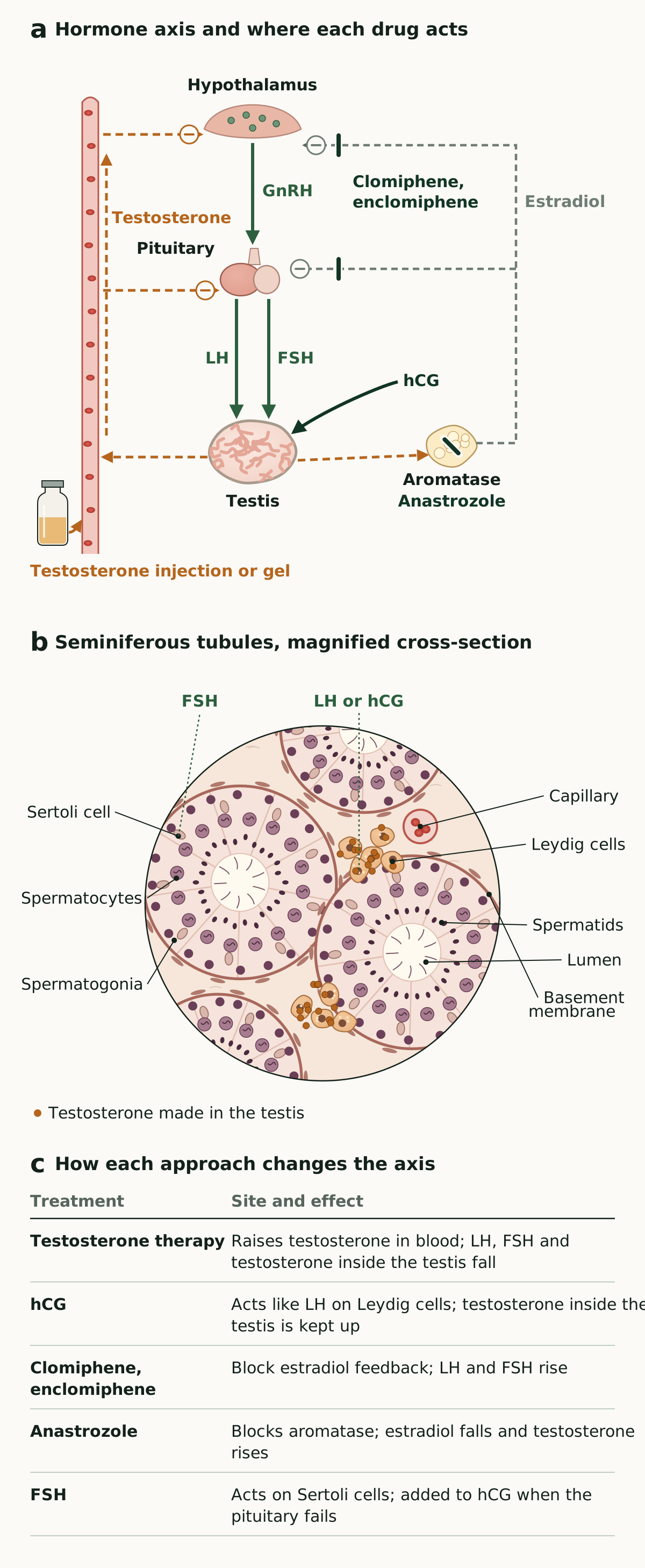
Sperm are made inside the seminiferous tubules of the testis. Luteinizing hormone (LH) from the pituitary stimulates the Leydig cells between the tubules to make testosterone, and follicle-stimulating hormone (FSH) acts on the Sertoli cells that line the tubules and support developing sperm.6 The testosterone that matters for sperm production is the testosterone inside the testis, which is far higher than the level in blood. In a study of 29 healthy men at the University of Washington, testosterone in fluid aspirated from the testis averaged 1,174 nmol/L at baseline, while the blood level was 14.1 nmol/L, about 1.2% of it.5
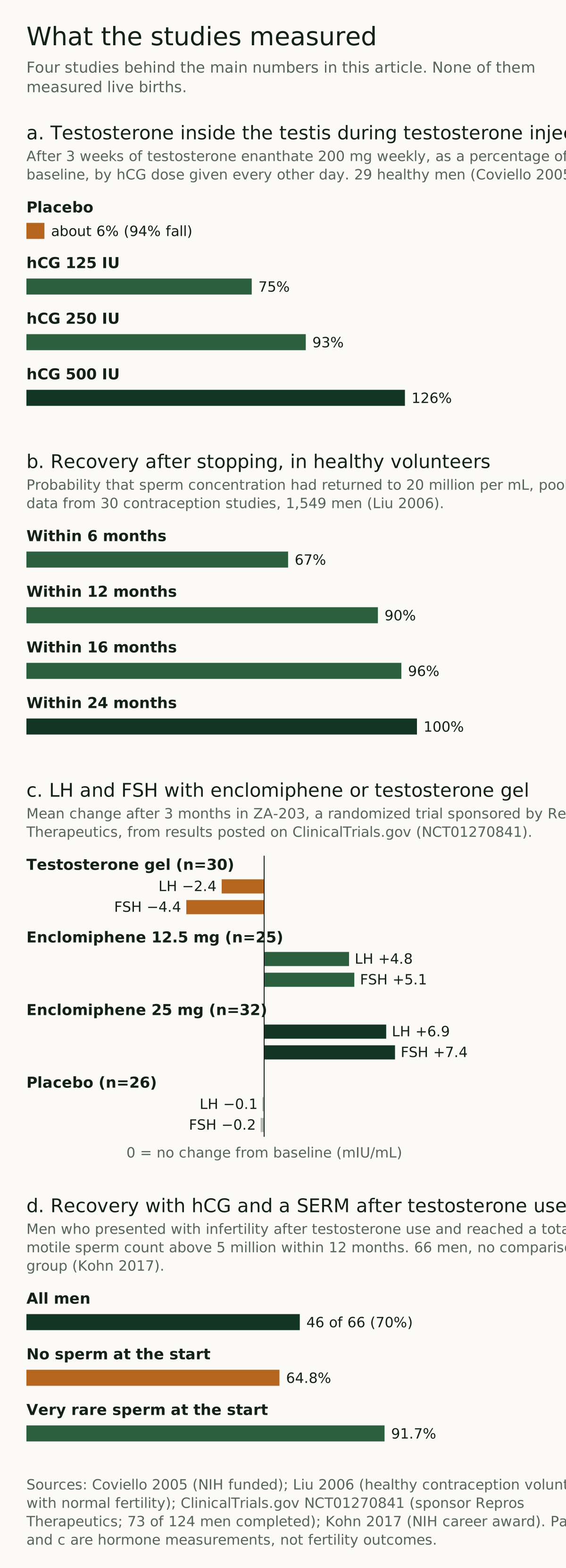
Testosterone from outside the body does not reach those concentrations inside the testis. It raises the blood level, and the hypothalamus and pituitary respond to the higher level by cutting GnRH, LH and FSH. In the same study, men given 200 mg of testosterone enanthate by injection each week with a placebo had LH and FSH suppressed to 5% and 3% of baseline, and testosterone inside the testis fell by 94%, from 1,234 to 72 nmol/L, within 3 weeks.5 The AUA/ASRM guideline on male infertility describes the result: depending on how far the hormones are suppressed, sperm production may decrease or stop altogether.3 The study was funded by the National Institutes of Health (NIH).5
What did the male contraception trials show?
The clearest evidence that testosterone stops sperm production comes from trials designed to do exactly that. In a WHO trial at ten centers in seven countries, 271 healthy, fertile men received 200 mg of testosterone enanthate by injection each week. 157 became azoospermic, meaning no sperm in three consecutive semen samples, and the cumulative rate at 6 months was 65%. The mean time to azoospermia was 120 days. During the 12-month efficacy phase there was one pregnancy in 1,486 months of use, 0.8 per 100 person-years.7 A second WHO trial enrolled 399 men at 15 centers in nine countries and allowed couples to rely on the injections when sperm fell to 3 million per mL or less. There were no pregnancies in 230.4 person-years among azoospermic men but four in 49.5 person-years among men whose counts were low but not zero, a rate of 8.1 per 100 person-years.8 Both trials were run by the WHO Task Force on Methods for the Regulation of Male Fertility.78
These trials show two things that matter outside contraception research. Testosterone injections can take sperm counts to zero within a few months, and it does not do so reliably in every man, so it cannot be counted on as a contraceptive. A Cochrane review of 33 randomized trials of hormonal male contraception found that the proportion of men who became azoospermic varied widely between regimens and concluded that no hormonal male contraceptive was ready for clinical use.9 The Endocrine Society notes that not all men with low testosterone are infertile, and that a semen analysis before treatment can show whether contraception is needed.1
How long does sperm production take to recover after stopping?
In the 1990 WHO trial, the estimated median time from azoospermia to a sperm concentration of at least 20 million per mL after the last injection was 3.7 months, and to each man’s own baseline it was 6.7 months.7 The largest analysis pooled individual data from 30 contraception studies published between 1990 and 2005, covering 1,549 healthy men aged 18 to 51, about 90% of all published data from men given androgen or androgen-progestin regimens. The median time for sperm to recover to 20 million per mL was 3.4 months. The probability of reaching that level was 67% within 6 months, 90% within 12 months, 96% within 16 months and 100% within 24 months. Recovery was faster in older men, men of Asian origin, men treated for shorter periods or with shorter-acting preparations, men with higher sperm counts and lower LH at baseline, and men whose counts had fallen faster.10 PubMed lists NIH support for the analysis.10
Men treated for low testosterone are not the same population. The contraception volunteers had normal testosterone, normal fertility and normal semen before treatment. The AUA guideline says there are no high-quality reports of recovery in men with testosterone deficiency or infertility who used testosterone, notes that 10% of contraception volunteers did not recover until the second year, and cites evidence that some infertile men may never recover.2 In a Baylor College of Medicine series of 66 men who sought care for infertility after testosterone use and were treated with hCG and a selective estrogen receptor modulator (SERM) after stopping, 46 (70%) reached a total motile sperm count above 5 million within 12 months. Older age and longer use of testosterone predicted slower recovery, and 64.8% of men who had no sperm at the start reached that count, compared with 91.7% of men with very rare sperm.11 The study had no untreated comparison group and was supported by an NIH career development award.11 Recovery can be incomplete after anabolic steroid use. Among 18 previously azoospermic men with follow-up in a Miami series, 5 still had no sperm after 6 months of clomiphene and hCG.12
What do the guidelines say about testosterone and fertility?
The three main US guidelines agree on the central point. The Endocrine Society’s 2018 guideline recommends against testosterone therapy in men planning fertility in the near term, a strong recommendation based on low-quality evidence, and lists desire for fertility in the near term in its table of conditions in which testosterone carries a high risk of adverse outcomes and should not be used. It adds that testosterone is not appropriate in men with hypogonadotropic hypogonadism, in which the pituitary or hypothalamus fails, who want children in the next 6 to 12 months, and that men unsure about future children may want to bank sperm if they are not azoospermic.1 If fertility is a concern, it advises at least two semen analyses several weeks apart.1 Six of the ten task force members, including the chair, declared relationships with drug companies, among them makers of testosterone products.1
The AUA’s 2018 testosterone guideline makes four related statements. Men with testosterone deficiency who are interested in fertility should have a reproductive evaluation before treatment, including a testicular examination and an FSH level (moderate recommendation, evidence grade B). The long-term effect of testosterone on sperm production should be discussed with men interested in future fertility (strong recommendation, grade A). Testosterone should not be prescribed to men who are currently trying to conceive (strong recommendation, grade A). And clinicians may use aromatase inhibitors, hCG, SERMs or a combination in men with testosterone deficiency who want to maintain fertility (conditional recommendation, grade C).2 The guideline’s chair disclosed consulting for Pfizer and Lilly.2
The joint AUA/ASRM guideline on male infertility, published in 2020 and amended in 2024, goes further on one point. It says that testosterone on its own should not be prescribed to any man interested in current or future fertility, a clinical principle. It also allows aromatase inhibitors, hCG, SERMs or combinations for infertile men with low testosterone (conditional recommendation, grade C).34 The panel was funded by the AUA and its members were unpaid. Two members disclosed trial work for Ferring Pharmaceuticals, which makes gonadotropin products, and others disclosed consulting for companies including Roman Health, Theralogix and EMD Serono.3
How does hCG protect or restore sperm production?
hCG acts like LH, which the AUA describes as virtually identical activity, so it stimulates the Leydig cells to make testosterone inside the testis even when the pituitary has been switched off.2 Of the alternatives the AUA reviewed, which were SERMs, aromatase inhibitors and hCG, hCG is the only one approved by the FDA for use in men, for hypogonadotropic hypogonadism and for undescended testes in boys.2 FSH preparations are also FDA approved to start sperm production in men with hypogonadotropic hypogonadism.31
Its best-established use is in men whose pituitary or hypothalamus does not make LH and FSH. In a 1985 study of 21 such men, hCG alone brought sperm counts into the normal range in all 6 whose hypogonadism began after puberty, but in only 1 of 15 whose hypogonadism began before puberty. When menopausal gonadotropin, which supplies FSH, was added, counts reached normal in 5 of 7 men who had not had undescended testes and in 1 of 7 who had.13 In 75 men treated at two Australian centers between 1981 and 2008, 38 became fathers, 5 of them through assisted reproduction. The median time to the first sperm was 7.1 months and to conception 28.2 months, and larger testes predicted a faster response.14 A meta-analysis of 44 studies of gonadotropin therapy in azoospermic men with hypogonadotropic hypogonadism found sperm in the semen in 75% overall, 68% in studies limited to men whose condition began before puberty, with better results when hCG and FSH were combined. Earlier testosterone treatment did not affect the result.15 Almost all of these studies were uncontrolled.151 The AUA/ASRM guideline describes the usual approach as hCG first, with FSH added once testosterone has normalized.3
The evidence for giving hCG alongside testosterone is much thinner. The Coviello study showed that low doses of hCG kept testosterone inside the testis near baseline during 3 weeks of testosterone injections, but it did not measure sperm.5 One retrospective series of 26 men, mean age 35.9, treated with testosterone and 500 IU of hCG every other day reported that no man became azoospermic and that 9 contributed to a pregnancy during a mean follow-up of 6.2 months.16 The AUA guideline notes that this is the only study of its kind.2 A series of 49 men from two clinics who were azoospermic or severely oligospermic while taking testosterone, and who were then treated with high-dose hCG and other drugs, reported return or improvement of sperm counts in 47 (95.9%), after an average of 4.6 months. There was no comparison group of untreated men.17 The AUA lists headache, irritability, depression, fatigue, edema, breast enlargement and injection-site pain among the adverse effects of hCG.2
What is the evidence for clomiphene?
Clomiphene is a SERM. It blocks estradiol’s feedback at the hypothalamus and pituitary, so LH and FSH rise and the testes make more testosterone and, potentially, more sperm.2 It is FDA approved for ovulatory dysfunction in women, and the AUA and AUA/ASRM guidelines both note that it is not FDA approved for use in men.2823 The Endocrine Society says clomiphene has been used empirically in men with hypogonadotropic hypogonadism but that neither its efficacy nor its safety has been demonstrated in randomized trials.1
The studies in men with low testosterone are small. In a retrospective review at Rush University of 65 men on clomiphene and 39 on testosterone gel, average testosterone on treatment was 573 ng/dL with clomiphene and 553 ng/dL with gel.18 In a double-blind trial at Albany Medical Center, 26 infertile men with testosterone below 350 ng/dL and normal LH were randomized to clomiphene or anastrozole for 12 weeks. Testosterone rose more with clomiphene than with anastrozole (571 versus 408 ng/dL as reported), estradiol rose with clomiphene and fell with anastrozole, and neither drug changed semen parameters.19 Neither study reported pregnancies.
For men with unexplained infertility and normal testosterone, the trials disagree. A WHO trial randomized 190 couples to 6 months of clomiphene or placebo for the man and found no difference in semen quality; cumulative pregnancy rates at 8 months were 11.7% with placebo and 8.1% with clomiphene.20 A 2013 meta-analysis of 11 randomized trials of clomiphene or tamoxifen reported a higher pregnancy rate with treatment (odds ratio 2.42, 95% CI 1.47 to 3.94).21 The AUA/ASRM guideline concludes that the benefits of SERMs in idiopathic infertility are small and should be weighed against the higher pregnancy rates of assisted reproduction such as IVF.3 The AUA lists visual symptoms, flushing, headache and abdominal discomfort as adverse effects of clomiphene.2
What is enclomiphene, and why was it not approved?
Clomiphene is a mixture of two isomers, enclomiphene and zuclomiphene, and enclomiphene was developed on its own by Repros Therapeutics for secondary hypogonadism in men.2226 All of the trials below were sponsored by Repros, and several authors were company employees.23242522
In the phase II trial ZA-203, men with secondary hypogonadism were randomized to placebo, testosterone gel or one of two doses of enclomiphene for 3 months. In the results posted on ClinicalTrials.gov, mean testosterone rose by 254 ng/dL with gel and by 259 and 197 ng/dL with the two enclomiphene doses, and fell by 17 ng/dL with placebo. LH fell by 2.4 mIU/mL with gel and rose by 4.8 and 6.9 mIU/mL with the two enclomiphene doses, and FSH fell by 4.4 with gel and rose by 5.1 and 7.4. Only 73 of the 124 men who started completed the trial, and the sperm results posted for the 57 men with data were highly variable.2423 Two parallel phase III trials, ZA-304 and ZA-305, compared enclomiphene with testosterone gel for 16 weeks in overweight men aged 18 to 60 with testosterone at or below 300 ng/dL and low or normal LH. Testosterone rose with both. LH and FSH rose with enclomiphene and fell with gel, and the authors reported that sperm concentration stayed in the normal range with enclomiphene but fell markedly with gel.25 The AUA guideline cites these as the two randomized trials showing that SERMs maintained sperm concentration while testosterone reduced it.2 None of the trials measured pregnancies.
The FDA did not approve enclomiphene. According to the company’s announcement, filed with the Securities and Exchange Commission, the FDA issued a complete response letter in December 2015 stating that the design of the phase III studies was no longer adequate to show clinical benefit and noting concerns about entry criteria, dose titration and validation of the laboratory method.26 In January 2018 the European Medicines Agency’s committee recommended refusing authorization in the European Union. It said the four main studies, involving 588 patients, had measured sperm production and testosterone but not whether symptoms improved, noted a risk of venous thromboembolism, and concluded that the benefits did not outweigh the risks.27
Do aromatase inhibitors or FSH have a role?
Aromatase inhibitors such as anastrozole block the conversion of testosterone to estradiol, which lowers estradiol and reduces its feedback on the pituitary.2 Both AUA guidelines allow them for men with low testosterone who want to preserve fertility, and the AUA notes that anastrozole is not FDA approved for use in men.23 The AUA advises that they generally should not be used for long periods because suppressing estradiol can reduce bone density.2 In a one-year NIH-funded trial in 69 men aged 60 and over with low or borderline testosterone, anastrozole raised mean testosterone from 319 to 524 ng/dL at 3 months and lowered estradiol, and spine bone density fell compared with placebo.29 In the 26-man Albany trial, anastrozole did not change semen parameters.19 The AUA notes that a study of azoospermic men with a low testosterone-to-estradiol ratio found no difference in sperm retrieval, pregnancy or live birth rates with aromatase inhibitor therapy.2
FSH is used in two settings. In hypogonadotropic hypogonadism it is added to hCG to complete sperm production, as described above.315 In men with unexplained infertility, the AUA/ASRM guideline says a clinician may consider an FSH preparation to improve sperm concentration and pregnancy and live birth rates (conditional recommendation, grade B), notes that FSH is not FDA approved for this use and calls the benefits measurable but limited.3 A Cochrane review of six randomized trials with 456 participants found higher spontaneous pregnancy rates with gonadotropin treatment, 16% versus 7% in five trials (moderate-quality evidence), and a higher live birth rate in a single trial of 30 participants (very low-quality evidence). The authors judged the evidence insufficient for firm conclusions.30 These data do not concern men whose sperm production was suppressed by testosterone.
Who should not use these treatments, and how are they monitored?
Testosterone, hCG, clomiphene, enclomiphene, anastrozole and FSH are all prescription medicines, and whether to start, change or stop any of them is a decision for a man and his clinician. For a man who wants children, the AUA/ASRM guideline encourages referral to an endocrinologist or male reproductive specialist when the pituitary is the cause, and the AUA says men with very low counts are best managed by a reproductive urologist.32 The AUA also cautions that the benefits shown for testosterone therapy cannot be assumed for the alternative drugs.2
The Endocrine Society recommends against testosterone in men planning fertility in the near term and in men with breast or prostate cancer, a palpable prostate nodule or induration, a PSA above 4 ng/mL (or above 3 ng/mL with high prostate cancer risk) without further urological evaluation, an elevated hematocrit, untreated severe obstructive sleep apnea, severe lower urinary tract symptoms, uncontrolled heart failure, a heart attack or stroke within the past 6 months, or thrombophilia.1 The AUA adds that testosterone should not be started for three to six months after a cardiovascular event.2 Monitoring of men on testosterone is described in the second article in this series.
Before treatment, the AUA recommends a testicular examination and an FSH level for men with low testosterone who are interested in fertility, with semen testing when FSH is high and genetic testing for men with very low counts or no sperm.2 The Endocrine Society advises at least two semen analyses when fertility is a concern.1 For men on a SERM, the AUA describes using LH to guide treatment: a low testosterone with a high LH suggests the testes themselves are not responding. For aromatase inhibitors it advises regular follow-up of estradiol and attention to bone density.2
How good is the evidence, and who paid for it?
The harm is well established. Randomized trials and large prospective contraception studies in healthy volunteers show that testosterone suppresses sperm production, and individual-level data from 1,549 men describe the recovery that follows.78910 What is weaker is the evidence that those findings apply unchanged to men treated for low testosterone, who are older, often have other conditions and may have impaired sperm production to begin with.2
The evidence for the alternatives is weaker still. The hCG data in hypogonadotropic hypogonadism are consistent but come from uncontrolled series.1514 The studies of hCG alongside testosterone, or after it, are a 3-week experiment without sperm outcomes and retrospective clinic series without comparison groups.5161711 The randomized trials of enclomiphene were sponsored by its manufacturer, measured hormones and sperm counts for 3 to 4 months, and did not persuade regulators in the United States or Europe.23252627 The only randomized trial of clomiphene or anastrozole with semen outcomes in men with low testosterone enrolled 26 men.19 No study reported here compared live birth rates between men who stayed on testosterone with hCG and men who switched to another drug.
Funding was mixed. Coviello 2005, Burnett-Bowie 2009 and Kohn 2017 were supported by NIH grants, and PubMed lists NIH support for Liu 2006.5291110 The enclomiphene program was paid for by Repros Therapeutics.2425 We could not find funding statements for the Hsieh, Wenker, Helo, Taylor, Chua, Rastrelli and 2009 Liu studies, or for the 1992 WHO clomiphene trial, in the records we could access. Industry ties appear at the guideline level too, as described above.123
What remains uncertain?
The AUA found no high-quality reports of how sperm production recovers in men who used testosterone for low testosterone, rather than as contraception volunteers.2 We found no randomized trial comparing hCG added to testosterone with a switch to another drug, so it is not known which better preserves fertility.216 The best dose of hCG for preserving sperm production during testosterone use has been tested only against testosterone levels inside the testis, not against pregnancy.5 Enclomiphene’s effects on symptoms, pregnancy and long-term safety were not established in its trials, according to the European regulator.27 The AUA/ASRM guideline was amended in 2024, and this article quotes the statements published in 2021.34
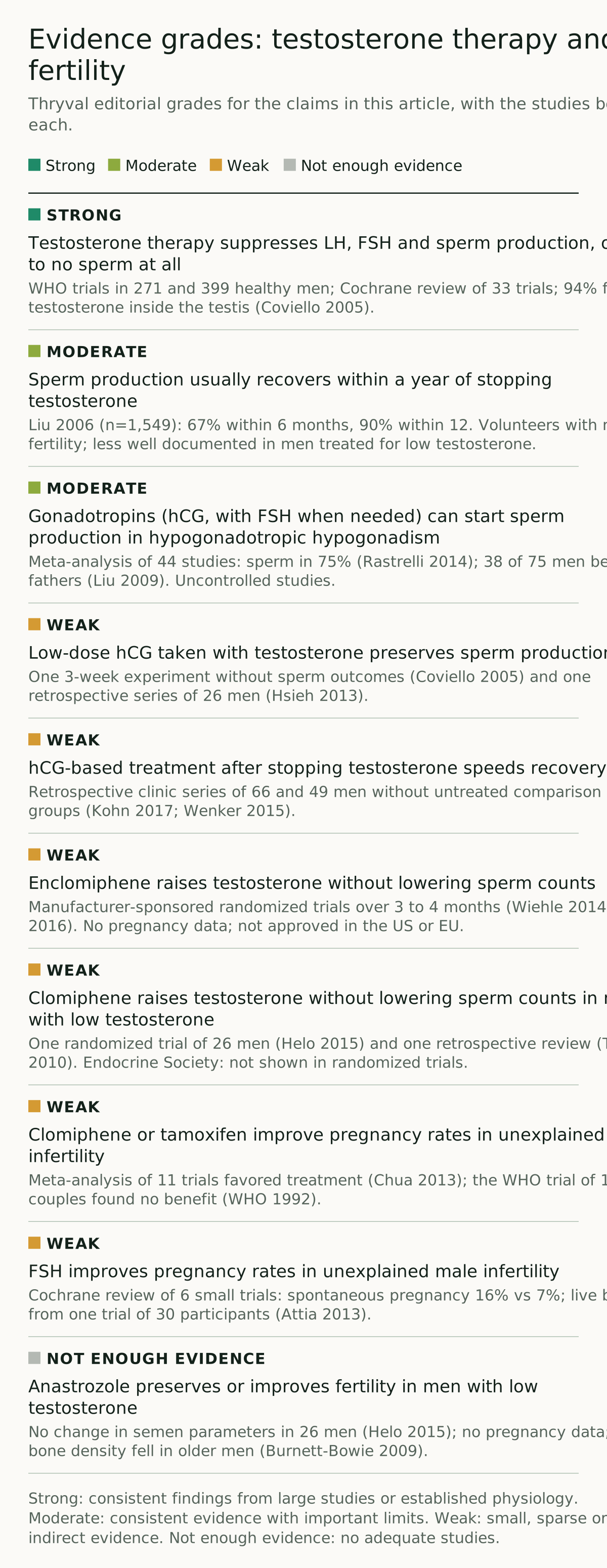
Evidence grades
The grades below are Thryval editorial judgments based on the studies cited in this article. The grading rules are set out on our Research page.
Frequently asked questions
Does testosterone therapy lower sperm count?
Yes, often to zero. In WHO contraception trials, weekly testosterone injections made 157 of 271 healthy men azoospermic, with a cumulative rate of 65% at 6 months.7 Testosterone suppresses LH and FSH and lowers testosterone inside the testis, which sperm production depends on.5
Can you get someone pregnant while on testosterone therapy?
Sometimes. Suppression is not complete in every man, and in a WHO trial there were four pregnancies in 49.5 person-years among men whose counts were low but not zero.8 Testosterone is not a reliable contraceptive, and the Endocrine Society notes that a semen analysis can show whether contraception is needed.1
How long does it take for sperm to come back after stopping testosterone?
In pooled data from 1,549 healthy volunteers, the median time to recover to 20 million per mL was 3.4 months, with 67% recovered within 6 months and 90% within 12 months.10 Men treated for low testosterone, especially older men and long-term users, may recover more slowly, and some may not recover.112
Is clomiphene or enclomiphene a replacement for testosterone therapy?
They work differently. They raise the body’s own LH, FSH and testosterone instead of supplying testosterone, and small trials found that sperm counts were maintained.2519 Neither is FDA approved for men, and the AUA notes that the benefits shown for testosterone therapy cannot be assumed for them.226 Which, if any, suits a particular man is a decision for his clinician.
Can hCG be taken with testosterone to protect fertility?
The AUA allows hCG for men with low testosterone who want to maintain fertility. The evidence for combining it with testosterone is one short experiment measuring testosterone inside the testis and one retrospective series of 26 men.2516 The choice of treatment belongs with a urologist or reproductive endocrinologist.
Should men bank sperm before starting testosterone?
The Endocrine Society suggests that men who are unsure about future children may want to bank sperm if they are not azoospermic, and recommends against testosterone in men planning fertility in the near term.1 The AUA recommends a reproductive evaluation before treatment for men interested in fertility.2
Implications for patients and clinicians
Testosterone therapy and the wish to father children in the near future are, under all three US guidelines, a poor combination.123 For men already on testosterone, the contraception trials suggest that sperm production usually returns within a year of stopping, though men treated for low testosterone are less well studied than the volunteers who supplied those data.102 hCG has a well-established role in men whose pituitary fails, and hCG, clomiphene, enclomiphene and aromatase inhibitors are used in other men to raise testosterone while sparing sperm production, on evidence the guidelines themselves rate as low.1523 A semen analysis before treatment, a conversation about plans for children, and referral to a clinician experienced in male reproduction are the steps the guidelines describe.12
This article is for education and is not medical advice.
References
-
Bhasin S, Brito JP, Cunningham GR, et al. Testosterone therapy in men with hypogonadism: an Endocrine Society clinical practice guideline. J Clin Endocrinol Metab. 2018;103(5):1715–1744. Clinical practice guideline using GRADE methods; recommendation 2.2, Table 7 and the fertility section; task force conflicts listed in the appendix. PubMed 29562364 ↩↩↩↩↩↩↩↩↩↩↩↩↩↩↩
-
Mulhall JP, Trost LW, Brannigan RE, et al. Evaluation and management of testosterone deficiency: AUA guideline. J Urol. 2018;200(2):423–432. Clinical guideline based on a systematic review; guideline statements 10, 16, 23 and 27 and Table 6; panel disclosures in the full text. PubMed 29601923 · AUA guideline PDF ↩↩↩↩↩↩↩↩↩↩↩↩↩↩↩↩↩↩↩↩↩↩↩↩↩↩↩↩↩↩↩↩↩↩↩
-
Schlegel PN, Sigman M, Collura B, et al. Diagnosis and treatment of infertility in men: AUA/ASRM guideline part II. Fertil Steril. 2021;115(1):62–69 (also published in J Urol. 2021;205(1):44–51). Clinical guideline based on a systematic review; statements 38 to 45; panel funded by the AUA; disclosures in the full text. PubMed 33309061 · PubMed 33295258 ↩↩↩↩↩↩↩↩↩↩↩↩↩↩↩↩↩↩
-
American Urological Association. Male infertility guideline (published 2020, amended 2024). AUA guideline page ↩↩
-
Coviello AD, Matsumoto AM, Bremner WJ, et al. Low-dose human chorionic gonadotropin maintains intratesticular testosterone in normal men with testosterone-induced gonadotropin suppression. J Clin Endocrinol Metab. 2005;90(5):2595–2602. Randomized trial, n=29, 3 weeks; funded by NIH (NICHD and NCRR) grants. PubMed 15713727 ↩↩↩↩↩↩↩↩↩↩↩↩
-
Oduwole OO, Huhtaniemi IT, Misrahi M. The roles of luteinizing hormone, follicle-stimulating hormone and testosterone in spermatogenesis and folliculogenesis revisited. Int J Mol Sci. 2021;22(23):12735. Narrative review; the authors declared no conflicts of interest. PMC8658012 · PubMed 34884539 ↩
-
World Health Organization Task Force on Methods for the Regulation of Male Fertility. Contraceptive efficacy of testosterone-induced azoospermia in normal men. Lancet. 1990;336(8721):955–959. Multicenter contraceptive efficacy study, n=271. PubMed 1977002 ↩↩↩↩↩↩↩
-
World Health Organization Task Force on Methods for the Regulation of Male Fertility. Contraceptive efficacy of testosterone-induced azoospermia and oligozoospermia in normal men. Fertil Steril. 1996;65(4):821–829. Prospective noncomparative multicenter study, n=399. PubMed 8654646 ↩↩↩↩↩
-
Grimes DA, Lopez LM, Gallo MF, Halpern V, Nanda K, Schulz KF. Steroid hormones for contraception in men. Cochrane Database Syst Rev. 2012;(3):CD004316. Systematic review of 33 randomized trials. PMC12050154 · PubMed 22419294 ↩↩↩
-
Liu PY, Swerdloff RS, Christenson PD, Handelsman DJ, Wang C; Hormonal Male Contraception Summit Group. Rate, extent, and modifiers of spermatogenic recovery after hormonal male contraception: an integrated analysis. Lancet. 2006;367(9520):1412–1420. Individual-participant analysis of 30 studies, n=1549; PubMed lists NIH (NCRR) support. PubMed 16650651 ↩↩↩↩↩↩↩↩
-
Kohn TP, Louis MR, Pickett SM, et al. Age and duration of testosterone therapy predict time to return of sperm count after human chorionic gonadotropin therapy. Fertil Steril. 2017;107(2):351–357.e1. Retrospective clinic series, n=66; supported by an NIH (NICHD) K12 award. PMC5292276 · PubMed 27855957 ↩↩↩↩↩↩↩
-
Ledesma BR, Weber A, Venigalla G, et al. Fertility outcomes in men with prior history of anabolic steroid use. Fertil Steril. 2023;120(6):1203–1209. Retrospective cohort, n=45; NIH grants; the authors declared no competing interests. PMC10841476 · PubMed 37769866 ↩
-
Finkel DM, Phillips JL, Snyder PJ. Stimulation of spermatogenesis by gonadotropins in men with hypogonadotropic hypogonadism. N Engl J Med. 1985;313(11):651–655. Uncontrolled treatment study, n=21. PubMed 3927163 ↩↩
-
Liu PY, Baker HW, Jayadev V, Zacharin M, Conway AJ, Handelsman DJ. Induction of spermatogenesis and fertility during gonadotropin treatment of gonadotropin-deficient infertile men: predictors of fertility outcome. J Clin Endocrinol Metab. 2009;94(3):801–808. Two-center clinical cohort, n=75. PubMed 19066302 ↩↩↩
-
Rastrelli G, Corona G, Mannucci E, Maggi M. Factors affecting spermatogenesis upon gonadotropin-replacement therapy: a meta-analytic study. Andrology. 2014;2(6):794–808. Meta-analysis of 44 gonadotropin and 16 GnRH studies. PubMed 25271205 ↩↩↩↩↩↩↩
-
Hsieh TC, Pastuszak AW, Hwang K, Lipshultz LI. Concomitant intramuscular human chorionic gonadotropin preserves spermatogenesis in men undergoing testosterone replacement therapy. J Urol. 2013;189(2):647–650. Retrospective series, n=26. PubMed 23260550 ↩↩↩↩↩
-
Wenker EP, Dupree JM, Langille GM, et al. The use of HCG-based combination therapy for recovery of spermatogenesis after testosterone use. J Sex Med. 2015;12(6):1334–1337. Retrospective two-clinic case series, n=49. PubMed 25904023 ↩↩↩↩
-
Taylor F, Levine L. Clomiphene citrate and testosterone gel replacement therapy for male hypogonadism: efficacy and treatment cost. J Sex Med. 2010;7(1 Pt 1):269–276. Retrospective review, n=104. PubMed 19694928 ↩↩
-
Helo S, Ellen J, Mechlin C, et al. A randomized prospective double-blind comparison trial of clomiphene citrate and anastrozole in raising testosterone in hypogonadal infertile men. J Sex Med. 2015;12(8):1761–1769. Randomized trial, n=26, 12 weeks. PubMed 26176805 ↩↩↩↩↩↩↩
-
World Health Organization. A double-blind trial of clomiphene citrate for the treatment of idiopathic male infertility. Int J Androl. 1992;15(4):299–307. Multicenter randomized placebo-controlled trial, 190 couples. PubMed 1516979 ↩↩
-
Chua ME, Escusa KG, Luna S, Tapia LC, Dofitas B, Morales M. Revisiting oestrogen antagonists (clomiphene or tamoxifen) as medical empiric therapy for idiopathic male infertility: a meta-analysis. Andrology. 2013;1(5):749–757. Meta-analysis of 11 randomized trials. PubMed 23970453 ↩↩
-
Kaminetsky J, Werner M, Fontenot G, Wiehle RD. Oral enclomiphene citrate stimulates the endogenous production of testosterone and sperm counts in men with low testosterone: comparison with testosterone gel. J Sex Med. 2013;10(6):1628–1635. Open-label randomized phase IIB study, n=12; the abstract’s copyright line names Repros Therapeutics. PubMed 23530575 ↩↩
-
Wiehle RD, Fontenot GK, Wike J, et al; ZA-203 Clinical Study Group. Enclomiphene citrate stimulates testosterone production while preventing oligospermia: a randomized phase II clinical trial comparing topical testosterone. Fertil Steril. 2014;102(3):720–727. Randomized phase II trial (ZA-203); five of six named authors were employees of Repros Therapeutics. PubMed 25044085 ↩↩↩↩
-
ClinicalTrials.gov. Normalization of morning testosterone levels in men with secondary hypogonadism (NCT01270841, ZA-203). Sponsor: Repros Therapeutics Inc. Posted results, accessed Nov 12, 2026. ClinicalTrials.gov NCT01270841 ↩↩↩
-
Kim ED, McCullough A, Kaminetsky J. Oral enclomiphene citrate raises testosterone and preserves sperm counts in obese hypogonadal men, unlike topical testosterone: restoration instead of replacement. BJU Int. 2016;117(4):677–685. Two parallel randomized phase III trials (ZA-304, NCT01993212; ZA-305, NCT01993225), both sponsored by Repros Therapeutics. PubMed 26496621 ↩↩↩↩↩↩↩
-
Repros Therapeutics Inc. Repros Therapeutics receives complete response letter from FDA for enclomiphene. Press release, Dec 1, 2015, filed with the US Securities and Exchange Commission as Exhibit 99.1. SEC filing ↩↩↩↩↩
-
European Medicines Agency. EnCyzix (enclomifene): refusal of the marketing authorisation. CHMP opinion Jan 25, 2018. EMA page ↩↩↩↩
-
Rodriguez KM, Pastuszak AW, Lipshultz LI. Enclomiphene citrate for the treatment of secondary male hypogonadism. Expert Opin Pharmacother. 2016;17(11):1561–1567. Narrative review; NIH (NICHD) K12 support; the authors declared no other relevant financial ties. PMC5009465 · PubMed 27337642 ↩
-
Burnett-Bowie SA, McKay EA, Lee H, Leder BZ. Effects of aromatase inhibition on bone mineral density and bone turnover in older men with low testosterone levels. J Clin Endocrinol Metab. 2009;94(12):4785–4792. Randomized placebo-controlled trial, n=69, 1 year; funded by NIH (NIA and NCRR) grants. PMC2795655 · PubMed 19820017 ↩↩↩
-
Attia AM, Abou-Setta AM, Al-Inany HG. Gonadotrophins for idiopathic male factor subfertility. Cochrane Database Syst Rev. 2013;(8):CD005071. Systematic review of 6 randomized trials, 456 participants; no conflicts of interest known. PMC11513186 · PubMed 23970458 ↩↩
-
EMD Serono. GONAL-f (follitropin alfa for injection), prescribing information; indication: induction of spermatogenesis in men with primary and secondary hypogonadotropic hypogonadism. DailyMed set ID ae85b9c3-e7eb-4981-a5d9-346050e8f189. DailyMed ↩