

Does time-restricted eating help weight loss? What the trials show
Limiting eating to an 8- or 10-hour window leads to modest weight loss compared with eating across the day, mostly because people eat less. When both groups are given the same calorie target, the eating window adds little. Effects on blood sugar and blood pressure are small, and there are no trials of heart attacks, strokes or survival.
The grade ModerateTime-restricted eating for weight loss in adults with overweight or obesity (modest loss; no more than daily calorie restriction in 12-month trials)
In brief. Time-restricted eating, which confines all food to a daily window of about 4 to 10 hours, produces modest weight loss compared with eating across the day. Two network meta-analyses of randomized trials put the average difference at 1.7 kg (95% CI 1.2 to 2.2) and 2.2 kg (95% CI 1.7 to 2.6).1617 It has not outperformed ordinary daily calorie restriction. In a 12-month trial in Guangzhou, adding an 8 am to 4 pm eating window to a calorie-restricted diet produced 1.8 kg more weight loss, a difference that was not statistically significant (95% CI −4.0 to 0.4), and a 2026 Cochrane review found little to no difference between intermittent fasting and regular dietary advice.1018 The best-known US trial of 16:8 eating found no difference from three structured meals a day over 12 weeks.7 Small changes in fasting glucose, insulin and systolic blood pressure track the weight lost, and some of that weight is lean mass.177 No trial has measured heart attacks, strokes or deaths, and an observational analysis that linked an eating window under 8 hours with higher cardiovascular mortality cannot show cause.19 People who take insulin or sulfonylureas, who are pregnant, who have had an eating disorder, or who are under 18 should not start without medical advice, and anyone on glucose-lowering or other prescription medicines should talk to their clinician first.211322
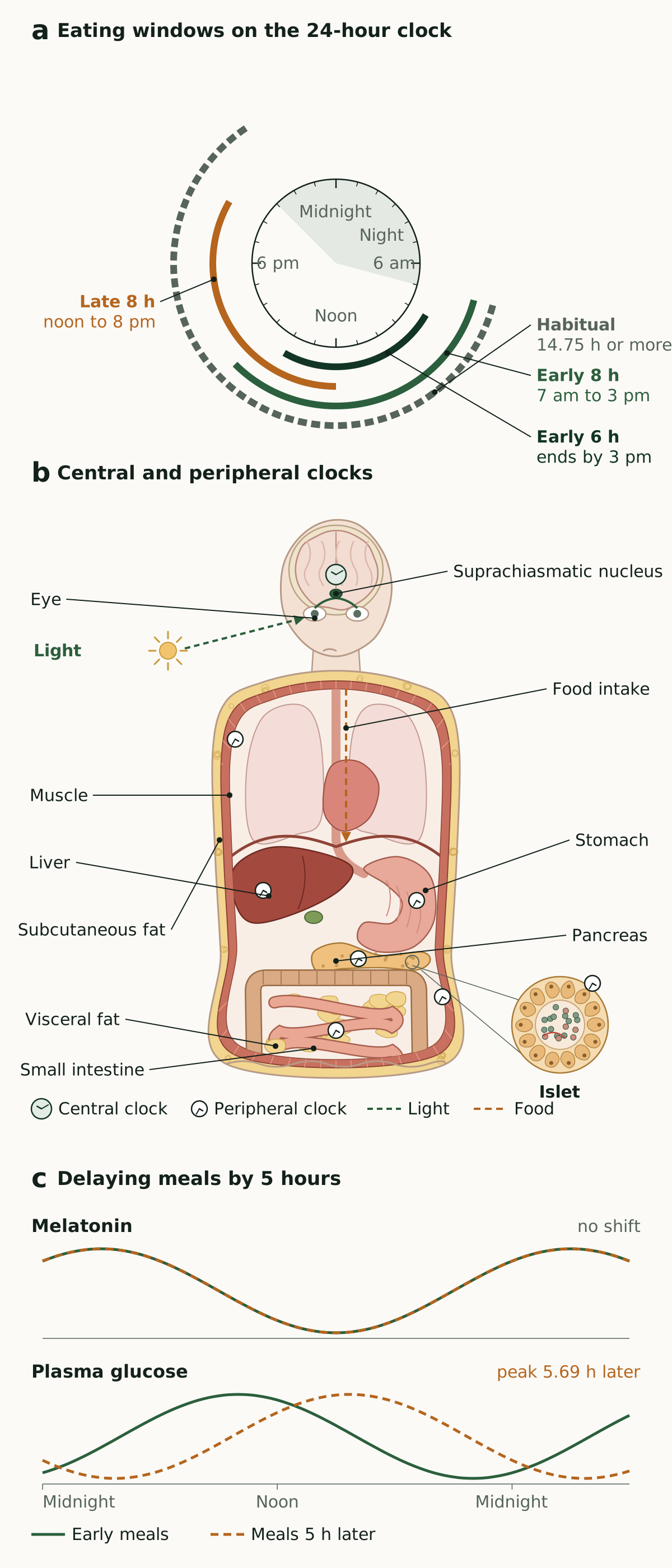
Time-restricted eating is the most popular form of intermittent fasting, and the 16:8 version (16 hours without calories, 8 hours of eating) is widely promoted for weight loss and blood sugar. The idea draws on circadian biology: the body’s clocks expect food during the day, and in a smartphone study of 156 adults at the Salk Institute, half ate over a span of more than 14.75 hours a day.23 This article describes the biology, then reviews the randomized trials of weight, blood sugar, blood pressure and body composition, the observational data on mortality, and the people for whom fasting carries specific risks.
What is time-restricted eating, and how does it differ from other intermittent fasting?
An international Delphi panel of 38 fasting researchers and clinicians published consensus definitions in 2024. It defined time-restricted eating as restricting food and caloric drinks to a set period each day, with a daily fasting window of at least 14 hours, and intermittent fasting as repeated fasting periods lasting up to 48 hours.1 Several panel members disclosed commercial interests in fasting programs, apps or books.1 Alternate-day fasting alternates fast days, usually with about a quarter of energy needs, with days of normal or extra eating. The 5:2 approach and other whole-day fasting schedules restrict intake on one or two days a week.1615 Most trials of time-restricted eating tell participants when to eat and not how much. Some combine the eating window with a calorie target, which makes them a test of meal timing on top of calorie restriction.1011
Why would the timing of meals matter?
The suprachiasmatic nucleus in the hypothalamus is the body’s central clock and is set mainly by light reaching the retina. The liver, pancreas, gut, fat tissue and muscle carry their own clocks, which respond to the timing of food as well as to signals from the brain.3 A study at the University of Surrey tested this directly. Ten healthy young men lived in a laboratory for 13 days, and their three daily meals were moved 5 hours later for 6 days. Their melatonin and cortisol rhythms, markers of the central clock, did not shift. Their plasma glucose rhythm shifted by 5.69 hours, and the rhythm of the clock gene PER2 in fat tissue shifted by 0.97 hours. The study was funded by the UK Biotechnology and Biological Sciences Research Council.4
In human studies, insulin sensitivity, the insulin response of the pancreas and the energy used to digest a meal are all higher in the morning than in the afternoon or evening, which is the main reason researchers expected early eating windows to work better than late ones.5 In people, the most consistent effect of a short eating window is that it reduces how much they eat.89
Does time-restricted eating help people lose weight?
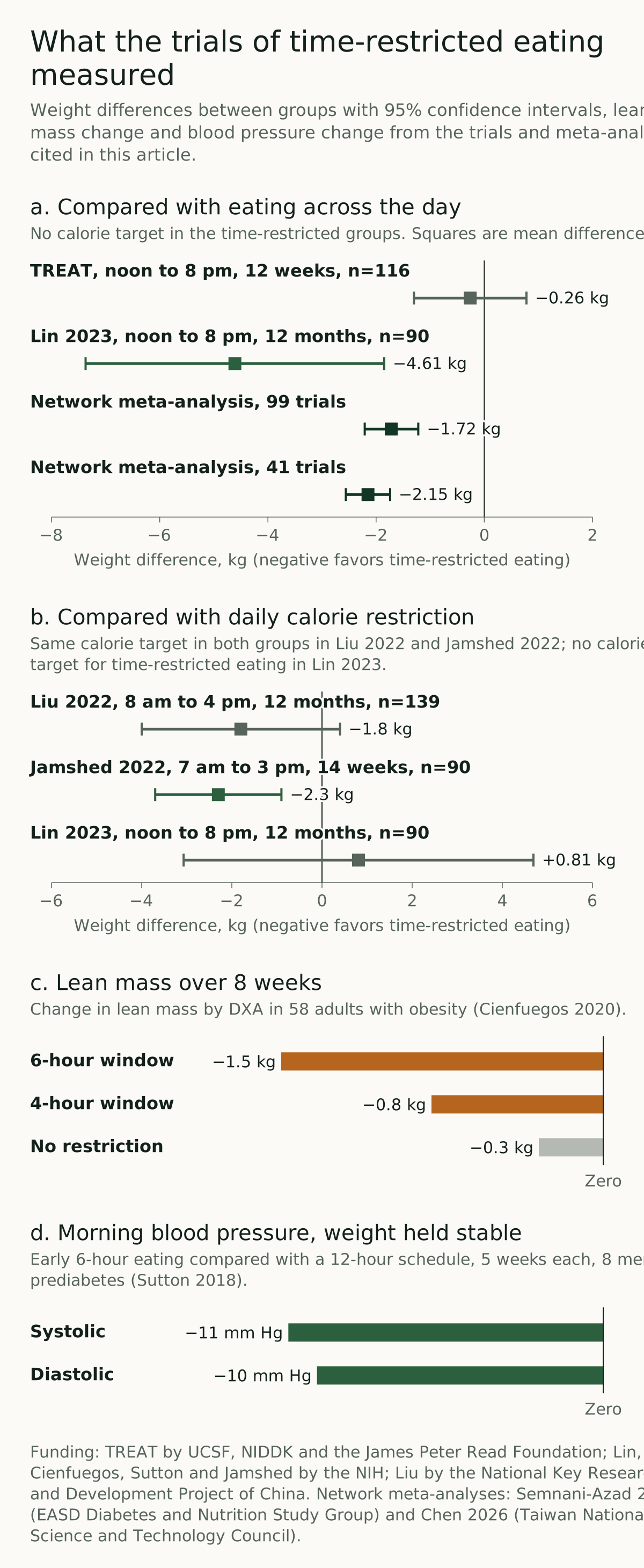
Compared with eating over a longer day, it produces modest weight loss. A 2025 network meta-analysis in The BMJ included 99 randomized trials with 6,582 adults and compared time-restricted eating, alternate-day fasting, whole-day fasting and continuous calorie restriction with unrestricted eating. Time-restricted eating reduced weight by 1.72 kg (95% CI 1.22 to 2.21) compared with unrestricted eating, an effect the authors classed as trivial, with moderate certainty of evidence.16 A 2026 network meta-analysis in BMJ Medicine of 41 trials with 2,287 participants found a reduction of 2.15 kg (95% CI 1.74 to 2.56) compared with usual diets and 0.84 kg (95% CI 0.13 to 1.56) compared with dietary advice.17
The individual trials show how much the result depends on the comparison. At the University of California, San Francisco, the TREAT trial randomized 116 adults with overweight or obesity to eat only between noon and 8 pm or to eat three structured meals a day for 12 weeks. The time-restricted group lost 0.94 kg and the comparison group 0.68 kg; the difference of 0.26 kg was not statistically significant (95% CI −1.30 to 0.78), and estimated energy intake did not differ between groups.7 At the University of Illinois Chicago, an 8-week trial randomized 58 adults with obesity to eating between 3 and 7 pm, between 1 and 7 pm, or with no restriction. Both restricted groups lost about 3.2% of their body weight compared with almost no change in controls, and both ate about 550 kcal a day less without counting calories.8
The longest trial of time-restricted eating on its own, also in Chicago, randomized 90 adults with obesity, 33% of them Black and 46% Hispanic, to eating between noon and 8 pm without calorie counting, to 25% daily calorie restriction, or to a control group that ate over 10 or more hours. After 12 months, the time-restricted group had lost 4.61 kg more than controls (95% CI 1.85 to 7.37) and the calorie-restriction group 5.42 kg more (95% CI 1.71 to 9.13). The two diets did not differ from each other (0.81 kg, 95% CI −3.07 to 4.69). Energy intake fell by a similar amount in both, 425 and 405 kcal a day. The trial was not blinded and was not powered to detect differences between the two diets.9
Is time-restricted eating better than counting calories?
The trials that tested this directly did not find it better. In Guangzhou, 139 adults with obesity were all given a calorie-restricted diet (1,500 to 1,800 kcal a day for men and 1,200 to 1,500 kcal for women) and randomized to eat it between 8 am and 4 pm or at any time. After 12 months, 118 completed follow-up. Mean weight loss was 8.0 kg with the eating window and 6.3 kg without, a net difference of 1.8 kg that was not statistically significant (95% CI −4.0 to 0.4; P=0.11). Waist size, body fat, lean mass, blood pressure and metabolic risk factors were consistent with that result, and adverse events did not differ. The trial was funded by China’s National Key Research and Development Project and other sources.10
One trial found an advantage for an early window. At the University of Alabama at Birmingham, 90 adults with obesity, 80% of them women, received the same weight-loss counseling and calorie targets and were randomized to eat between 7 am and 3 pm or over 12 or more hours. After 14 weeks the early-window group had lost 2.3 kg more (95% CI 0.9 to 3.7), which the authors estimated was equivalent to cutting a further 214 kcal a day. Body fat did not differ significantly between groups (−1.4 kg, 95% CI −2.9 to 0.2), and diastolic blood pressure was 4 mm Hg lower (95% CI 0 to 8). The study was funded by the National Institutes of Health (NIH); the institution of one author holds intellectual property in the app used to measure food intake.11
The pooled evidence agrees with the two longer trials. In the BMJ network meta-analysis, none of the intermittent fasting strategies except alternate-day fasting differed from continuous calorie restriction, and in trials of 24 weeks or more there were no differences between any fasting strategy and calorie restriction.16 The 2026 Cochrane review, which required at least 6 months of follow-up, included 22 trials with 1,995 participants. Compared with regular dietary advice, intermittent fasting made little to no difference to the percentage of weight lost (mean difference −0.33 percentage points, 95% CI −0.92 to 0.26; low certainty) or to the chance of losing 5% of body weight. Compared with no intervention or a waiting list, weight fell by 3.42 percentage points more (95% CI 1.90 to 4.95; moderate certainty), a difference the authors still described as little to no difference.18
Does time-restricted eating improve blood sugar and insulin sensitivity?
The pooled effects are small. In the BMJ Medicine analysis, time-restricted eating lowered fasting glucose by 3.69 mg/dL (95% CI 1.18 to 6.19) and fasting insulin by 0.56 μIU/mL compared with usual diets, with no significant effect on HbA1c or on HOMA-IR, a measure of insulin resistance.17 The BMJ analysis found no differences in HbA1c between any fasting strategy, calorie restriction and unrestricted eating.16
Whether meal timing improves insulin sensitivity without weight loss has been tested in two small crossover trials with opposite results. At the Pennington Biomedical Research Center, 8 men with prediabetes (12 were enrolled) ate all their food within 6 hours, with dinner before 3 pm, and then on a 12-hour schedule, for 5 weeks each. Food was supplied and matched to keep weight stable. The early schedule lowered mean insulin during a glucose tolerance test by 26 mU/L and improved insulin sensitivity, while glucose levels did not change. Morning blood pressure fell by 11 mm Hg systolic and 10 mm Hg diastolic, although blood pressure was measured only in the morning. Fasting triglycerides rose by 57 mg/dL, which the authors thought was likely explained by the longer fast before testing. The trial was NIH-funded and the authors declared no competing interests.5 At the German Institute of Human Nutrition, 31 women with overweight or obesity ate their usual food either between 8 am and 4 pm or between 1 and 9 pm for 2 weeks each. Insulin sensitivity did not change with either schedule (between-schedule difference −0.07, 95% CI −0.77 to 0.62), and 24-hour glucose, lipid and inflammatory markers showed no clinically meaningful differences. The late schedule shifted sleep timing later by 15 minutes. Participants lost a little weight on both schedules, 1.08 kg early and 0.44 kg late, so calories were not perfectly held steady.6
Early windows may do slightly better than late ones. In the BMJ Medicine network, early eating, with the last meal before 5 pm, reduced weight by 1.15 kg (95% CI 0.45 to 1.86) and fasting insulin by 3.32 μIU/mL more than late eating, with high certainty for that comparison.17 In a 5-week trial from the Chinese Academy of Medical Sciences in Beijing, 90 adults without obesity were randomized to eat within an 8-hour period between 6 am and 3 pm, between 11 am and 8 pm, or without restriction. The early window improved insulin sensitivity more than the midday window, with HOMA-IR falling by 1.08 compared with a rise of 0.39.12
For type 2 diabetes there is one longer trial. In Chicago, 75 adults with obesity and type 2 diabetes, with a mean HbA1c of 8.1%, were randomized to eating between noon and 8 pm, to 25% calorie restriction, or to a control group for 6 months. Compared with controls, weight fell by 3.56% with time-restricted eating, which was statistically significant, and by 1.78% with calorie restriction, which was not (P=.06). HbA1c fell by similar amounts in both groups, 0.91 and 0.94 percentage points relative to controls. No serious adverse events were reported. Participants’ diabetes medicines were adjusted by the study team at the start under a written protocol, and glucose was monitored with continuous glucose monitors. The trial was funded by the National Institute of Diabetes and Digestive and Kidney Diseases (NIDDK).13
Does it lower blood pressure or improve cholesterol?
Compared with usual diets, time-restricted eating lowered systolic blood pressure by 4.94 mm Hg (95% CI 2.95 to 6.92) in the BMJ Medicine analysis, with no effect on diastolic pressure, and lowered triglycerides by 10.12 mg/dL.17 In the BMJ network, time-restricted eating produced a small increase in total cholesterol compared with whole-day fasting, and alternate-day fasting lowered total cholesterol, non-HDL cholesterol and triglycerides more than time-restricted eating.16 The 12-month trials in Guangzhou and Chicago found no differences in blood pressure or lipids between time-restricted eating and calorie restriction.109 In a single-group study at the University of California, San Diego, 19 people with metabolic syndrome, most of them taking a statin or blood pressure medicine, ate within 10 hours for 12 weeks; weight fell by 3.3 kg, systolic and diastolic pressure by 5.1 and 6.5 mm Hg and LDL cholesterol by 11.9 mg/dL. There was no control group.14
Does time-restricted eating cause muscle loss?
Part of the weight lost is lean mass, as with other forms of dieting. In the BMJ Medicine analysis, lean mass fell by 0.84 kg (95% CI 0.41 to 1.27) more with time-restricted eating than with usual diets.17 In the TREAT trial, among the 50 participants measured in person, the time-restricted group lost more appendicular lean mass, the muscle of the arms and legs, than the comparison group (difference in lean mass index −0.16 kg/m², 95% CI −0.27 to −0.05).7 In the 8-week Chicago trial, the 6-hour group lost 1.5 kg of lean mass, compared with 0.8 kg in the 4-hour group and 0.3 kg in controls.8 In the Guangzhou trial, lean mass changes with an eating window did not differ from those with calorie restriction alone.10 None of these trials tested whether added protein or resistance exercise prevents the loss.
What about alternate-day fasting?
Alternate-day fasting produces weight loss similar to or slightly greater than daily calorie restriction, and it is harder to keep up. In a 1-year trial in Chicago, 100 adults with obesity were randomized to alternate-day fasting (25% of energy needs on fast days and 125% on the days between), to eating 75% of energy needs every day, or to no intervention. Weight loss relative to controls was 6.0% with alternate-day fasting and 5.3% with calorie restriction at 12 months. The dropout rate was 38% with alternate-day fasting, 29% with calorie restriction and 26% in controls, and LDL cholesterol was 11.5 mg/dL higher with alternate-day fasting than with calorie restriction at 12 months. The trial was funded by the NIH.15 In the BMJ network, alternate-day fasting reduced weight by 1.29 kg (95% CI 0.59 to 1.99) more than continuous calorie restriction, an advantage the authors found in shorter trials and not in trials of 24 weeks or more.16
Does time-restricted eating affect heart disease or lifespan?
No randomized trial has measured heart attacks, strokes, cancer or deaths, so the data on these outcomes come from observational studies. In March 2024, researchers from Shanghai Jiao Tong University presented a poster at an American Heart Association (AHA) meeting based on the US National Health and Nutrition Examination Survey (NHANES). Among about 20,000 adults, an eating span under 8 hours on two 24-hour dietary recalls was associated with a 91% higher risk of cardiovascular death than eating over 12 to 16 hours, and not with a lower risk of death from any cause. The AHA noted that meeting abstracts are not peer reviewed and are preliminary until published.20 The analysis was published in full in 2025. Among 19,831 adults followed for a median of 8.1 years, an eating span under 8 hours was associated with higher cardiovascular mortality than a span of 12 to 14 hours (hazard ratio 2.35, 95% CI 1.39 to 3.98), but not with all-cause or cancer mortality. The authors wrote that further research is needed to tell whether the risk comes from the short eating span itself or from residual confounding.19
This analysis has serious limits. Eating span was estimated from two days of recall, the people who reported short spans were not following a time-restricted eating plan by design, and short eating spans can reflect illness, poverty, shift work or skipped meals. It does not show that time-restricted eating causes cardiovascular death, and the trials do not show that it prevents it.193
Who should be careful with time-restricted eating or fasting?
People taking insulin or sulfonylureas, such as glipizide, glyburide or glimepiride, and the related meglitinides, have the clearest risk, because these drugs can cause low blood sugar when food is skipped or delayed. An expert review in Nutrients concluded that people with diabetes can undertake intermittent fasting safely when it is supervised by their healthcare provider and accompanied by appropriate glucose monitoring, while noting that the research behind this advice is limited.21 In the 6-month diabetes trial described above, sulfonylurea and insulin doses were adjusted at the start under a written protocol based on each participant’s HbA1c.13 That is a reason to plan any change in eating pattern with the prescribing clinician; it is not guidance for anyone to change a dose on their own. Anyone taking glucose-lowering or other prescription medicines should talk to their clinician before starting, and time-restricted eating is not a substitute for any prescribed treatment. Our berberine article covers another product that is promoted for blood sugar.
The trials offer no safety data for several groups. Most excluded people who were pregnant or trying to become pregnant, and the diabetes trial also excluded people with a history of eating disorders; the BMJ review excluded studies in children and pregnant women.91316 In a national survey of 2,762 Canadian adolescents and young adults, 47.7% of women and 38.4% of men reported intermittent fasting in the past year, and fasting was associated with eating disorder symptoms. The survey was cross-sectional and could not show which came first, and the authors reported no conflicts of interest.22 People who are pregnant or breastfeeding, who have had an eating disorder, or who are under 18 should not take up fasting regimens without advice from a clinician who knows their history.
Reported side effects in the trials were mostly mild. In the Cochrane review, the evidence on adverse events was very uncertain (risk ratio 1.45 compared with dietary advice, 95% CI 0.64 to 3.28).18 The Guangzhou trial found no substantial difference in adverse events between groups, and the diabetes trial reported no serious adverse events.1013
How good is the evidence, and who paid for it?
The randomized evidence on weight is reasonably large and consistent in direction. The pooled analyses include 41 to 99 trials, the BMJ authors rated the main weight comparisons for time-restricted eating as moderate certainty, and the 12-month trials in Guangzhou and Chicago were well conducted.1617109 The limits are short duration, no blinding of participants, which is not possible for a diet, and few trials beyond a year: only 17 of the 99 trials in the BMJ network lasted 24 weeks or more.16 The Cochrane authors noted that their included studies reported effects only up to 12 months.18 Evidence on blood sugar without weight loss rests on two small crossover trials that disagree.56
Most of the trials were publicly funded. The TREAT trial was funded by a UCSF cardiology award, the NIDDK and the James Peter Read Foundation, and iHealth Labs donated the Bluetooth scales. Its senior author disclosed being a cofounder of and equity holder in Keyto and owning stock in Virta, and the first author reported fees from Keyto.7 The Chicago trials of Cienfuegos, Lin, Pavlou and Trepanowski were funded by the NIH, and their senior author has received fees for diet books on alternate-day fasting and fasting.891315 The San Diego study and the smartphone study came from the Salk Institute group whose senior author wrote a book on circadian eating.142 The BMJ network meta-analysis was commissioned by the Diabetes and Nutrition Study Group of the European Association for the Study of Diabetes, and several authors reported research support or fees from food industry organizations and drug companies.16 The Cochrane review had no dedicated funding, and the BMJ Medicine analysis was funded by Taiwan’s National Science and Technology Council.1817 We could not find funding statements for the Peters 2025 and Chen 2025 studies in the records we could access.
What remains uncertain?
We found no randomized trial longer than 12 months of time-restricted eating alone, no trial with cardiovascular events or deaths as an outcome, and no trial in pregnancy or in people under 18.1816 Whether an early window adds anything beyond eating less is unsettled, because the supporting comparisons come largely from short trials and the 2025 crossover trial found no benefit when calories were held steady.176 How much lean mass is lost over the long term, and whether protein intake or exercise changes that, has not been tested in these trials.717 The observational link between short eating spans and cardiovascular death needs testing in data that measure eating patterns over longer periods.19
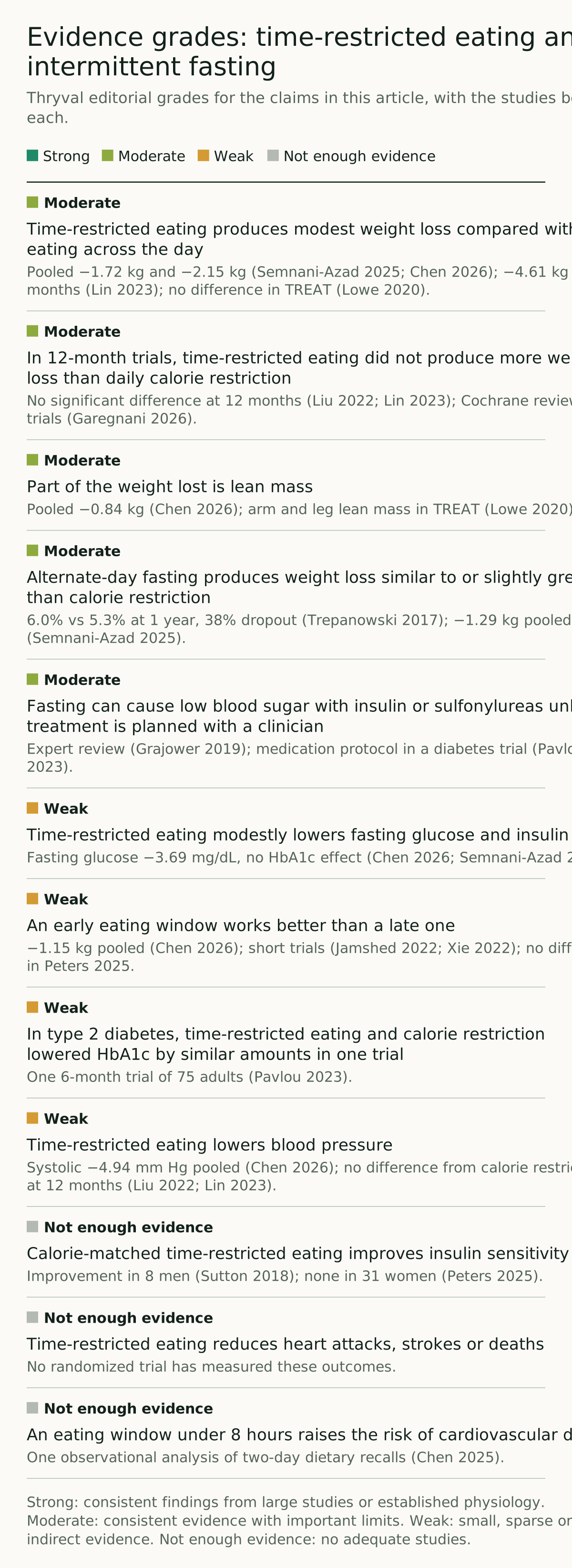
Evidence grades
The grades below are Thryval editorial judgments based on the studies cited in this article. The grading rules are set out on our Research page.
Frequently asked questions
Does 16:8 intermittent fasting work for weight loss?
It produces modest weight loss compared with eating across the day, about 1.7 to 2.2 kg on average in pooled trials, mostly because people eat less in a shorter window.16178 In the best-known US trial of noon to 8 pm eating, weight loss did not differ from three structured meals a day over 12 weeks.7
Is time-restricted eating better than calorie counting?
The trials have not found it better. Two 12-month trials found no significant difference between time-restricted eating and daily calorie restriction, and the 2026 Cochrane review found little to no difference between intermittent fasting and regular dietary advice.10918
Is it better to eat early or late in the day?
Early windows did slightly better in a network meta-analysis, with about 1.15 kg more weight loss and lower fasting insulin than late windows.17 A 2025 crossover trial in which people ate their usual amount of food found no difference in insulin sensitivity between 8 am to 4 pm and 1 to 9 pm eating.6
Does intermittent fasting cause muscle loss?
Some of the weight lost is lean mass, as with other diets. Pooled trials found about 0.84 kg more lean mass loss than with usual diets, and the TREAT trial found more loss of arm and leg lean mass with time-restricted eating.177
Does an 8-hour eating window raise the risk of heart disease death?
An observational analysis of US survey data found that people who reported eating over less than 8 hours had higher cardiovascular mortality, but eating span came from two days of recall and the authors could not rule out confounding.1920 No randomized trial has measured cardiovascular events or deaths.16
Is intermittent fasting safe for people with diabetes?
People taking insulin or sulfonylureas can develop low blood sugar when they fast, so fasting should be planned with the clinician who prescribes their diabetes treatment, with glucose monitoring.21 Anyone on glucose-lowering or other prescription medicines should talk to their clinician first, and nobody should change a dose on their own.13
Implications for patients and clinicians
For adults with overweight or obesity, time-restricted eating is one way to eat less, and in 12-month trials it did not produce more weight loss than daily calorie restriction, although those trials were not designed to show that the two are equivalent.91016 The choice between them is mostly a matter of which a person can keep up; the Cochrane authors wrote that physicians and patients may need to weigh willingness, readiness, practicality and sustainability.18 The effects on glucose, insulin and blood pressure are small, and evidence that meal timing helps beyond eating less is inconsistent.1756 Clinicians advising patients who take insulin or sulfonylureas should plan medication management before any fasting begins, and should ask about past eating disorders, pregnancy and age before recommending any fasting regimen.211322
This article is for education and is not medical advice.
References
-
Koppold DA, Breinlinger C, Hanslian E, et al. International consensus on fasting terminology. Cell Metab. 2024;36(8):1779–1794.e4. Delphi consensus of 38 experts; several authors disclosed commercial interests in fasting clinics, apps, supplements and books. PMC11504329 · PubMed 39059384 ↩↩
-
Gill S, Panda S. A smartphone app reveals erratic diurnal eating patterns in humans that can be modulated for health benefits. Cell Metab. 2015;22(5):789–798. App-based observational study, n=156, and an uncontrolled 16-week pilot, n=8; NIH and foundation support. PMC4635036 · PubMed 26411343 ↩↩
-
Manoogian ENC, Chow LS, Taub PR, Laferrère B, Panda S. Time-restricted eating for the prevention and management of metabolic diseases. Endocr Rev. 2022;43(2):405–436. Narrative review. PMC8905332 · PubMed 34550357 ↩↩↩
-
Wehrens SMT, Christou S, Isherwood C, et al. Meal timing regulates the human circadian system. Curr Biol. 2017;27(12):1768–1775.e3. Laboratory study, n=10 men, 13 days; funded by the UK Biotechnology and Biological Sciences Research Council. PMC5483233 · PubMed 28578930 ↩
-
Sutton EF, Beyl R, Early KS, Cefalu WT, Ravussin E, Peterson CM. Early time-restricted feeding improves insulin sensitivity, blood pressure, and oxidative stress even without weight loss in men with prediabetes. Cell Metab. 2018;27(6):1212–1221.e3. Randomized crossover supervised feeding trial, n=8 completers, 5 weeks per period; NIH funding; no competing interests. PMC5990470 · PubMed 29754952 ↩↩↩↩↩
-
Peters B, Schwarz J, Schuppelius B, et al. Intended isocaloric time-restricted eating shifts circadian clocks but does not improve cardiometabolic health in women with overweight. Sci Transl Med. 2025;17(822):eadv6787. Randomized crossover trial, n=31, 2 weeks per period. PubMed 41160666 ↩↩↩↩↩↩↩
-
Lowe DA, Wu N, Rohdin-Bibby L, et al. Effects of time-restricted eating on weight loss and other metabolic parameters in women and men with overweight and obesity: the TREAT randomized clinical trial. JAMA Intern Med. 2020;180(11):1491–1499. Randomized clinical trial, n=116, 12 weeks; funded by UCSF, NIDDK and the James Peter Read Foundation; senior author a cofounder and equity holder of Keyto. PMC7522780 · PubMed 32986097 ↩↩↩↩↩↩↩↩↩↩
-
Cienfuegos S, Gabel K, Kalam F, et al. Effects of 4- and 6-h time-restricted feeding on weight and cardiometabolic health: a randomized controlled trial in adults with obesity. Cell Metab. 2020;32(3):366–378.e3. Randomized controlled trial, n=58, 8 weeks; NIDDK funding; senior author received book fees. PMC9407646 · PubMed 32673591 ↩↩↩↩↩↩
-
Lin S, Cienfuegos S, Ezpeleta M, et al. Time-restricted eating without calorie counting for weight loss in a racially diverse population: a randomized controlled trial. Ann Intern Med. 2023;176(7):885–895. Randomized controlled trial, n=90, 12 months; NIDDK funding. PMC11192144 · PubMed 37364268 ↩↩↩↩↩↩↩↩↩↩↩
-
Liu D, Huang Y, Huang C, et al. Calorie restriction with or without time-restricted eating in weight loss. N Engl J Med. 2022;386(16):1495–1504. Randomized trial, n=139, 12 months; funded by the National Key Research and Development Project of China and others. PubMed 35443107 ↩↩↩↩↩↩↩↩↩↩↩
-
Jamshed H, Steger FL, Bryan DR, et al. Effectiveness of early time-restricted eating for weight loss, fat loss, and cardiometabolic health in adults with obesity: a randomized clinical trial. JAMA Intern Med. 2022;182(9):953–962. Randomized clinical trial, n=90, 14 weeks; NIH funding; institutional intellectual property in the food-intake app disclosed. PMC9361187 · PubMed 35939311 ↩↩↩↩
-
Xie Z, Sun Y, Ye Y, et al. Randomized controlled trial for time-restricted eating in healthy volunteers without obesity. Nat Commun. 2022;13(1):1003. Randomized controlled trial, n=90, 5 weeks; Chinese Academy of Medical Sciences funding; no competing interests. PMC8864028 · PubMed 35194047 ↩↩
-
Pavlou V, Cienfuegos S, Lin S, et al. Effect of time-restricted eating on weight loss in adults with type 2 diabetes: a randomized clinical trial. JAMA Netw Open. 2023;6(10):e2339337. Randomized clinical trial, n=75, 6 months; NIDDK funding; senior author received book fees. PMC10611992 · PubMed 37889487 ↩↩↩↩↩↩↩↩↩↩
-
Wilkinson MJ, Manoogian ENC, Zadourian A, et al. Ten-hour time-restricted eating reduces weight, blood pressure, and atherogenic lipids in patients with metabolic syndrome. Cell Metab. 2020;31(1):92–104.e5. Single-arm trial, n=19, 12 weeks; UCSD pilot grant; author disclosures include drug company consulting and a book royalty. PMC6953486 · PubMed 31813824 ↩↩
-
Trepanowski JF, Kroeger CM, Barnosky A, et al. Effect of alternate-day fasting on weight loss, weight maintenance, and cardioprotection among metabolically healthy obese adults: a randomized clinical trial. JAMA Intern Med. 2017;177(7):930–938. Randomized clinical trial, n=100, 1 year; NIH funding; senior author received an advance for a diet book. PMC5680777 · PubMed 28459931 ↩↩↩↩
-
Semnani-Azad Z, Khan TA, Chiavaroli L, et al. Intermittent fasting strategies and their effects on body weight and other cardiometabolic risk factors: systematic review and network meta-analysis of randomised clinical trials. BMJ. 2025;389:e082007. Network meta-analysis of 99 trials, 6,582 adults, GRADE certainty; commissioned by the EASD Diabetes and Nutrition Study Group; author disclosures include food industry and drug company support. PMC12175170 · PubMed 40533200 ↩↩↩↩↩↩↩↩↩↩↩↩↩↩↩↩↩↩↩↩
-
Chen YE, Tsai HL, Tu YK, Chen LW. Effects of timing and eating duration of time restricted eating on metabolic outcomes: systematic review and network meta-analysis. BMJ Med. 2026;5(1):e001071. Network meta-analysis of 41 trials, 2,287 participants; funded by Taiwan’s National Science and Technology Council and National Taiwan University. PMC12829361 · PubMed 41586347 ↩↩↩↩↩↩↩↩↩↩↩↩↩↩↩↩↩↩↩↩
-
Garegnani LI, Oltra G, Ivaldi D, et al. Intermittent fasting for adults with overweight or obesity. Cochrane Database Syst Rev. 2026;2(2):CD015610. Systematic review of 22 trials, 1,995 participants, GRADE certainty; no dedicated funding. PubMed 41692034 ↩↩↩↩↩↩↩↩↩↩
-
Chen M, Xu L, Van Horn L, et al. Association of eating duration less than 8 h with all-cause, cardiovascular, and cancer mortality. Diabetes Metab Syndr. 2025;19(7):103278. Prospective analysis of NHANES 2003 to 2018 with death records, n=19,831; the authors declared no competing interests. PubMed 40849219 ↩↩↩↩↩↩
-
American Heart Association. 8-hour time-restricted eating linked to a 91% higher risk of cardiovascular death. News release, March 18, 2024, on Abstract P192 (Chen M, Zhong VW et al.), Epidemiology and Prevention and Lifestyle and Cardiometabolic Health Scientific Sessions 2024. Meeting abstract, not peer reviewed at the time; the full analysis was later published as Chen 2025. AHA news release ↩↩↩
-
Grajower MM, Horne BD. Clinical management of intermittent fasting in patients with diabetes mellitus. Nutrients. 2019;11(4):873. Narrative review with expert-based recommendations; one author on drug company speakers’ bureaus, the other with research grants for fasting studies. PMC6521152 · PubMed 31003482 ↩↩↩↩↩
-
Ganson KT, Cuccolo K, Hallward L, Nagata JM. Intermittent fasting: describing engagement and associations with eating disorder behaviors and psychopathology among Canadian adolescents and young adults. Eat Behav. 2022;47:101681. Cross-sectional survey, n=2,762; the authors reported no conflicts. PubMed 36368052 ↩↩↩