
Does curcumin help joint pain or inflammation? What the trials show
Oral curcuminoids reduce knee osteoarthritis pain and improve function versus placebo in short randomized trials and meta-analyses. Short head-to-head comparisons with NSAIDs are limited and do not prove equivalence. Absorption is poor without piperine or specialized formulations, systemic CRP and IL-6 changes do not clearly explain the symptom benefit, and bioavailability-enhanced products have been linked to liver injury reports.
The grade ModerateOral curcuminoids for knee osteoarthritis pain
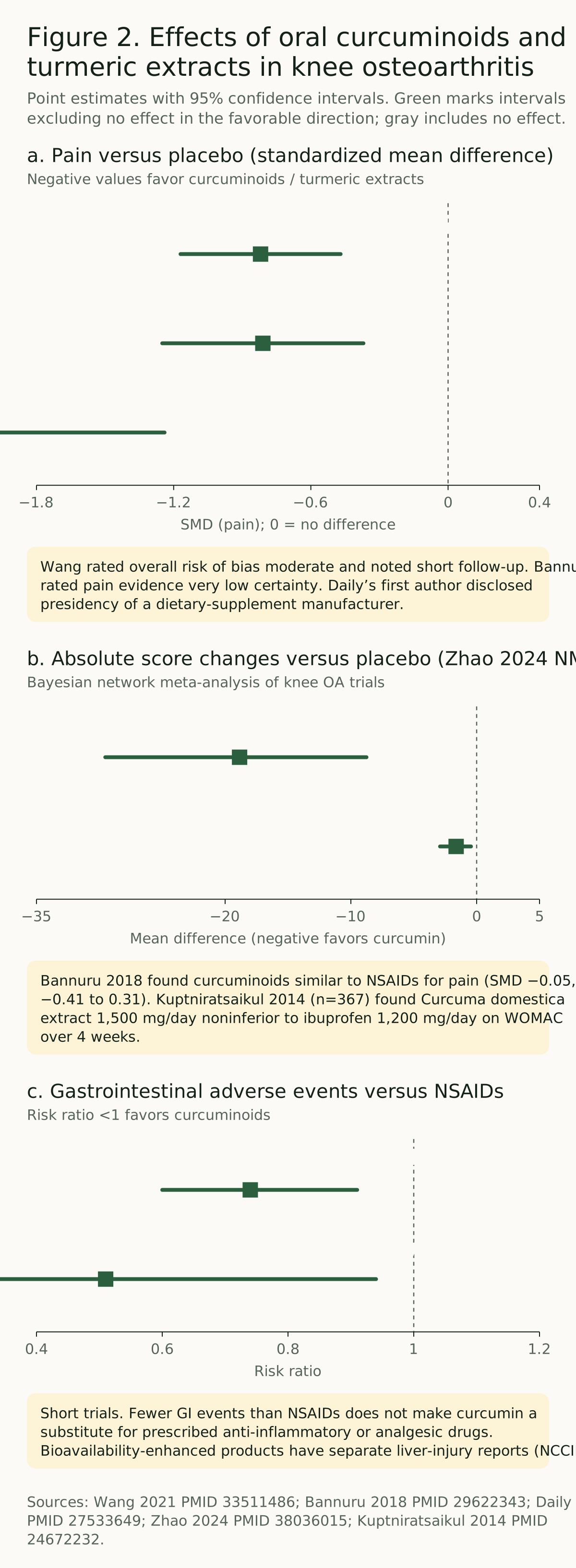
In brief. Oral curcuminoids, the yellow polyphenols from turmeric (Curcuma longa), reduce knee osteoarthritis pain and improve physical function compared with placebo in short randomized trials. In a 2021 systematic review of 16 randomized trials in 1,810 adults with knee osteoarthritis, turmeric extracts lowered pain (standardized mean difference [SMD] −0.82, 95% CI −1.17 to −0.47) and improved function (SMD −0.75, −1.18 to −0.33) versus placebo. In the same review, turmeric extracts were not clearly better or worse than NSAIDs for symptoms in short head-to-head trials and had about 12% fewer adverse events than NSAIDs; those comparisons do not prove equivalence.1 An earlier NIH-supported meta-analysis found curcuminoids better than placebo for pain (SMD −0.81, −1.25 to −0.37) and function (SMD −0.48, −0.74 to −0.22), a nonsignificant and imprecise pain difference versus NSAIDs (SMD −0.05, −0.41 to 0.31) that does not prove equivalence, and less likely to cause gastrointestinal adverse events than NSAIDs (risk ratio 0.74, 0.60 to 0.91).2 A 2024 Bayesian network meta-analysis of 23 knee osteoarthritis trials (2,175 patients) estimated that curcumin lowered visual analogue scale (VAS) pain by 1.63 points (−2.91 to −0.45) and total Western Ontario and McMaster Universities Osteoarthritis Index (WOMAC) score by 18.85 points (−29.53 to −8.76) versus placebo.3 Most trials lasted weeks to a few months, products and doses vary widely, risk of bias is often moderate or high, and unformulated curcumin is poorly absorbed.148 In a double-blind trial that improved symptoms with curcuminoids plus piperine, between-group changes in hs-CRP and IL-6 were not significant, so systemic inflammatory markers do not clearly explain the clinical effect.7 Curcuminoids are not a substitute for prescribed analgesics or NSAIDs. Bioavailability-enhanced products have been linked to liver injury reports.2018 People who take warfarin should involve a clinician before using medicinal curcumin doses because a New Zealand medicines-agency case report linked a turmeric supplement to an INR rise above 10.19 People with gallstones or biliary disease are often advised to avoid medicinal curcumin doses as a precaution because curcumin contracts the gallbladder in healthy volunteers; that contraction finding is not evidence from osteoarthritis trials that curcumin causes gallstone complications.16
Turmeric is a kitchen spice and a traditional medicine. Curcumin, demethoxycurcumin and bisdemethoxycurcumin together are the curcuminoids sold in capsules, often with black-pepper extract (piperine) or as phospholipid, nanoparticle or other “high bioavailability” formulations. This article reviews oral curcuminoid trials for osteoarthritis, especially of the knee, what is known about inflammatory biomarkers and absorption, and safety.
What are curcuminoids, and how might they act in an osteoarthritic joint?
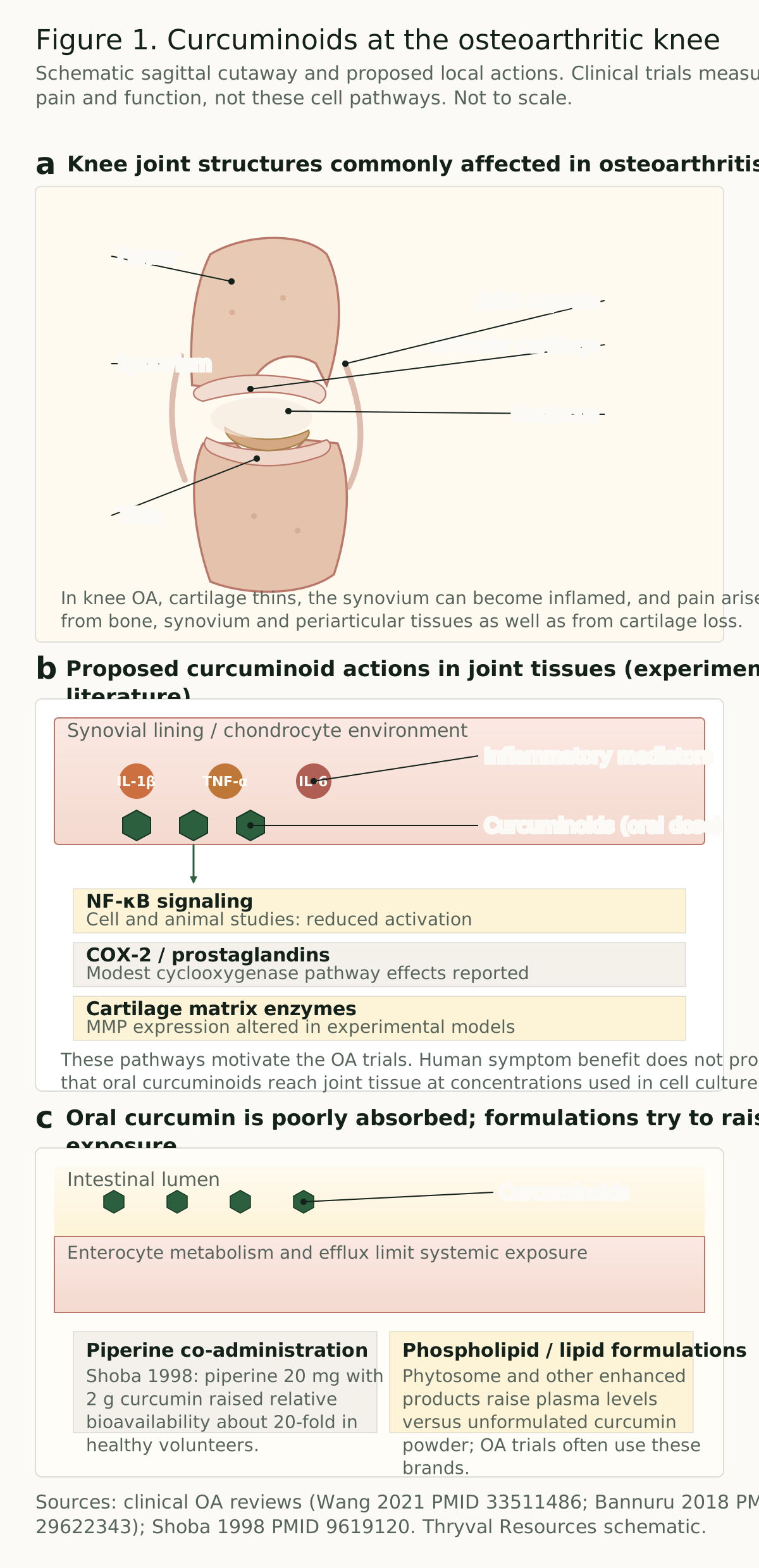
Curcuminoids are lipophilic polyphenols. In cell and animal models they have been reported to dampen NF-κB signaling, reduce cyclooxygenase-2–related prostaglandin production and alter matrix metalloproteinase expression in joint tissues.21 Those laboratory findings are a rationale for osteoarthritis trials; they are not proof that an oral capsule delivers the same concentrations to human cartilage or synovium.
Osteoarthritis pain is multifactorial. Cartilage loss, synovial inflammation, bone marrow lesions and periarticular soft tissues all contribute. Symptom trials therefore use patient-reported scores such as WOMAC and VAS rather than imaging as primary endpoints. Meta-analyses that looked for biochemical or imaging changes have not shown consistent between-group differences for those secondary markers.1
Do oral curcuminoids reduce knee osteoarthritis pain?
Yes, in short placebo-controlled trials, with important limits on certainty and duration. Wang and colleagues pooled turmeric extract trials of up to 16 weeks and found a large average pain reduction versus placebo (SMD −0.82), with extreme heterogeneity (I² 86%).1 Higher body mass index was associated with smaller improvements.1 Bannuru and colleagues, in an NIH-supported review that separated curcuminoid from boswellia products, reported a similar pain SMD versus placebo (−0.81) and rated the certainty of that evidence as very low because of bias risk, heterogeneity and imprecision.2 Daily and colleagues’ 2016 meta-analysis of earlier arthritis trials estimated VAS pain 2.04 points lower with turmeric or curcumin than with placebo (−2.85 to −1.24); the first author disclosed that he was president of a dietary-supplement manufacturer.4
Zhao and colleagues’ 2024 network meta-analysis added more recent trials and estimated absolute WOMAC and VAS differences versus placebo that exclude no effect, while also ranking curcumin alone and curcumin plus other agents among the better options for rescue-medication use.3 Across these syntheses the direction of effect is consistent. The size of the average effect, the mix of proprietary products, and the short follow-up keep the editorial grade for pain at Moderate rather than Strong.
Do curcuminoids improve function and stiffness?
Function generally improves with pain. Wang reported a function SMD of −0.75 versus placebo.1 Bannuru reported −0.48 (−0.74 to −0.22) with no heterogeneity (I² 0%) across three curcuminoid trials.2 Stiffness results are less consistent across reviews; some pooled analyses find benefit and others do not isolate stiffness as clearly as pain.311 Imaging outcomes have not shown a clear structural advantage for turmeric extracts over control in the short trials Wang reviewed.1
How do curcuminoids compare with ibuprofen and other NSAIDs?
Head-to-head data show fewer gastrointestinal complaints than NSAIDs; short-term symptom differences versus NSAIDs have been statistically nonsignificant but are too imprecise to prove equivalence. In Bannuru’s analysis, curcuminoids were not statistically different from NSAIDs for pain or function, and gastrointestinal adverse events were less common with curcuminoids (RR 0.74, 0.60 to 0.91).2 Zhao’s network estimated lower odds of adverse reactions with curcumin than with NSAIDs (OR 0.51, 0.25 to 0.94).3
The largest single comparator trial is Kuptniratsaikul and colleagues’ multicenter Thai study of 367 adults with primary knee osteoarthritis and pain of at least 5 of 10.5 Participants took Curcuma domestica extracts 1,500 mg/day or ibuprofen 1,200 mg/day for four weeks. WOMAC total, pain and function scores with the turmeric extract were noninferior to ibuprofen; abdominal pain or discomfort was reported more often with ibuprofen (P=0.046).5 The trial was supported by the National Research Council of Thailand, a clinical research network and the Thai Government Pharmaceutical Organization; authors reported no conflicts of interest.5 Four weeks is short for a chronic disease, and noninferiority to ibuprofen in that window is not a license to replace a prescribed NSAID or other indicated therapy.
What about inflammatory biomarkers such as CRP and IL-6?
Symptom improvement and systemic biomarker change are not the same finding. Panahi and colleagues randomized 40 adults with mild-to-moderate knee osteoarthritis to curcuminoids 1,500 mg/day (with piperine 15 mg/day) or placebo for six weeks and reported larger reductions in WOMAC, VAS and Lequesne scores with curcuminoids.6 In the companion biomarker analysis by Rahimnia and colleagues, hs-CRP, IL-6 and IL-4 fell within the curcuminoid arm, but the magnitude of change did not differ significantly from placebo for the evaluated markers; the authors concluded that the clinical benefit could not be attributed to systemic anti-inflammatory effects in that design.7
Registry studies of Meriva, a curcumin–phosphatidylcholine phytosome marketed by Indena, reported large drops in CRP and improvements in WOMAC and walking distance over three and eight months in osteoarthritis cohorts.1314 Those studies are product-evaluation registries rather than independently funded, fully blinded placebo trials of the kind that anchor the meta-analyses above, and they must be read with that sponsorship and design in mind. A short non-interaction study of Meriva in patients on antiplatelet drugs or anticoagulants reported no significant change in bleeding time or INR over about 10 days; it was conducted by investigators linked to Meriva research programs and does not settle long-term interaction risk.15
Does bioavailability matter for osteoarthritis outcomes?
Unformulated curcumin is poorly absorbed. In healthy volunteers, Shoba and colleagues found that 2 g of curcumin alone produced undetectable or very low serum levels, whereas adding 20 mg of piperine increased relative bioavailability about 20-fold (described as a 2,000% increase) over a short sampling window, without adverse effects in that study.8 Many osteoarthritis products therefore include piperine or use phospholipid, lipid or other delivery systems.
Whether a higher plasma curve translates into better osteoarthritis outcomes is less clear than marketing implies. Hsiao and colleagues’ dose meta-analysis found similar pain relief for higher-dose and lower-dose curcuminoid regimens and did not show a clean dose–response separating “enhanced” from standard products across trials.9 Formulations differ by brand, curcuminoid content and co-ingredients, so cross-trial comparisons confound product chemistry with dose. Bioavailability claims should be treated as pharmacokinetic facts about specific preparations, not as proof of superior joint disease modification.
What doses appear in the trials?
Common oral regimens in osteoarthritis trials are on the order of about 500 to 1,500 mg/day of curcuminoids or turmeric extracts for 4 to 16 weeks, sometimes with piperine, sometimes as proprietary extracts such as BCM-95 or phytosome products providing lower milligram amounts of curcumin with higher reported absorption.1564 Labels should be read for elemental curcuminoid content and for whether piperine or other enhancers are present. None of these regimens is a substitute for prescription therapy a clinician has recommended for osteoarthritis, inflammatory arthritis or pain.
Is curcumin safe? Gastrointestinal effects, liver, gallstones and anticoagulants
In short osteoarthritis trials, curcuminoids were generally well tolerated and caused fewer gastrointestinal adverse events than NSAIDs in pooled comparisons.235 The U.S. National Center for Complementary and Integrative Health (NCCIH) states that conventionally formulated oral turmeric or curcumin is likely safe in recommended amounts for up to two or three months, that digestive symptoms such as nausea, reflux or changes in stool can occur, and that highly bioavailable curcumin formulations have been linked to liver damage reports; people who develop fatigue, poor appetite, dark urine or jaundice should stop the product and seek care.20 An analysis of Italian phytovigilance reports and published cases has described acute cholestatic hepatitis temporally associated with some Curcuma longa–containing supplements.18
Curcumin stimulates gallbladder contraction. In healthy volunteers, 20 mg of curcumin reduced gallbladder volume by about 29% over two hours on ultrasound.16 People with gallstones, biliary obstruction or other biliary disease are often advised to avoid medicinal turmeric or curcumin doses as a physiologic precaution based on that contraction effect; the advice is not based on demonstrated gallstone complications in osteoarthritis trials.
Anticoagulant and antiplatelet interactions remain uncertain rather than ruled out. Rat work found pharmacokinetic changes with warfarin and clopidogrel without clear pharmacodynamic anticoagulation changes at the doses tested.17 New Zealand Medsafe reported a CARM case in which a patient on warfarin with previously stable INR measurements had an INR rise to over 10 within weeks of starting a turmeric-containing product; the reporter attributed the change to an interaction, and Medsafe warned that this does not apply to turmeric used as food.19 The short Meriva non-interaction study did not change INR over 10 days in stable patients, which is reassuring for that product and window but not definitive for all curcumin products or longer use.15 Anyone on warfarin, direct oral anticoagulants or dual antiplatelet therapy should not start medicinal curcumin without clinician advice and appropriate monitoring. Curcuminoids are not a substitute for prescribed anticoagulants, antiplatelet drugs or osteoarthritis medicines. NCCIH advises talking with a clinician before combining herbal products with medicines because some herbs and medicines interact.20
NCCIH also advises against turmeric supplements in pregnancy at doses above food amounts.20
How good is the evidence, and who paid for it?
The positive osteoarthritis signal rests on multiple independent meta-analyses with overlapping trials.123410 Certainty is limited by short duration, heterogeneous products, moderate or high risk of bias in many primary studies, and industry involvement in proprietary formulations.1212
Funding and conflicts vary by paper. Bannuru’s review was supported by NCCIH grants; authors reported no competing interests.2 Daily’s 2016 meta-analysis was supported by the Korea Institute of Oriental Medicine; James W. Daily disclosed presidency of Daily Manufacturing, Inc., a supplement maker.4 Kuptniratsaikul’s ibuprofen comparator trial was publicly funded in Thailand with no author conflicts declared.5 Meriva registry studies evaluate an Indena product and should be read as industry-linked evidence.1314 Zhao’s network meta-analysis authors declared no competing interests.3 An overview of systematic reviews rated the methodological and evidentiary quality of the curcumin osteoarthritis review literature itself as generally low to moderate and called for better primary trials.12
What remains uncertain?
It is unknown whether benefits persist beyond a few months of continuous use, whether any oral curcuminoid slows radiographic progression, which commercial products match the preparations used in positive trials, and whether piperine or phospholipid enhancement improves osteoarthritis outcomes more than matched milligram doses of standard curcuminoids.19 The contribution of systemic CRP or cytokine change to symptom relief is not established in placebo-controlled biomarker analyses.7 Long-term safety of high-bioavailability products, especially regarding the liver, needs clearer product-specific pharmacovigilance.2018
Evidence grades
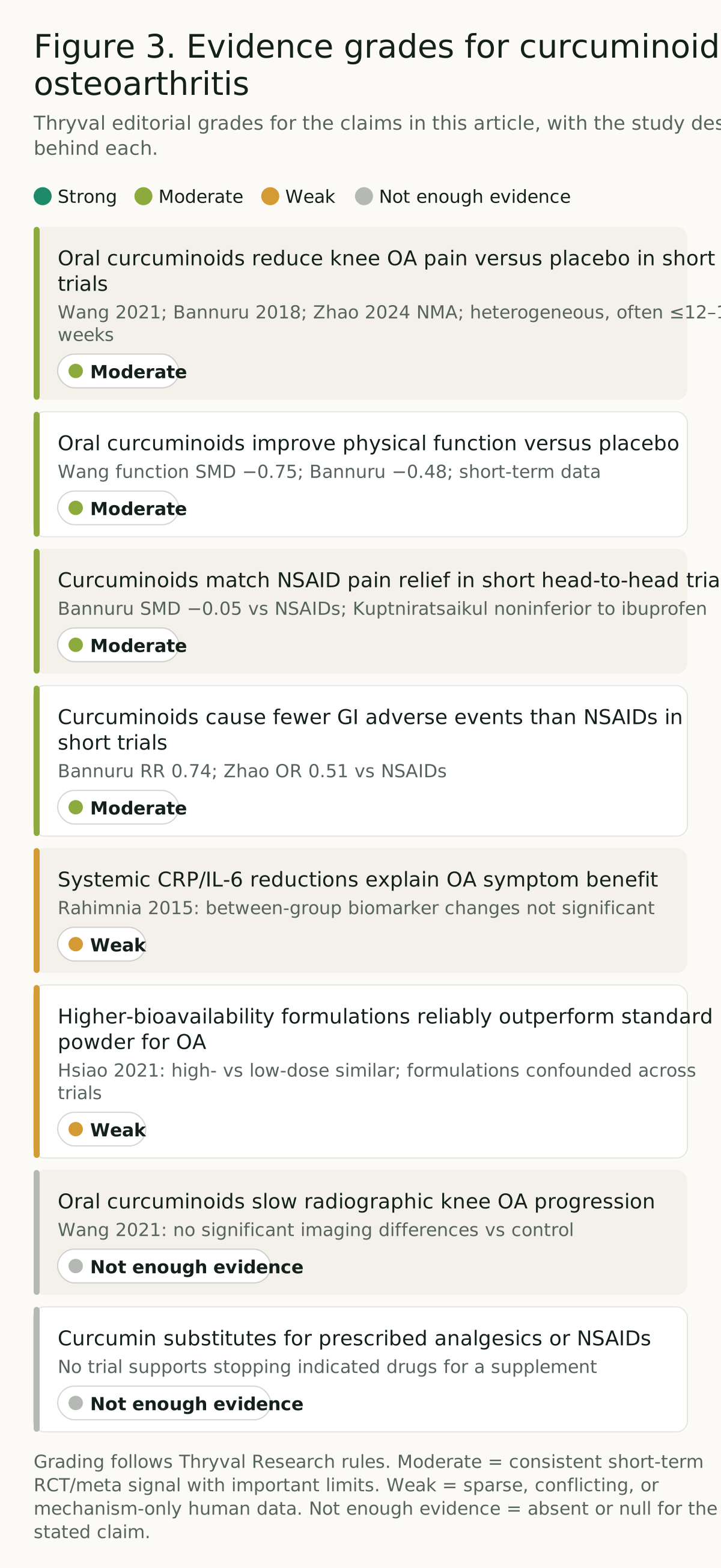
The grades below are Thryval editorial judgments based on the studies cited in this article. Moderate indicates a consistent short-term randomized and meta-analytic signal with important limits on duration, product heterogeneity and certainty. The grading rules are set out on our Research page.
Frequently asked questions
Does curcumin help knee osteoarthritis pain?
Short randomized trials and meta-analyses find less pain and better function than with placebo. Certainty is limited by product differences, bias risk, short follow-up and sparse head-to-head NSAID comparisons that do not prove equivalence.123
Is turmeric the same as curcumin?
Turmeric is the spice. Curcuminoids (mainly curcumin) are concentrated extracts used in most trials. Food amounts of turmeric are not the same exposure as 500 to 1,500 mg/day curcuminoid capsules.20
Should I take curcumin with black pepper (piperine)?
Piperine raises curcumin blood levels substantially in a classic volunteer study.8 Many OA products include it. That pharmacokinetic effect is not by itself proof of better joint outcomes, and piperine can affect drug metabolism.
Does curcumin lower CRP or IL-6 in osteoarthritis?
Not consistently in placebo-controlled comparisons. One trial that improved symptoms with curcuminoids plus piperine did not show significant between-group differences in hs-CRP or IL-6.7
Is curcumin safe with warfarin or blood thinners?
Do not start medicinal curcumin without clinician advice if you take anticoagulants or antiplatelet drugs. Medsafe reported a case of INR rising above 10 in a patient on warfarin after starting a turmeric supplement.19 One short Meriva study did not change INR over 10 days.15
Can people with gallstones take curcumin?
Medicinal doses can contract the gallbladder in healthy volunteers.16 People with gallstones or biliary disease are generally advised to avoid supplemental curcumin as a precaution unless a clinician says otherwise; contraction is not the same as proven gallstone harm in osteoarthritis trials.
Implications for patients and clinicians
Oral curcuminoids have a Moderate evidence grade for short-term relief of knee osteoarthritis pain and function versus placebo, and fewer gastrointestinal events than NSAIDs in short trials; head-to-head symptom comparisons with NSAIDs are limited and do not prove equivalence.1235 That is a better evidence base than many joint supplements, and it is still not a reason to abandon weight management, exercise therapy, topical or oral NSAIDs when indicated, or guideline-directed care. Prefer products that match trial curcuminoid content when possible, treat bioavailability marketing skeptically, watch for liver symptoms with enhanced formulations, and involve a clinician before combining curcumin with anticoagulants or using it in biliary disease.1916208 Readers comparing metabolic and inflammatory claims may also find our reviews of berberine and blood sugar and omega-3 for mood useful.
This article is for education and is not medical advice.
References
-
Wang Z, Singh A, Jones G, et al. Efficacy and Safety of Turmeric Extracts for the Treatment of Knee Osteoarthritis: a Systematic Review and Meta-analysis of Randomised Controlled Trials. Curr Rheumatol Rep. 2021;23(2):11. Meta-analysis, 16 RCTs, 1,810 adults. PubMed 33511486 ↩↩↩↩↩↩↩↩↩↩↩↩↩↩↩↩↩
-
Bannuru RR, Osani MC, Al-Eid F, Wang C. Efficacy of curcumin and Boswellia for knee osteoarthritis: Systematic review and meta-analysis. Semin Arthritis Rheum. 2018;48(3):416–429. Meta-analysis; NCCIH-supported. PubMed 29622343 · PMC6131088 ↩↩↩↩↩↩↩↩↩↩↩↩↩↩↩↩
-
Zhao J, Liang G, Zhou G, et al. Efficacy and safety of curcumin therapy for knee osteoarthritis: A Bayesian network meta-analysis. J Ethnopharmacol. 2024;321:117493. Network meta-analysis, 23 studies, 2,175 patients; authors declare no competing interests. PubMed 38036015 ↩↩↩↩↩↩↩↩↩↩↩
-
Daily JW, Yang M, Park S. Efficacy of Turmeric Extracts and Curcumin for Alleviating the Symptoms of Joint Arthritis: A Systematic Review and Meta-Analysis of Randomized Clinical Trials. J Med Food. 2016;19(8):717–729. Meta-analysis, 8 RCTs; first author disclosed supplement-company presidency. PubMed 27533649 · PMC5003001 ↩↩↩↩↩
-
Kuptniratsaikul V, Dajpratham P, Taechaarpornkul W, et al. Efficacy and safety of Curcuma domestica extracts compared with ibuprofen in patients with knee osteoarthritis: a multicenter study. Clin Interv Aging. 2014;9:451–458. RCT, n=367; Thai public funding. PubMed 24672232 · PMC3964021 ↩↩↩↩↩↩↩↩
-
Panahi Y, Rahimnia AR, Sharafi M, et al. Curcuminoid treatment for knee osteoarthritis: a randomized double-blind placebo-controlled trial. Phytother Res. 2014;28(11):1625–1631. RCT, n=40; curcuminoids 1,500 mg/day with piperine. PubMed 24853120 ↩↩
-
Rahimnia AR, Panahi Y, Alishiri G, et al. Impact of Supplementation with Curcuminoids on Systemic Inflammation in Patients with Knee Osteoarthritis: Findings from a Randomized Double-Blind Placebo-Controlled Trial. Drug Res (Stuttg). 2015;65(10):521–525. Companion biomarker analysis to Panahi 2014. PubMed 25050518 ↩↩↩↩↩
-
Shoba G, Joy D, Joseph T, et al. Influence of piperine on the pharmacokinetics of curcumin in animals and human volunteers. Planta Med. 1998;64(4):353–356. Human volunteer PK study; ~20-fold relative bioavailability increase with piperine. PubMed 9619120 ↩↩↩↩↩
-
Hsiao AF, Lien YC, Tzeng IS, et al. The efficacy of high- and low-dose curcumin in knee osteoarthritis: A systematic review and meta-analysis. Complement Ther Med. 2021;63:102775. Meta-analysis, 11 RCTs, 1,258 participants. PubMed 34537344 ↩↩↩
-
Paultre K, Cade W, Hernandez D, et al. Therapeutic effects of turmeric or curcumin extract on pain and function for individuals with knee osteoarthritis: a systematic review. BMJ Open Sport Exerc Med. 2021;7(1):e000935. Systematic review, 10 RCTs. PubMed 33500785 · PMC7812094 ↩
-
Bideshki MV, Jourabchi-Ghadim N, Radkhah N, et al. The efficacy of curcumin in relieving osteoarthritis: A meta-analysis of meta-analyses. Phytother Res. 2024;38(6):2875–2891. Umbrella meta-analysis of 11 meta-analyses. PubMed 38576215 ↩
-
Chen W, Shi H, Deng P, et al. Quality of Evidence Supporting the Role of Curcuma Longa Extract/Curcumin for the Treatment of Osteoarthritis: An Overview of Systematic Reviews. Evid Based Complement Alternat Med. 2022;2022:6159874. Overview of 9 SRs/MAs. PubMed 35399636 · PMC8991401 ↩↩
-
Belcaro G, Cesarone MR, Dugall M, et al. Product-evaluation registry of Meriva, a curcumin-phosphatidylcholine complex, for the complementary management of osteoarthritis. Panminerva Med. 2010;52(2 Suppl 1):55–62. Meriva (Indena) registry, n=50. PubMed 20657536 ↩↩↩
-
Belcaro G, Cesarone MR, Dugall M, et al. Efficacy and safety of Meriva, a curcumin-phosphatidylcholine complex, during extended administration in osteoarthritis patients. Altern Med Rev. 2010;15(4):337–344. Meriva registry, n=100 over 8 months. PubMed 21194249 ↩↩
-
Hu S, Belcaro G, Dugall M, et al. Interaction study between antiplatelet agents, anticoagulants, thyroid replacement therapy and a bioavailable formulation of curcumin (Meriva). Eur Rev Med Pharmacol Sci. 2018;22(15):5042–5046. Short non-interaction study. PubMed 30070343 ↩↩↩
-
Rasyid A, Lelo A. The effect of curcumin and placebo on human gall-bladder function: an ultrasound study. Aliment Pharmacol Ther. 1999;13(2):245–249. Crossover, n=12; ~29% volume reduction at 2 h after 20 mg. PubMed 10102956 ↩↩↩↩
-
Liu AC, Zhao LX, Lou HX. Curcumin alters the pharmacokinetics of warfarin and clopidogrel in Wistar rats but has no effect on anticoagulation or antiplatelet aggregation. Planta Med. 2013;79(11):971–977. Rat PK/PD study. PubMed 23807811 ↩
-
Lombardi N, Crescioli G, Maggini V, et al. Acute liver injury following turmeric use in Tuscany: An analysis of the Italian Phytovigilance database and systematic review of case reports. Br J Clin Pharmacol. 2021;87(3):741–753. Pharmacovigilance and case review. PubMed 32656820 ↩↩↩
-
Medsafe New Zealand. Beware turmeric/curcumin containing products can interact with warfarin. Monitoring Communication. 17 April 2018. CARM case: patient on warfarin with previously stable INR had INR rise to over 10 after starting a turmeric-containing product; warning does not apply to turmeric used as food. Accessed November 6, 2026. medsafe.govt.nz ↩↩↩↩
-
National Center for Complementary and Integrative Health. Turmeric: Usefulness and Safety. NCCIH. Updated summary on oral turmeric/curcumin for osteoarthritis, conventional versus bioavailable formulations, liver injury reports, pregnancy caution, and talking with clinicians about herb–drug interactions. NCCIH turmeric fact sheet ↩↩↩↩↩↩↩↩