
Do probiotics prevent antibiotic-associated diarrhea? What the trials show
Antibiotics often disturb the gut microbiota and can cause diarrhea. Pooled trials, including Cochrane reviews, find that certain probiotic strains cut that risk, especially in children at higher doses, but a large UK hospital trial in older adults found no benefit, and prevention of C. difficile diarrhea looks smaller in absolute terms than older reviews suggested.
The grade ModerateProbiotics for preventing antibiotic-associated diarrhea
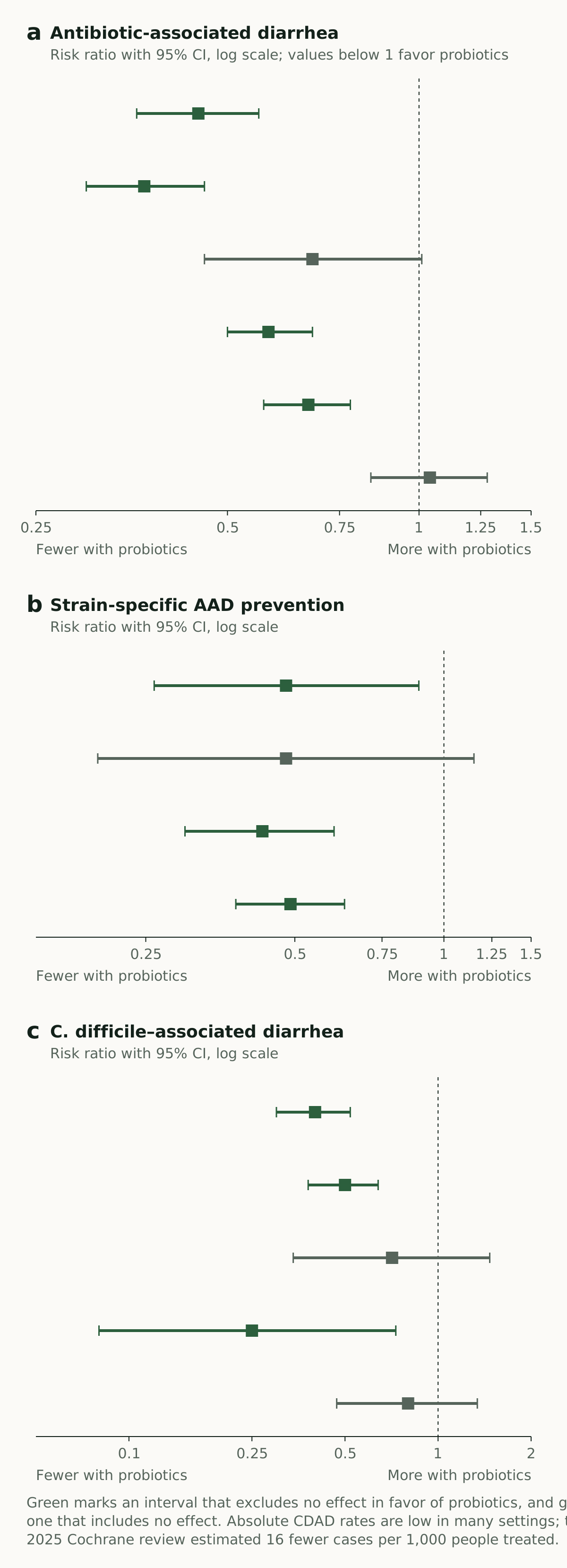
In brief. Probiotics can reduce the risk of antibiotic-associated diarrhea (AAD), but the size of the benefit depends on age, dose, strain and setting. A 2019 Cochrane review of 33 pediatric trials (6,352 children) found AAD in 8% of children given probiotics versus 19% of controls (risk ratio [RR] 0.45, 95% CI 0.36 to 0.56; number needed to treat for benefit [NNTB] 9), with moderate-certainty evidence.1 The effect was clearer at doses of at least 5 billion colony-forming units (CFU) a day (RR 0.37, NNTB 6).1 Across ages, a JAMA meta-analysis of 63 trials (11,811 participants) reported an RR of 0.58 (0.50 to 0.68), and a 2025 Cochrane update of trials that also measured Clostridioides difficile outcomes found an RR of 0.67 (0.57 to 0.78) for AAD, both with remaining heterogeneity.23 The largest pragmatic adult trial, PLACIDE, in nearly 3,000 UK inpatients aged 65 or older, found no reduction in AAD with a multistrain lactobacillus–bifidobacterium product (RR 1.04, 0.84 to 1.28).4 For C. difficile–associated diarrhea the absolute benefit is small in many settings: the 2025 Cochrane review estimated 16 fewer cases per 1,000 people treated (RR 0.50, low certainty).3 Strain matters. Meta-analyses support Lactobacillus rhamnosus GG in children and Saccharomyces boulardii in children and adults for AAD prevention; adult evidence for LGG alone is weaker.567 Many positive trials had industry ties, which this article discloses.
Antibiotics kill or suppress bacteria that normally occupy the gut. That loss of colonization resistance makes room for opportunistic microbes, including toxigenic C. difficile, and is one reason diarrhea is a common adverse effect of antibiotic courses.18 A probiotic, as defined by an international consensus panel, is a live microorganism that, when administered in adequate amounts, confers a health benefit on the host.17 That is a strain-specific claim, not a property of every capsule labeled “probiotic.” This article reviews what randomized trials and Cochrane reviews have measured when probiotics were given with antibiotics, which strains and doses were studied, how large the effects were, and who paid for the research. Related posts cover fermented foods and dietary fiber.
What is antibiotic-associated diarrhea?
AAD is diarrhea that begins while a person is taking antibiotics, or shortly afterward, when other causes have been judged unlikely. Definitions differ across trials: some require three or more loose stools a day for two days, others use looser criteria, and follow-up ranges from days to weeks.12 Incidence in control arms of trials has ranged from under 10% to more than 30%, depending on antibiotic class, age, setting and definition.24 Most AAD is self-limited. A minority of cases is caused by C. difficile, which can produce toxin-mediated colitis and, in older or immunocompromised people, severe or recurrent disease.83
How might probiotics reduce that risk?
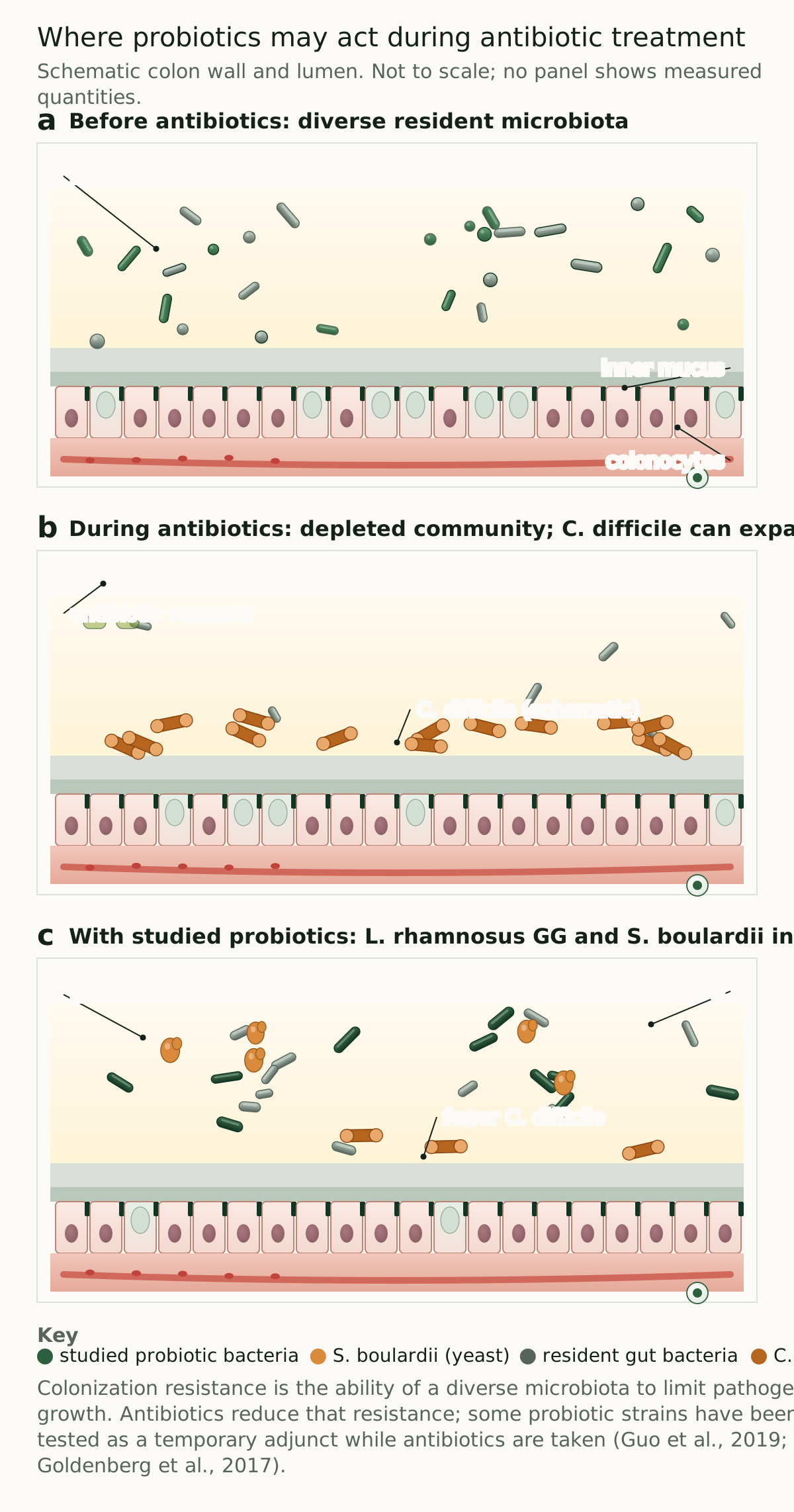
The leading idea is temporary restoration of colonization resistance: live microbes occupy niches, compete for nutrients, produce inhibitory metabolites or reinforce barrier and immune signals that limit pathogen growth.18 Figure 1 sketches that sequence. The mechanism is not proven for every product on the shelf, and stool recovery of an ingested strain does not prove that it prevents diarrhea. Trials remain the evidence that matters.
Do probiotics prevent antibiotic-associated diarrhea in children?
Yes, with moderate-certainty evidence when the trials are pooled, and a clearer effect at higher doses. Guo and colleagues, updating earlier Cochrane work, included 33 randomized trials in children aged 0 to 18 years (6,352 participants).1 On complete-case analysis, AAD occurred in 8% (259/3,232) with probiotics versus 19% (598/3,120) with placebo, active control or no treatment (RR 0.45, 0.36 to 0.56; NNTB 9, 7 to 13; moderate certainty).1 An a priori dose subgroup was credible by the authors’ criteria: at ≥5 billion CFU per day the RR was 0.37 (0.30 to 0.46; NNTB 6); below that dose the RR was 0.68 (0.46 to 1.01) and no longer excluded no effect.1 Fifteen of the 33 trials tested S. boulardii or L. rhamnosus GG.1 Risk of bias was high in 20 trials and low in 13; loss to follow-up reached 46% in some studies, though extreme missing-data assumptions still favored probiotics.1 The review authors declared no known conflicts; external support listed included the Hospital for Sick Kids Foundation in Toronto.1
The European Society for Paediatric Gastroenterology, Hepatology and Nutrition (ESPGHAN) working group on probiotics, reviewing trials with named strains, recommended L. rhamnosus GG or S. boulardii when prevention of AAD is considered because of risk factors such as antibiotic class, duration, age or prior AAD (moderate quality of evidence, strong recommendation).7
Do probiotics prevent antibiotic-associated diarrhea in adults?
Pooled analyses suggest a benefit, but the largest independent hospital trial did not. Hempel and colleagues at RAND, in a systematic review funded under US Public Health Service contract 290-2007-10062-I, pooled 63 prevention or treatment trials with 11,811 participants and found an RR of 0.58 (0.50 to 0.68; NNT 13), with I² 54%.2 Strains were often poorly documented, and the authors concluded that the evidence was insufficient to say which probiotics work for which patients and antibiotics.2 The 2025 Cochrane update of trials that reported C. difficile outcomes also pooled AAD (40 trials) and found RR 0.67 (0.57 to 0.78; low certainty).3
Against that backdrop sits PLACIDE, a multicenter, double-blind UK trial in 2,941 analyzed inpatients aged 65 or older receiving antibiotics. Participants took a multistrain lactobacillus and bifidobacterium preparation (6 × 10¹⁰ organisms daily for 21 days) or placebo. AAD occurred in 10.8% of the microbial-preparation group and 10.4% of the placebo group (RR 1.04, 0.84 to 1.28).4 C. difficile diarrhea was uncommon in both arms (0.8% vs 1.2%; RR 0.71, 0.34 to 1.47).4 The trial was funded by the National Institute for Health Research Health Technology Assessment programme, not by a probiotic manufacturer.4 It shows that a positive pooled estimate does not guarantee benefit for every product in every adult population, particularly frail older inpatients.
Which strains have the strongest trial support?
Effects are strain-specific. For L. rhamnosus GG, Szajewska and Kołodziej pooled 12 trials (1,499 participants).5 Across ages, AAD fell from 22.4% to 12.3% (RR 0.49, 0.29 to 0.83; low quality of evidence). Separated by age, the reduction was significant in children (five trials, RR 0.48, 0.26 to 0.89; moderate quality) but not in adults overall (six trials, RR 0.48, 0.20 to 1.15; low quality), except in a subset receiving antibiotics as part of Helicobacter pylori eradication (RR 0.26, 0.11 to 0.59).5 Early outpatient trials in children found large relative reductions; a Mayo Clinic inpatient adult trial of 20 × 10⁹ CFU/day found no difference (29.3% vs 29.9%).121314
For S. boulardii, an updated meta-analysis of 21 trials (4,780 participants) found AAD rates of 8.5% with the yeast versus 18.7% without (RR 0.47, 0.38 to 0.57; NNT 10).6 The reduction held in children (RR 0.43, 0.30 to 0.60) and adults (RR 0.49, 0.38 to 0.63).6 For C. difficile–associated diarrhea, the same review found a significant reduction only in children (RR 0.25, 0.08 to 0.73), not in adults (RR 0.80, 0.47 to 1.34).6 Crossref records list Medical University of Warsaw funding for both Szajewska meta-analyses.56
Other single strains and multi-strain mixtures appear in the Cochrane pools, but ESPGHAN withheld recommendations where fewer than two strain-specified trials were available.71 Our fermented foods article covers industry-funded trials of probiotic fermented milks (for example Actimel), which are a different exposure from named capsule products.
Do probiotics prevent C. difficile–associated diarrhea?
They may, but the absolute benefit is often small, and certainty has fallen as more trials have been added. Goldenberg and colleagues’ 2017 Cochrane review of 31 trials (8,672 participants with CDAD outcomes) found CDAD in 1.5% of probiotic recipients versus 4.0% of controls (RR 0.40, 0.30 to 0.52; moderate certainty; NNTB 42).8 A post hoc subgroup suggested benefit mainly when baseline CDAD risk exceeded 5% (NNTB 12), with little effect in low-risk settings.8 The authors declared no known conflicts.8
The 2025 Cochrane update added eight trials and regraded the evidence. Across 38 trials (13,179 participants), CDAD incidence was 1.6% with probiotics versus 3.2% with control (RR 0.50, 0.38 to 0.64), or about 16 fewer cases per 1,000 (NNTB 65, 48 to 97), now rated low-certainty evidence.3 Detection of C. difficile in stool without diarrhea did not clearly differ (RR 0.87, 0.68 to 1.11).3 There was no source of funding for that update; authors declared no relevant disclosures.3 An earlier Annals of Internal Medicine meta-analysis by Johnston and colleagues had reported a 66% relative reduction (RR 0.34, 0.24 to 0.49) with moderate-quality evidence.9
The American Gastroenterological Association’s 2020 guideline conditionally suggested specific formulations (S. boulardii; or L. acidophilus CL1285 plus L. casei LBC80R; or named three- and four-strain combinations) for prevention of C. difficile infection in adults and children on antibiotics, while making no recommendation on probiotics for treating established C. difficile infection outside trials.1011
Are probiotics safe when taken with antibiotics?
In the randomized trials that reported adverse events, serious probiotic infections were not seen among typical participants, and overall adverse-event rates were similar or slightly lower with probiotics. The 2025 Cochrane review found an adverse-event RR of 0.86 (0.72 to 1.01; moderate certainty).3 The pediatric AAD Cochrane review reported no serious adverse events attributable to probiotics among 24 trials that recorded them; common complaints were rash, nausea, gas, bloating and constipation.1 PLACIDE found serious adverse events at similar rates in both arms, none attributed to the study product.4
Case reports and case reviews outside those trials document S. boulardii fungemia and Lactobacillus bacteremia, mostly in people with central venous catheters, critical illness or severe immunocompromise.1 One review counted at least 33 fungemia and at least eight Lactobacillus bacteremia reports,15 and a systematic review of 108 Saccharomyces fungemia cases found that most followed S. boulardii use, often in intensive care.16 Product labels and hospital policies often caution against probiotic yeasts in those groups. Probiotics are not a substitute for any antibiotic or other medicine a clinician has prescribed, and they do not treat established C. difficile colitis on their own.10
How good is the evidence, and who paid for it?
The pediatric AAD signal is the most coherent: moderate-certainty Cochrane evidence, a credible high-dose subgroup, and concordant strain-level meta-analyses for LGG and S. boulardii.156 Adult evidence is mixed because positive pools sit beside PLACIDE’s null result with a different multistrain product.243 For CDAD, relative reductions persist but absolute benefits are modest when baseline risk is low, and GRADE certainty fell from moderate (2017) to low (2025).83
Industry involvement is common among the underlying trials. Cochrane risk-of-bias assessments repeatedly flag manufacturer funding, advisory roles and product supply, including Danone-supported fermented-milk trials.81 The Hempel, Guo, Goldenberg and 2025 Cochrane reviews themselves were not industry-funded on the declarations we could read.2183 Readers should separate the independence of the systematic reviews from the funding of many included RCTs.
What remains uncertain?
It is still unclear which commercial products match the strains and CFU counts used in positive trials, because labels vary and viability after shelf storage is not always verified in independent labs.21 Whether probiotics help when baseline AAD or CDAD risk is very low is uncertain, and PLACIDE shows that older inpatients may not benefit from every multistrain formula.48 Head-to-head trials comparing LGG, S. boulardii and multi-strain products are few. Long-term effects on the microbiota after antibiotics stop are outside the scope of most AAD prevention trials.3
Evidence grades
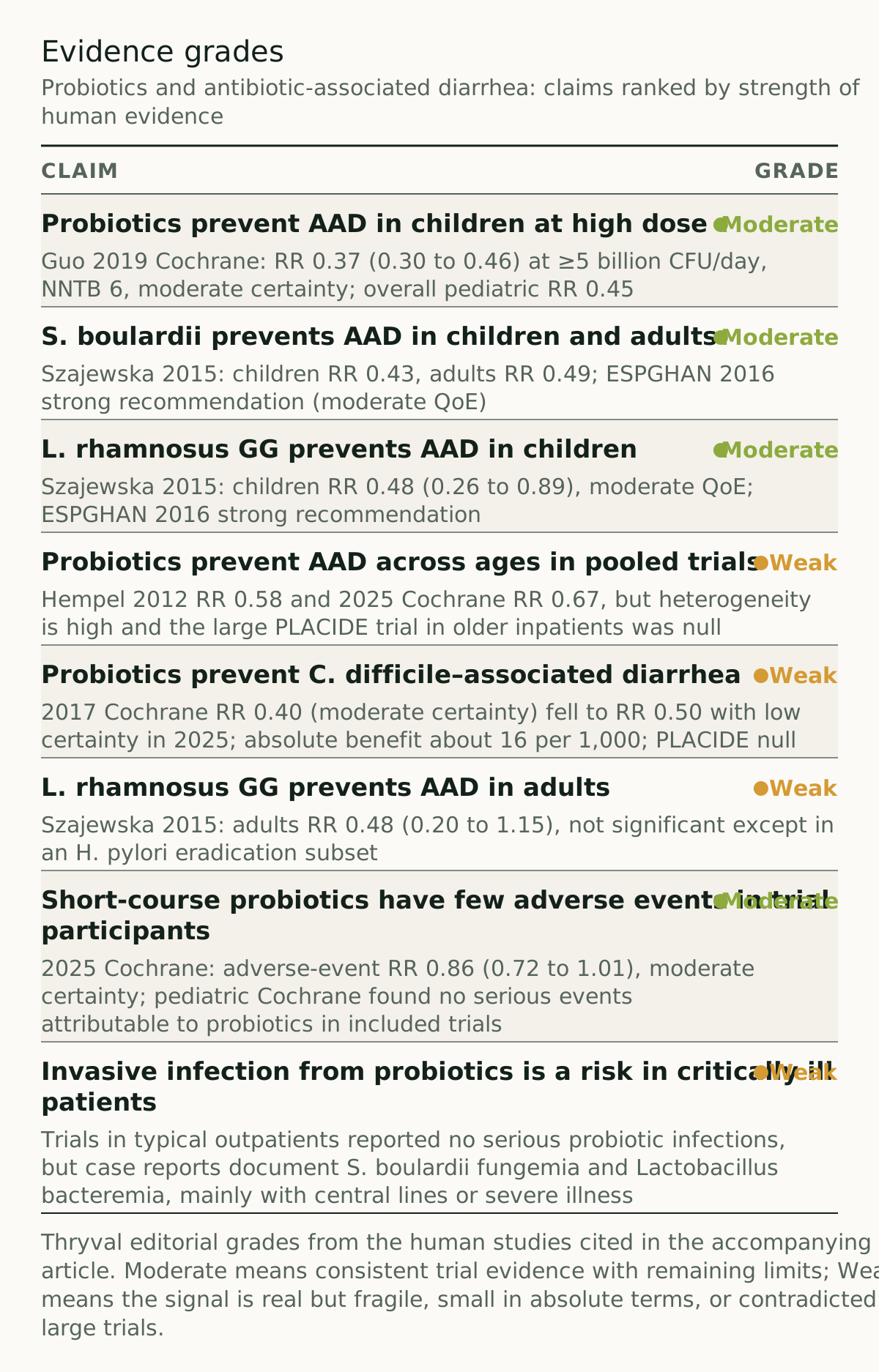
The grades below are Thryval editorial judgments based on the studies cited in this article. The grading rules are set out on our Research page.
Frequently asked questions
Do probiotics prevent diarrhea from antibiotics?
They can reduce the risk, especially in children and with well-studied strains at higher doses. A Cochrane review in children found AAD roughly halved (RR 0.45, moderate certainty), while the large PLACIDE trial in older hospital patients found no benefit from its multistrain product.14
Which probiotic strains were studied for antibiotic-associated diarrhea?
The best-documented are Lactobacillus rhamnosus GG and Saccharomyces boulardii. ESPGHAN recommends those two when AAD prevention is being considered in children.567 Other strains appear in pooled reviews but with less strain-level evidence.
How much probiotic did the positive trials use?
In children, Cochrane authors found a clearer effect at ≥5 billion CFU per day (RR 0.37) than at lower doses.1 Adult and strain-specific trials often used on the order of 5 to 20 billion CFU daily, or 250 to 500 mg of S. boulardii, for the duration of antibiotics and sometimes a few days after; check the specific trial rather than assuming every retail product matches.561
Do probiotics prevent C. difficile infection?
Pooled trials show a relative reduction, but the 2025 Cochrane review rated the evidence low certainty and estimated only about 16 fewer CDAD cases per 1,000 people treated.3 Benefit appears larger when baseline risk is high.8 AGA conditionally suggests certain formulations for prevention during antibiotic treatment.1011
Are probiotics safe to take with antibiotics?
In randomized trials, serious adverse events attributable to probiotics were rare, and overall adverse-event rates were not higher with probiotics.31 People who are critically ill, profoundly immunocompromised or who have central venous catheters face a documented risk of invasive infection from probiotic organisms and should ask a clinician before use.11516
Should everyone on antibiotics take a probiotic?
No. The decision depends on age, antibiotic regimen, prior AAD or C. difficile, and whether a product matches a studied strain and dose.174 Probiotics do not replace medical care for severe diarrhea, blood in the stool or suspected C. difficile colitis.
Implications for patients and clinicians
For children at appreciable risk of AAD, trial evidence supports considering L. rhamnosus GG or S. boulardii at doses used in positive studies, typically at least 5 billion CFU a day while antibiotics continue.1756 For adults, pooled estimates are favorable but PLACIDE shows that not every multistrain product helps older inpatients, so strain and setting matter.24 Prevention of C. difficile diarrhea is a weaker, smaller absolute effect in unselected populations, though guidelines conditionally endorse specific products when that risk is a concern.310 People with severe symptoms need clinical assessment; probiotics are an adjunct under study for prevention, not a replacement for prescribed antibiotics or for treatment of established C. difficile infection.10 Readers comparing food-based microbes can see our review of fermented foods and inflammation.
References
-
Guo Q, Goldenberg JZ, Humphrey C, El Dib R, Johnston BC. Probiotics for the prevention of pediatric antibiotic-associated diarrhea. Cochrane Database Syst Rev. 2019;4(4):CD004827. Systematic review and meta-analysis (GRADE): 33 trials, 6,352 children; authors declared no known conflicts; Hospital for Sick Kids Foundation listed among sources of support. PMC6490796 · PubMed 31039287 ↩↩↩↩↩↩↩↩↩↩↩↩↩↩↩↩↩↩↩↩↩↩↩↩↩↩↩↩
-
Hempel S, Newberry SJ, Maher AR, et al. Probiotics for the prevention and treatment of antibiotic-associated diarrhea: a systematic review and meta-analysis. JAMA. 2012;307(18):1959–1969. Systematic review and meta-analysis: 63 RCTs in the AAD incidence pool, 11,811 participants; RAND Southern California Evidence-Based Practice Center; PubMed lists PHS HHS grant 290-2007-10062-I. PubMed 22570464 ↩↩↩↩↩↩↩↩↩↩
-
Esmaeilinezhad Z, Ghosh NR, Walsh CM, et al. Probiotics for the prevention of Clostridioides difficile-associated diarrhea in adults and children. Cochrane Database Syst Rev. 2025;9(9):CD006095. Systematic review and meta-analysis (GRADE): 47 included studies (15,260 participants), 38 RCTs with CDAD outcomes (13,179); no source of funding for the update; authors declared no relevant disclosures. PMC12424122 · PubMed 40931979 ↩↩↩↩↩↩↩↩↩↩↩↩↩↩↩↩↩↩
-
Allen SJ, Wareham K, Wang D, et al. Lactobacilli and bifidobacteria in the prevention of antibiotic-associated diarrhoea and Clostridium difficile diarrhoea in older inpatients (PLACIDE): a randomised, double-blind, placebo-controlled, multicentre trial. Lancet. 2013;382(9900):1249–1257. Randomized controlled trial, 2,941 analyzed; funded by the NIHR Health Technology Assessment programme. PubMed 23932219 ↩↩↩↩↩↩↩↩↩↩↩↩↩
-
Szajewska H, Kołodziej M. Systematic review with meta-analysis: Lactobacillus rhamnosus GG in the prevention of antibiotic-associated diarrhoea in children and adults. Aliment Pharmacol Ther. 2015;42(10):1149–1157. Meta-analysis: 12 RCTs, 1,499 participants; Crossref lists Medical University of Warsaw funding. PubMed 26365389 ↩↩↩↩↩↩↩↩↩↩
-
Szajewska H, Kołodziej M. Systematic review with meta-analysis: Saccharomyces boulardii in the prevention of antibiotic-associated diarrhoea. Aliment Pharmacol Ther. 2015;42(7):793–801. Meta-analysis: 21 RCTs, 4,780 participants; Crossref lists Medical University of Warsaw funding. PubMed 26216624 ↩↩↩↩↩↩↩↩↩↩
-
Szajewska H, Canani RB, Guarino A, et al. Probiotics for the prevention of antibiotic-associated diarrhea in children. J Pediatr Gastroenterol Nutr. 2016;62(3):495–506. ESPGHAN Working Group on Probiotics position paper / systematic review. PubMed 26756877 ↩↩↩↩↩↩↩↩
-
Goldenberg JZ, Yap C, Lytvyn L, et al. Probiotics for the prevention of Clostridium difficile-associated diarrhea in adults and children. Cochrane Database Syst Rev. 2017;12(12):CD006095. Systematic review and meta-analysis (GRADE): 31 trials with CDAD outcomes, 8,672 participants; authors declared no known conflicts. PMC6486212 · PubMed 29257353 ↩↩↩↩↩↩↩↩↩↩↩↩
-
Johnston BC, Ma SSY, Goldenberg JZ, et al. Probiotics for the prevention of Clostridium difficile-associated diarrhea: a systematic review and meta-analysis. Ann Intern Med. 2012;157(12):878–888. Systematic review and meta-analysis: 20 trials, 3,818 participants; primary funding source none. PubMed 23362517 ↩
-
Su GL, Ko CW, Bercik P, et al. AGA Clinical Practice Guidelines on the Role of Probiotics in the Management of Gastrointestinal Disorders. Gastroenterology. 2020;159(2):697–705. Clinical practice guideline. PubMed 32531291 ↩↩↩↩↩
-
American Gastroenterological Association. AGA does not recommend the use of probiotics for most digestive conditions. Press release, June 9, 2020. Summarizes conditional suggestions for certain probiotics to prevent C. difficile infection during antibiotic treatment. gastro.org ↩↩
-
Vanderhoof JA, Whitney DB, Antonson DL, Hanner TL, Lupo JV, Young RJ. Lactobacillus GG in the prevention of antibiotic-associated diarrhea in children. J Pediatr. 1999;135(5):564–568. Randomized controlled trial, 188 children analyzed. PubMed 10547243 ↩
-
Arvola T, Laiho K, Torkkeli S, et al. Prophylactic Lactobacillus GG reduces antibiotic-associated diarrhea in children with respiratory infections: a randomized study. Pediatrics. 1999;104(5):e64. Randomized controlled trial. PubMed 10545590 ↩
-
Thomas MR, Litin SC, Osmon DR, Corr AP, Weaver AL, Lohse CM. Lack of effect of Lactobacillus GG on antibiotic-associated diarrhea: a randomized, placebo-controlled trial. Mayo Clin Proc. 2001;76(9):883–889. Randomized controlled trial, 267 adults analyzed. PubMed 11560298 ↩↩
-
Doron S, Snydman DR. Risk and safety of probiotics. Clin Infect Dis. 2015;60(Suppl 2):S129–S134. Narrative review of case reports. The supplement was sponsored by Bio-K Plus International, and one author reports fees from Bio-K Plus. PMC4490230 · PubMed 25922398 ↩↩↩
-
Vinayagamoorthy K, Pentapati KC, Prakash H. Epidemiology of Saccharomyces fungemia: a systematic review. Med Mycol. 2023;61(2):myad014. Systematic review of 108 cases; 73 (67.6%) followed S. boulardii use. PubMed 36806741 ↩↩↩
-
Hill C, Guarner F, Reid G, et al. The International Scientific Association for Probiotics and Prebiotics consensus statement on the scope and appropriate use of the term probiotic. Nat Rev Gastroenterol Hepatol. 2014;11(8):506–514. Consensus definition. PubMed 24912386 ↩