
Are dietary supplements regulated? What the FDA checks and what third-party seals mean
The FDA does not approve dietary supplements before they are sold. It sets manufacturing and labeling rules and acts after products reach the market, while laboratory studies keep finding labels that misstate doses and, in some categories, undeclared drugs. Third-party seals test contents against a standard; none of them tests whether a product works.
The grade ModerateSupplement labels often misstate contents, and some products contain undeclared drugs; laboratory analyses of small samples, mostly from higher-risk categories
In brief. Dietary supplements are regulated in the United States under a 1994 law that does not require FDA approval before sale; the agency acts mainly once products are on the market.12 Independent laboratory studies often find doses that differ from the label, and FDA warnings named 776 products with hidden drugs from 2007 to 2016.23 Third-party seals check contents, not effectiveness.35
In the 2017–2018 National Health and Nutrition Examination Survey, 57.6% of US adults said they had used a dietary supplement in the previous 30 days, and use rose with age to 80.2% of women aged 60 and over.22 The FDA says the number of supplement products has grown nearly twentyfold since 1994.3 Most buyers cannot tell from a bottle what checks it has passed. This article sets out what federal law requires of a supplement before and after it reaches a shelf, what the label must and need not say, what laboratory analyses have found inside products bought in stores and online, and what the main certification seals do and do not test. It covers US law only, as it stood in November 2026.
Are supplements regulated by the FDA?
Yes, although under rules much closer to those for food than for drugs. The Dietary Supplement Health and Education Act (DSHEA), signed on October 25, 1994, amended the Federal Food, Drug, and Cosmetic Act to define a dietary supplement as a product taken by mouth that contains a “dietary ingredient”: a vitamin, mineral, herb or other botanical, amino acid, a dietary substance used to supplement the diet, or a concentrate, extract or combination of these.12 The product must be labeled as a dietary supplement, and it cannot be presented as a conventional food or as the sole item of a meal.2 Supplements sit within the FDA’s Human Foods Program.2
Under the act, the company that makes or distributes a supplement is responsible for making sure it is not adulterated or misbranded, and for having evidence that any claim on the label is truthful and not misleading; in general it does not have to show that evidence to the FDA before or after sale.2 Facilities that make, pack or hold supplements must register with the FDA.2 The agency’s own tools come into play once products are being sold: it inspects manufacturers, monitors the market, examines imports and investigates complaints and adverse event reports.2
The law also sets who carries the burden of proof. To treat a supplement as adulterated because it presents “a significant or unreasonable risk of illness or injury,” the government must prove each element in court, and the court decides the question afresh.51 For a prescription drug the burden runs the other way: the manufacturer must show safety and effectiveness in clinical trials before the FDA approves it.24
Does the FDA approve dietary supplements before they are sold?
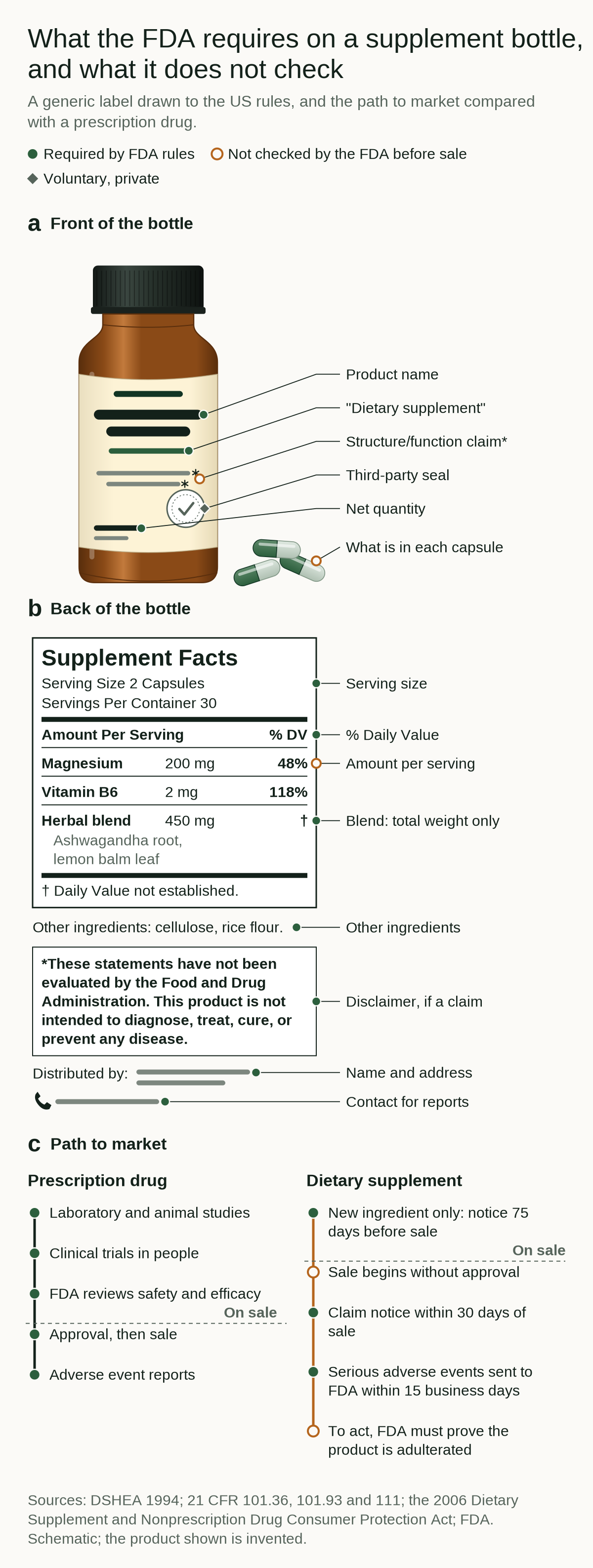
No. The FDA states that under DSHEA it “does not have the authority to approve dietary supplements before they are marketed,” and that by law it “does not approve dietary supplements or their labeling.”2 In many cases a company can start selling a supplement without notifying the agency at all.34
The one premarket step concerns new dietary ingredients, meaning ingredients not marketed in the United States before October 15, 1994. Unless the ingredient is already present in the food supply in a chemically unaltered form, the manufacturer or distributor must send the FDA a notification, with the safety information on which it relies, at least 75 days before selling the product.26 The notice is not an approval. In October 2026 the FDA issued final guidance on the identity and safety information such notifications should contain, describing the process as “the agency’s only opportunity to evaluate the safety of NDIs in dietary supplements before they become available to consumers.”12
Some substances cannot be sold as supplements at all. An article approved as a drug, or studied as a new drug in substantial, publicly disclosed clinical investigations, is excluded from the supplement definition unless it was sold as a supplement or food first.2 On this basis the FDA has concluded that products containing cannabidiol (CBD) cannot lawfully be sold as dietary supplements.15 In November 2026 the agency proposed, for the first time, to use its rulemaking power to lift such an exclusion, for N-acetyl-L-cysteine (NAC); comments close on January 19, 2027.13
How do you read a Supplement Facts label?
FDA rules require a product name with the words “dietary supplement” or an equivalent such as “herbal supplement,” the name and place of business of the manufacturer, packer or distributor, a Supplement Facts panel, a list of other ingredients and the net quantity of contents.2 The panel gives the serving size and servings per container and declares each dietary ingredient with its amount per serving, by weight, as a percentage of the Daily Value, or both.2 Ingredients in a proprietary blend are an exception: the blend’s total weight must be given, but the amount of each ingredient within it need not be.2 The label must also carry a domestic address or telephone number through which serious adverse events can be reported to the company.216
Statements such as “calcium builds strong bones” are structure/function claims. They describe an effect on the normal structure or function of the body, and the FDA does not approve them in advance; the company must have substantiation and must notify the agency no later than 30 days after first marketing the product with the claim.107 Any such claim must be linked to a disclaimer in bold type: “This statement has not been evaluated by the Food and Drug Administration. This product is not intended to diagnose, treat, cure, or prevent any disease.”7 A product whose label claims to treat or prevent a disease, or presents itself as a substitute for a disease therapy, is regulated as a drug unless the claim is an authorized health claim.7 In December 2025 the FDA said it would not enforce the rule that the disclaimer appear on every panel carrying a claim while it considers amending that rule; the requirement to carry the disclaimer and link it to each claim was unchanged.11 Nothing on the label tells a reader whether the amounts shown were measured in the product they are holding.
What does the FDA check after a supplement goes on sale?
Manufacturers must follow current good manufacturing practice rules, published in 2007 at 21 CFR part 111. Before using a dietary ingredient, a manufacturer must run at least one appropriate test to confirm its identity; for other components it may rely on a supplier’s certificate of analysis once it has qualified that supplier.8 For finished products, it must verify that batches meet its own specifications for identity, purity, strength, composition and contamination limits, either for every batch or for a subset chosen by a sound statistical sampling plan.8 The specifications are set by the company. The FDA checks compliance through inspections rather than by testing each product.2
The Dietary Supplement and Nonprescription Drug Consumer Protection Act, signed on December 22, 2006, requires the company named on the label to send the FDA any report of a serious adverse event it receives within 15 business days and to keep records for 6 years.16 Anyone else, including patients and clinicians, can report through the FDA’s Safety Reporting Portal.217 Reporting captures a small share of harms. An analysis by FDA staff of the 15,430 reports naming a supplement from 2004 through 2013 found that the 2006 law had a substantial effect on reporting, and estimated that only about 2% of supplement adverse events were reported.33
When it finds a problem, the FDA can send warning letters, publish consumer notices and press for recalls, and it lists products cited for hidden ingredients and other violations in its Health Fraud Product Database. The agency notes that the database covers “only a small fraction” of hazardous products on the market.1918 Entries posted in October and November 2026 include joint-pain products found to contain undeclared diclofenac and dexamethasone and sexual enhancement products with undeclared sildenafil or tadalafil.19 Banning an ingredient outright requires the agency to meet the burden of proof in DSHEA. The only ingredient listed in the regulation on supplements that present a significant or unreasonable risk is ephedrine alkaloids, declared adulterated in 2004.9
How do you know if a supplement is legit?
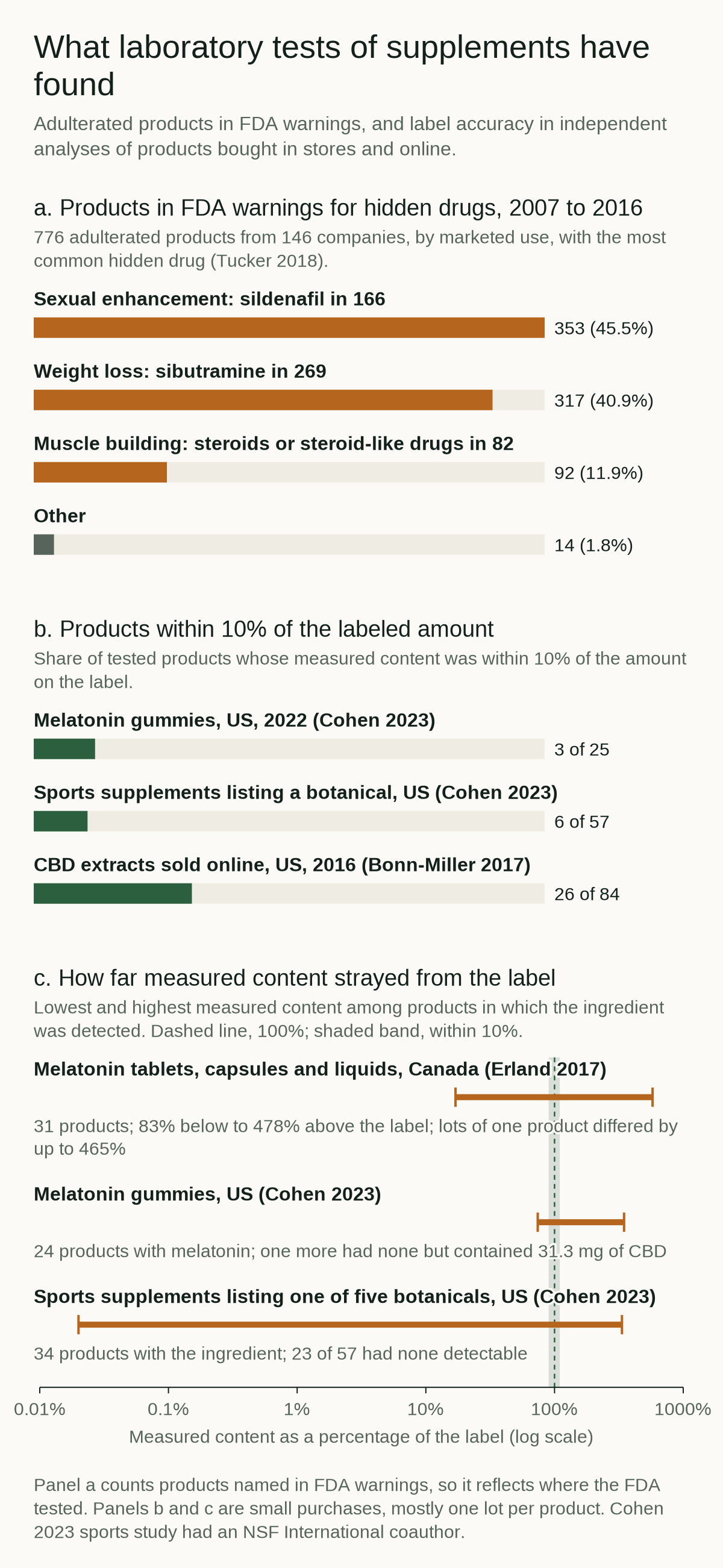
The most direct evidence comes from laboratories that buy products and measure what is in them. The largest analysis of hidden drugs used the FDA’s tainted supplements database: from 2007 through 2016 the agency issued warnings about 776 adulterated products from 146 companies.23 Most were sold for sexual enhancement (353, 45.5%), weight loss (317, 40.9%) or muscle building (92, 11.9%). Sildenafil was found in 166 of the sexual enhancement products, sibutramine, which the FDA describes as a banned weight-loss drug, in 269 of the weight-loss products, and synthetic steroids or steroid-like ingredients in 82 of the muscle-building products; 157 products (20.2%) contained more than one unapproved ingredient.23 These counts reflect what the FDA chose to test; from 2014 to 2016, 117 of 303 adulterated samples came from online purchases and 104 from international mail shipments. They show where the problem is concentrated rather than how common it is across all supplements.23 An international study from Cologne found anabolic steroids not declared on the label in 94 of 634 non-hormonal supplements (14.8%) bought in 13 countries in 2000 and 2001.24
Undeclared drugs also turn up in products sold for cognition and sport. Cohen and colleagues bought 10 supplements labeled as containing one of four drugs not approved for human use in the United States, such as aniracetam. They found five unapproved drugs across the products, some at up to four times pharmaceutical doses; several declared drugs were missing, and 9 of the 12 declared quantities were inaccurate.25 In 57 sports supplements listing one of five botanical ingredients, 23 (40%) contained none of the labeled ingredient, only 6 (11%) were within 10% of the labeled amount, and 7 (12%) contained at least one drug the FDA prohibits in supplements, such as 1,4-DMAA, octodrine or deterenol.26
Label accuracy is a separate problem from hidden drugs, and it extends to mainstream products. Erland and Saxena measured melatonin in 31 supplements bought in Ontario, Canada, and found content from 83% below to 478% above the label, with lots of the same product differing by up to 465%; eight contained serotonin.27 Of 25 melatonin gummy products bought in the United States in 2022, 22 (88%) were mislabeled and only 3 were within 10% of the declared dose; one contained no melatonin and 31.3 mg of CBD.28 Of 84 CBD extracts bought online in 2016, 26 (31%) were accurately labeled, 36 (43%) contained more CBD than stated and 22 (26%) less, and 18 contained tetrahydrocannabinol (THC).29 Among 30 immune-support supplements featured on Amazon in 2021, 13 had accurate labels, 13 listed ingredients that were not detected and 9 contained substances not on the label.30 Of 44 weight-loss supplements bought on or near 12 US military bases in 2023 and 2024, 36 (82%) had inaccurate labels and 16 (36%) contained hidden ingredients.31 None of the 74 products in the two military-funded studies carried a third-party certification seal.3031
A shopper cannot see these problems on the shelf. The Department of Defense’s Operation Supplement Safety program advises that “the only way to know the actual ingredients (or their amounts) in a dietary supplement product is through laboratory testing,” and suggests relying on a vetted independent program that has done it.35 Product categories matter: sexual enhancement, weight-loss and muscle-building products account for nearly all of the products in FDA hidden-drug warnings, and the FDA warns that contaminated products are sold through large online marketplaces, social media advertisements, gas stations and supplement stores.2318 The FDA’s Health Fraud Product Database can be searched by product name, with the caveat that absence from it does not mean a product is safe.1918
What is the difference between NSF certification and third-party tested?
“Third-party tested” has no legal definition, and a company can print it without saying who tested what. A certification program is a named organization that tests and audits a product against a published standard and licenses its mark for use on the label. The only published standard for supplement certification is NSF/ANSI 173, according to the Department of Defense guidance, and each program sets its own list of what it tests for.35 A 2019 consensus statement from the US Anti-Doping Agency, Major League Baseball and its players’ association, the UFC and the Uniformed Services University proposed minimum features for such programs, including accreditation to ISO 17065 and impartiality from the companies being certified.3431
The programs describe their own work as follows. USP Verified requires an audit of the manufacturing site against FDA good manufacturing practice and USP’s own chapter, a review of quality-control documents, laboratory testing against USP–NF or the manufacturer’s specifications, and later testing of products bought off the shelf.36 NSF certification under NSF/ANSI 173 combines a review that the label matches the contents, a toxicology review of intentionally added ingredients and screening for undeclared ingredients and unacceptable contaminant levels, with annual audits; NSF Certified for Sport adds screening for 280 substances banned by most major athletic organizations.37 Informed Sport, run by LGC Group, says it tests every batch of a certified sports product for substances banned in sport before release, and its directory can be searched by batch number.38 ConsumerLab tests products it selects and publishes the results to subscribers, and separately certifies products for manufacturers who pay a testing fee, checking identity, strength, specified contaminants and disintegration and retesting a sample bought on the open market every 12 months.3940 The Department of Defense lists four programs it considers well vetted (those of BSCG, Informed Sport, NSF Certified for Sport and USP Verified) and notes that USP Verified does not screen for substances banned in sport.35
The Department of Defense guidance is explicit about the limits of certification: “Third-party certification does not mean the product has been evaluated for safety (whether it could cause an adverse event) or effectiveness (whether it works the way it is claimed to). It means the product content and label match.”35 A seal also says nothing about whether a dose is right for a particular person or how the ingredient interacts with their medicines. We found no published study that bought certified and uncertified products of the same type and compared their label accuracy, so the benefit of a seal rests on what the programs test rather than on independent comparisons. Several of the laboratory studies above were run by researchers who also work with certifiers: Cohen has collaborated with NSF International, and the 2023 sports supplement study had an NSF International coauthor.2526
Are supplements safer than drugs?
The question cannot be answered for supplements as a class, because they range from vitamin D to stimulant blends, and most have never been compared with a drug in a trial. National surveillance gives a sense of the harms. Using data from 63 emergency departments from 2004 through 2013, researchers from the Centers for Disease Control and Prevention and the FDA estimated that adverse events from supplements led to 23,005 emergency visits and 2,154 hospitalizations a year in the United States.32 Weight-loss and energy products accounted for 71.8% of the supplement-related visits for palpitations, chest pain or rapid heartbeat, and more than half of those visits involved people aged 20 to 34; among adults 65 and older, choking or difficulty swallowing pills caused 37.6% of supplement-related visits, mostly with vitamins and minerals.32 The study was funded by the Department of Health and Human Services.32
Hidden drugs add risk that a label cannot reveal, including interactions with prescribed medicines and with underlying conditions.23 Even a correctly labeled supplement can change how a prescribed medicine works; our article on supplement and prescription medicine interactions reviews the combinations with the best evidence. The FDA advises talking to a doctor, pharmacist or other health professional before using a supplement, partly for this reason.2 Supplements are not a substitute for a prescribed medicine, and any change to a medicine is a decision to make with the prescriber or pharmacist.
What changed in 2025 and 2026?
The framework set in 1994 has not changed, and the FDA’s recent steps have been small. In December 2025 it announced enforcement discretion on where the DSHEA disclaimer must appear, citing requests to change the rule, made in response to a federal deregulation request for information.11 In March 2026 it held a public meeting on what counts as a “dietary substance” under DSHEA and on ingredients made by newer methods such as precision fermentation.14 In October 2026 it made final several sections of guidance on new dietary ingredient notifications that it had first proposed in 2016, and in November 2026 it proposed allowing NAC in supplements.1213 Congress has not changed the law. The Dietary Supplement Listing Act of 2026, which would require every supplement sold in the United States to be listed with the FDA with its label and ingredients, was introduced in the Senate in January 2026 and in the House in April 2026, and as of November 2026 neither bill had left committee.2021
How can the Thryval app help?
The Thryval app (App Store, Google Play) works at the level of ingredients rather than products. Each herb or supplement entry shows what kind of research backs it, from meta-analyses and randomized trials to regulatory monographs, observational studies and traditional use, with the citations, journals and publication years, so a reader can see what a label’s claim rests on before buying. Entries can be searched by substance, symptom or condition, and the app flags known interactions between a substance and FDA-approved medicines, drawn from clinical pharmacology references; a flag is a prompt to talk to a pharmacist or prescriber, and the absence of one does not mean a combination has been studied. The app does not test products or rate brands, so it cannot say whether a particular bottle contains what its label states. For anyone who has started a supplement and wants to judge it fairly, our guide to tracking whether a supplement is working describes how to keep a useful record.
How good is the evidence, and who paid for it?
The legal statements in this article come from the statute, the regulations and the FDA’s own descriptions, so they are not in doubt, although how the FDA enforces them depends on its resources and priorities, which we did not measure. The evidence on product quality is consistent but thin in a particular way. Each laboratory study bought a small sample, usually 25 to 84 products and often one lot per product, from a category chosen because problems were suspected, so the studies show that mislabeling is common in those categories without estimating its rate across the market.28262930 The FDA warning data describe the products the agency tested, which were weighted toward online orders and international mail.23 The emergency visit estimates come from a national surveillance sample and depend on clinicians recording a supplement as the cause.32
Funding and conflicts: Tucker 2018 had no funding and was done by California Department of Public Health staff.23 Erland 2017 was funded by Canada’s Natural Sciences and Engineering Research Council and declared no conflicts.27 Cohen reported research support from Consumers Union and the Pew Charitable Trusts and royalties from UpToDate, and a jury found in his favor in a civil suit brought by a supplement company, Hi-Tech Pharmaceuticals; his 2021 paper discloses collaboration with NSF International, and the 2023 sports study had an NSF International coauthor. His coauthor Khan reported grants from the FDA, NIH and USDA and coordinates a botanical science conference supported by supplement companies.252826 Bonn-Miller 2017 was funded by the Institute for Research on Cannabinoids, and two authors reported fees from cannabis and pharmaceutical companies.29 Crawford 2022 and 2024 were funded by the Department of Defense’s Operation Supplement Safety program, which also publishes the certification guidance quoted here.303135 Geller 2015 was funded by HHS, and the authors of the 2018 adverse event analysis were FDA staff.3233 The descriptions of USP, NSF, Informed Sport and ConsumerLab programs are the organizations’ own and were not independently checked.
What remains uncertain?
No study we found estimates the share of all US supplements whose contents match their labels, or compares products with and without a certification seal bought in the same way. How often FDA inspections find good manufacturing practice violations, and how quickly hidden-drug products return after warnings, was outside the sources checked for this article, although 28 products in the 2007 to 2016 warnings were named more than once, 19 of them with new hidden ingredients.23 Whether the proposed listing requirement would improve product quality is untested, and its passage is uncertain.2021 The laboratory studies were done between 2000 and 2024, and products and formulations change.
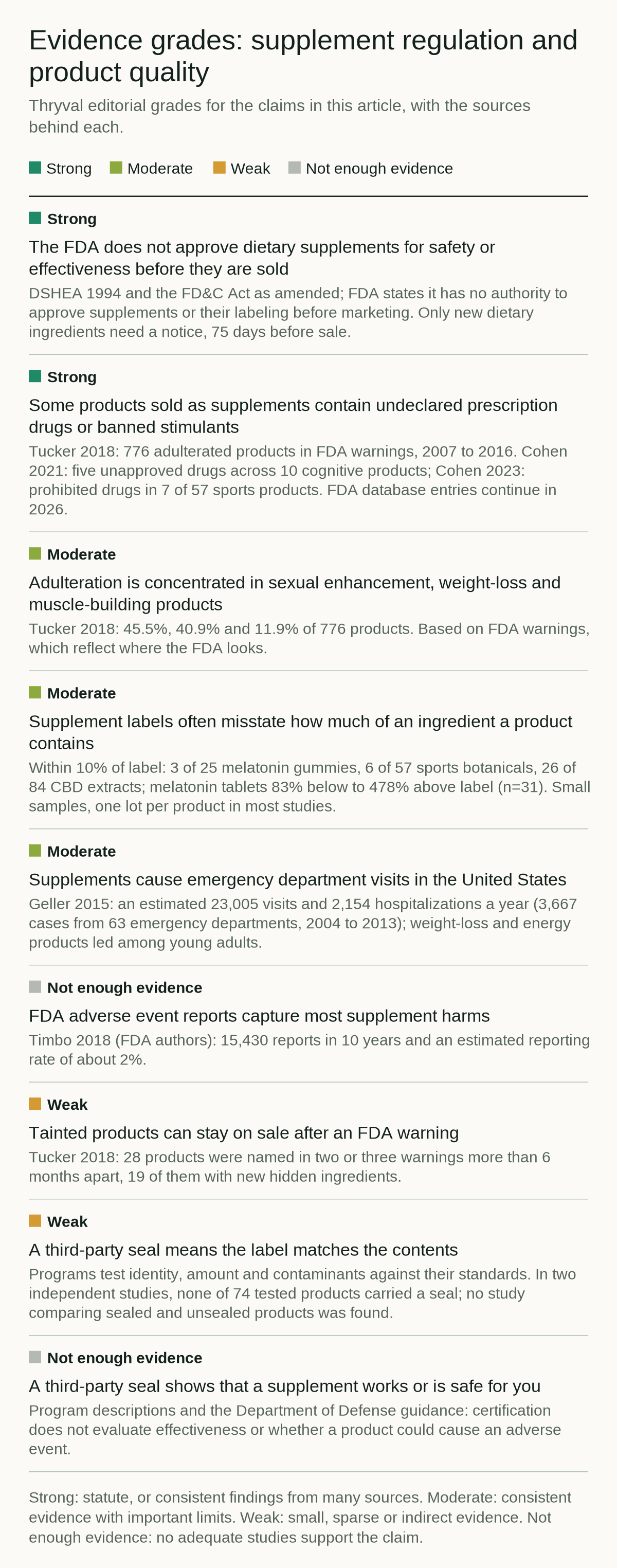
Evidence grades
The grades below are Thryval editorial judgments based on the studies and legal sources cited in this article. The grading rules are set out on our Research page.
Frequently asked questions
Do herbal supplements need FDA approval?
No. Herbs and other botanicals are dietary ingredients under DSHEA, and the FDA does not approve dietary supplements, herbal or otherwise, before they are sold.2 A botanical that was not marketed in the United States before October 15, 1994 is a new dietary ingredient and needs a safety notification to the FDA 75 days before sale, unless it is already in the food supply in an unaltered form; the notification is not an approval.26
Is creatine FDA approved?
Creatine sold in US stores is marketed as a dietary supplement, and the FDA does not approve supplements; the manufacturer is responsible for its safety and labeling.2 The absence of approval says nothing either way about whether creatine works. Our article on creatine and the brain reviews the trials.
How is my local nutrition shop allowed to sell ephedra?
Since 2004 an FDA regulation has declared dietary supplements containing ephedrine alkaloids adulterated because they present an unreasonable risk of illness or injury, so a supplement that contains them cannot lawfully be sold.9 We cannot tell from a product name what is inside it. Laboratory studies have found other stimulants the FDA prohibits in supplements, such as 1,4-DMAA, octodrine and deterenol, in sports supplements.26 A product suspected of containing a banned ingredient can be reported to the FDA through the Safety Reporting Portal.17
How can you tell if supplements are fake?
The package alone is not a reliable guide. Counterfeit and contaminated products are sold through large online marketplaces and in stores, and the FDA recommends checking its Health Fraud Product Database, which lists only a fraction of such products.1819 Products sold for sexual enhancement, weight loss or muscle building carry the highest risk of hidden drugs.23 For a product bearing a certification seal, the certifier’s own website lists the products it has certified, and Informed Sport’s directory can be searched by batch number.3835
Is it safe to take supplements without seeing a doctor?
The FDA advises talking to a doctor, pharmacist or other health professional before buying or using a supplement, in part because some supplements interact with medicines or with other supplements.2 That advice matters most for people who take prescription medicines, are pregnant or breastfeeding, or are older; adults 65 and older were most often seen in emergency departments for pills that were hard to swallow.32 Anyone who has a reaction should see a clinician, and the reaction can be reported to the FDA.17
Implications for patients and clinicians
A supplement label is a manufacturer’s statement that no regulator has checked before sale, and the FDA’s power to act afterward depends on proving harm or finding violations. Laboratory studies give good reason to doubt labels in the categories they examined, especially stimulant, sexual enhancement and muscle-building products, and the FDA’s own warnings point the same way. A certification seal adds an outside check that the contents match the label, without saying whether the product works or suits the person taking it. For clinicians, asking patients for the exact product and brand, and not only the ingredient, makes it possible to check FDA notices and certifier listings. Questions about combining a supplement with a prescribed medicine belong with the prescriber or pharmacist, and no supplement should replace a prescribed treatment without that conversation.
This article is for education and is not medical advice.
References
-
Dietary Supplement Health and Education Act of 1994. Public Law 103-417, 108 Stat. 4325, October 25, 1994. Sec. 4 places the burden of proof on the United States; Sec. 8 creates the 75-day new dietary ingredient notification. GovInfo ↩↩↩↩
-
US Food and Drug Administration. Questions and Answers on Dietary Supplements. Content current as of August 27, 2026. FDA ↩↩↩↩↩↩↩↩↩↩↩↩↩↩↩↩↩↩↩↩↩↩↩
-
US Food and Drug Administration. Information for Consumers on Using Dietary Supplements. Content current as of October 21, 2022. FDA ↩↩
-
US Food and Drug Administration. Is It Really “FDA Approved”? Consumer update; content current as of May 4, 2026. FDA ↩↩
-
21 U.S.C. 342, Adulterated food, paragraph (f) on dietary supplements and the burden of proof. United States Code, 2023 edition. GovInfo ↩
-
21 U.S.C. 350b, New dietary ingredients. United States Code, 2023 edition. GovInfo ↩↩↩
-
21 CFR 101.93, Certain types of statements for dietary supplements (30-day notification, disclaimer text and placement, disease claims). Electronic Code of Federal Regulations. eCFR ↩↩↩
-
21 CFR 111.75, What must you do to determine whether specifications are met? Part 111, current good manufacturing practice for dietary supplements (72 FR 34942, June 25, 2007). Electronic Code of Federal Regulations. eCFR ↩↩
-
21 CFR part 119, Dietary supplements that present a significant or unreasonable risk; section 119.1, ephedrine alkaloids (69 FR 6853, February 11, 2004). Electronic Code of Federal Regulations. eCFR ↩↩
-
US Food and Drug Administration. Structure/Function Claims. Content current as of March 28, 2024. FDA ↩
-
US Food and Drug Administration. Letter to the Dietary Supplement Industry on the DSHEA Disclaimer. December 11, 2025. FDA ↩↩
-
US Food and Drug Administration. FDA Issues Guidance on Identity and Safety Information for New Dietary Ingredient Notifications. Constituent update, October 19, 2026. FDA ↩↩
-
US Food and Drug Administration. FDA Issues Proposed Rule on NAC Products as Dietary Supplements. Constituent update, November 16, 2026; Federal Register comments due January 19, 2027. FDA ↩↩
-
US Food and Drug Administration. Public Meeting: Exploring the Scope of Dietary Supplement Ingredients, March 27, 2026. Docket FDA-2026-N-2047. FDA ↩
-
US Food and Drug Administration. FDA Regulation of Cannabis and Cannabis-Derived Products, Including Cannabidiol (CBD). Question 9. Content current as of July 16, 2024. FDA ↩
-
Dietary Supplement and Nonprescription Drug Consumer Protection Act. Public Law 109-462, December 22, 2006 (serious adverse event reports within 15 business days; records kept 6 years; domestic address or telephone number on the label). GovInfo ↩↩
-
US Food and Drug Administration. How to Report a Problem with Dietary Supplements. FDA ↩↩↩
-
US Food and Drug Administration. Health Fraud Product Database. Accessed November 23, 2026. FDA ↩↩↩↩↩
-
S.3677, Dietary Supplement Listing Act of 2026. 119th Congress; introduced January 15, 2026 and referred to the Committee on Health, Education, Labor, and Pensions. Congress.gov ↩↩
-
H.R.8370, Dietary Supplement Listing Act of 2026. 119th Congress; introduced April 20, 2026 and referred to the Committee on Energy and Commerce. Congress.gov ↩↩
-
Mishra S, Stierman B, Gahche JJ, Potischman N. Dietary supplement use among adults: United States, 2017–2018. NCHS Data Brief. 2021;(399):1–8. National survey (NHANES). CDC · PubMed 33663653 ↩
-
Tucker J, Fischer T, Upjohn L, Mazzera D, Kumar M. Unapproved pharmaceutical ingredients included in dietary supplements associated with US Food and Drug Administration warnings. JAMA Netw Open. 2018;1(6):e183337. Analysis of the FDA tainted supplements database, 2007 to 2016; California Department of Public Health authors; no funding; corrected November 2018. PMC6324457 · PubMed 30646238 ↩↩↩↩↩↩↩↩↩↩↩↩↩
-
Geyer H, Parr MK, Mareck U, Reinhart U, Schrader Y, Schänzer W. Analysis of non-hormonal nutritional supplements for anabolic-androgenic steroids: results of an international study. Int J Sports Med. 2004;25(2):124–129. 634 supplements from 13 countries; funding not seen in the abstract. PubMed 14986195 ↩
-
Cohen PA, Avula B, Wang YH, Zakharevich I, Khan I. Five unapproved drugs found in cognitive enhancement supplements. Neurol Clin Pract. 2021;11(3):e303–e307. 10 products; no targeted funding; Cohen disclosed collaboration with NSF International. PMC8382366 · PubMed 34484905 ↩↩↩↩
-
Cohen PA, Avula B, Katragunta K, Travis JC, Khan I. Presence and quantity of botanical ingredients with purported performance-enhancing properties in sports supplements. JAMA Netw Open. 2023;6(7):e2323879. 57 products; one author from NSF International. PMC10352857 · PubMed 37459101 ↩↩↩↩↩↩↩
-
Erland LA, Saxena PK. Melatonin natural health products and supplements: presence of serotonin and significant variability of melatonin content. J Clin Sleep Med. 2017;13(2):275–281. 31 products from 16 brands bought in Guelph, Ontario; funded by NSERC; no conflicts. PMC5263083 · PubMed 27855744 ↩↩↩
-
Cohen PA, Avula B, Wang YH, Katragunta K, Khan I. Quantity of melatonin and CBD in melatonin gummies sold in the US. JAMA. 2023;329(16):1401–1402. 25 products. PMC10130950 · PubMed 37097362 ↩↩↩↩
-
Bonn-Miller MO, Loflin MJE, Thomas BF, Marcu JP, Hyke T, Vandrey R. Labeling accuracy of cannabidiol extracts sold online. JAMA. 2017;318(17):1708–1709. 84 products from 31 companies; funded by the Institute for Research on Cannabinoids; two authors reported fees from cannabis and pharmaceutical companies. PMC5818782 · PubMed 29114823 ↩↩↩↩
-
Crawford C, Avula B, Lindsey AT, et al. Analysis of select dietary supplement products marketed to support or boost the immune system. JAMA Netw Open. 2022;5(8):e2226040. 30 products bought from Amazon in May 2021; funded by the Department of Defense (CHAMP and Operation Supplement Safety); no conflicts. PMC9366544 · PubMed 35947382 ↩↩↩↩↩↩
-
Crawford C, Lindsey AT, Avula B, et al. Label accuracy and quality of select weight-loss dietary supplements sold on or near US military bases. Nutrients. 2024;16(24):4369. 44 products from 12 installations, March 2023 to January 2024; funded by CHAMP and Operation Supplement Safety; no conflicts. PMC11678486 · PubMed 39770990 ↩↩↩↩↩↩
-
Geller AI, Shehab N, Weidle NJ, et al. Emergency department visits for adverse events related to dietary supplements. N Engl J Med. 2015;373(16):1531–1540. National surveillance, 63 emergency departments, 2004 to 2013; funded by HHS. PMC6196363 · PubMed 26465986 ↩↩↩↩↩↩↩
-
Timbo BB, Chirtel SJ, Ihrie J, et al. Dietary supplement adverse event report data from the FDA Center for Food Safety and Applied Nutrition Adverse Event Reporting System (CAERS), 2004–2013. Ann Pharmacother. 2018;52(5):431–438. FDA authors. PubMed 29171279 ↩↩↩
-
Eichner AK, Coyles J, Fedoruk M, et al. Essential features of third-party certification programs for dietary supplements: a consensus statement. Curr Sports Med Rep. 2019;18(5):178–182. Authors from USADA, MLB, the MLB Players Association, the UFC and the Uniformed Services University. PubMed 31082891 ↩
-
Operation Supplement Safety, Uniformed Services University (US Department of Defense). Why is third-party certification important for dietary supplements? Accessed November 23, 2026. OPSS ↩↩↩↩↩↩↩↩↩
-
US Pharmacopeia. Dietary Supplement Verification Program. Program description by the certifier. Accessed November 23, 2026. USP ↩↩
-
NSF. Supplement and Vitamin Certification. Program description by the certifier. Accessed November 23, 2026. NSF ↩↩
-
Informed Sport (LGC Group). Program description by the certifier. Accessed November 23, 2026. Informed Sport ↩↩
-
ConsumerLab.com. About ConsumerLab.com. Description by the company. Accessed November 23, 2026. ConsumerLab ↩
-
ConsumerLab.com. Quality Certification Program. Description by the company; testing fee paid by the manufacturer. Accessed November 23, 2026. ConsumerLab ↩