
How can you tell if a supplement is working? What the research on self-tracking shows
People given placebo in supplement trials often improve as much as people given the real product, so feeling better after starting something new is weak evidence that it works. Blinded self-experiments, time-stamped records and the right blood test can do better, within limits.
The grade StrongImprovement in self-reported symptoms after starting a supplement often happens without it; placebo groups in supplement trials improve substantially
In brief. Feeling better after starting a supplement is a poor guide to whether it works. In randomized trials, people given placebo often improve substantially: 60.1% of the placebo group in a 1,583-person glucosamine trial met the knee-pain target, fatigue scores fell 28.8% on placebo in an iron trial, and men on placebo in a saw palmetto trial improved more than men on the extract.132 Much of this comes from symptoms drifting back toward their usual level after a bad spell, a statistical effect called regression to the mean; compared with no treatment, a placebo itself has only a small effect.57 The most reliable personal test is a blinded N-of-1 trial, in which one person takes the supplement and identical dummy capsules in random order and compares the periods.1516 Time-stamped diaries are more trustworthy than memory, wrist wearables measure heart rate better than calories, and a blood test can show whether a nutrient level rose, but a higher level does not prove you feel better because of it.24222526 None of this applies to prescribed medicines, which should only be changed with the prescriber.
People who take supplements usually judge them by how they feel. Clinical research learned long ago that this judgment is unreliable, for reasons that have little to do with honesty or intelligence. This article reviews the evidence on why symptoms improve without an active treatment, what single-person trials have shown when supplements were tested properly, how accurate the common self-tracking tools are, and which blood tests answer which questions.
How do you know if a supplement is working?
The only way to separate the effect of a supplement from everything else that changes your symptoms is to compare periods on and off it under conditions where you do not know which is which. Large trials do this across many people. For one person, the equivalent is the N-of-1 trial, described in The New England Journal of Medicine in 1986 by Gordon Guyatt and colleagues at McMaster University: a single patient takes pairs of treatment periods, one active and one placebo per pair, in an order decided at random, with an agreed measure of the result.15
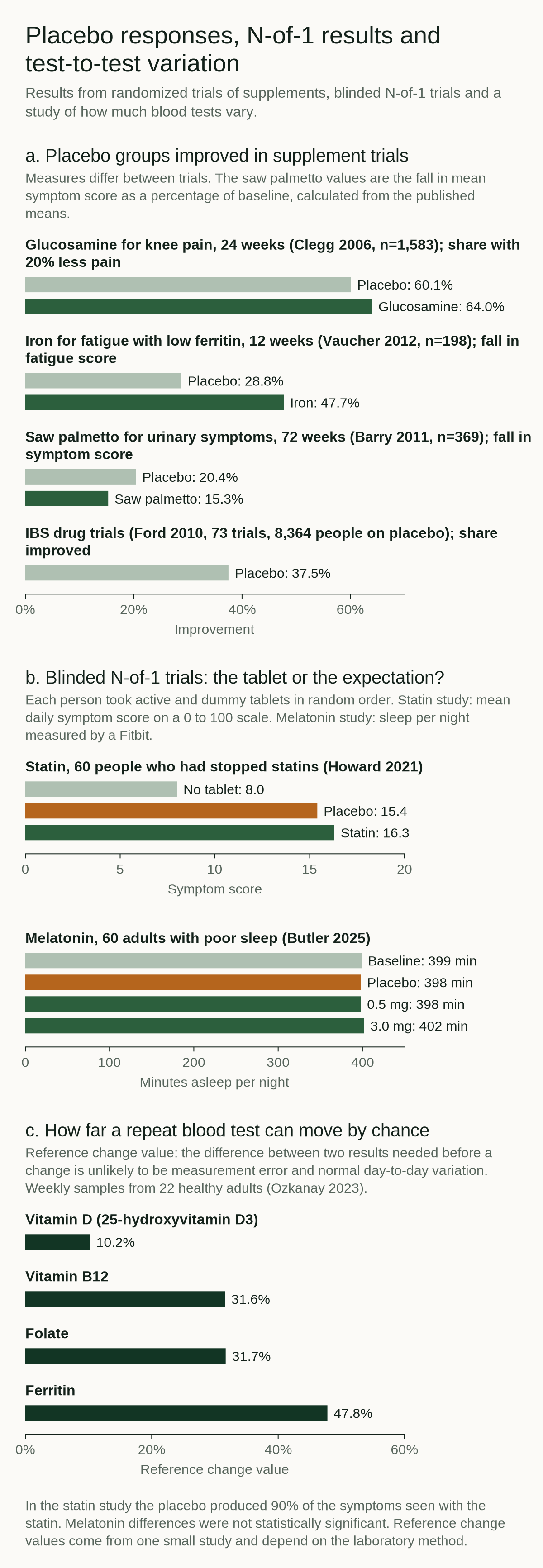
Two observations explain why anything less is easy to misread. First, the people in the placebo arms of supplement trials improve a great deal. In the Glucosamine/chondroitin Arthritis Intervention Trial (GAIT), 1,583 people with knee osteoarthritis were randomized to glucosamine, chondroitin, both, the anti-inflammatory drug celecoxib or placebo for 24 weeks. A 20% reduction in knee pain was reached by 60.1% of the placebo group and by 64.0% of the glucosamine group, a difference that was not statistically significant; celecoxib was 10.0 percentage points better than placebo.1 In the CAMUS trial of 369 men with urinary symptoms from an enlarged prostate, the symptom score fell by 2.99 points on placebo and 2.20 points on saw palmetto over 72 weeks, even though the extract dose was raised to three times the standard amount.2 Across 73 randomized trials of drugs for irritable bowel syndrome (IBS), 37.5% of 8,364 people given placebo reported improvement.4 Anyone who took glucosamine or saw palmetto outside a trial and felt better would have had good reason to credit the supplement, and the trials show that most of that improvement would have happened anyway.
Second, a real effect can still be present when the placebo response is large. In a French trial of 198 menstruating women with unexplained fatigue, ferritin below 50 µg/L and no anemia, fatigue scores fell by 47.7% with 80 mg of elemental iron a day and by 28.8% with placebo over 12 weeks.3 Women in the iron group could not have known from their own experience that about three-fifths of their improvement also occurred in the placebo group. Our article on iron supplements and fatigue reviews that evidence in detail.
Should you trust how you feel after starting a supplement?
How you feel is the outcome that matters, but the feeling on its own cannot tell you what caused it. Several processes push in the same direction.
Why do people improve on placebo?
Most improvement in placebo groups is not caused by the placebo. Asbjørn Hróbjartsson and Peter Gøtzsche at the Nordic Cochrane Centre reviewed trials that randomized patients to placebo or to no treatment at all, which separates the effect of taking a dummy pill from the natural course of the illness. In their 2001 analysis of 114 trials with usable data, placebo had no significant effect on binary or objective outcomes and a small effect on continuous self-reported outcomes; for pain, it corresponded to 6.5 mm on a 100 mm scale.6 Their 2010 Cochrane update of 202 trials found a standardized mean difference of −0.23 for continuous outcomes, larger for patient-reported than for observer-reported measures, and no significant effect in insomnia, anxiety or depression trials, though with wide confidence intervals.7
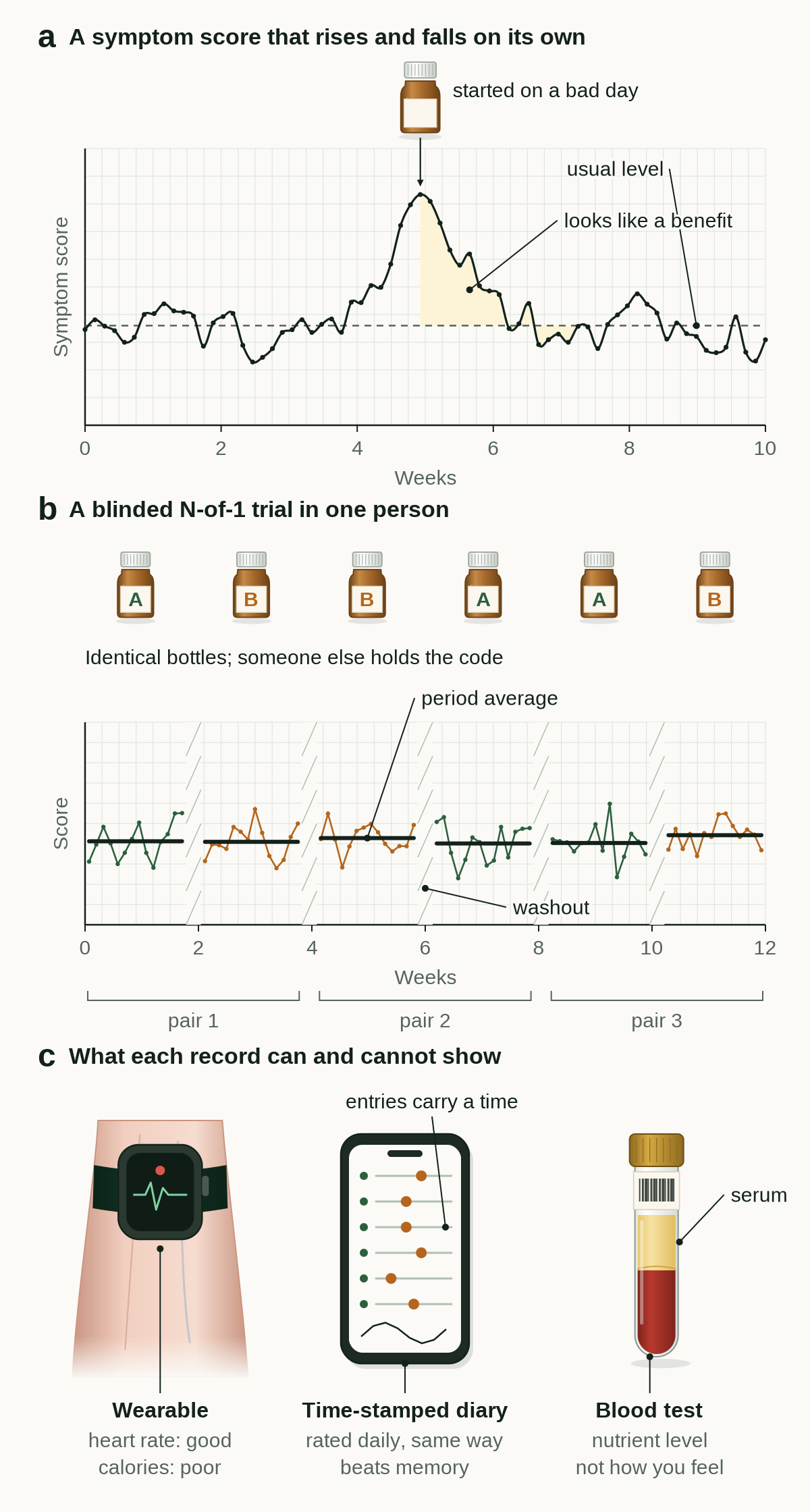
The rest of the improvement comes from the natural course of the condition and from regression to the mean. Adrian Barnett and colleagues describe regression to the mean as “a statistical phenomenon that can make natural variation in repeated data look like real change”: unusually high or low measurements tend to be followed by measurements closer to the average, and the effect is largest when a group is selected because its first measurement was extreme.5 People usually start a supplement when a symptom is at its worst, which is exactly that selection. Figure 1a shows the pattern.
Expectation also matters. In a three-week trial at Beth Israel Deaconess Medical Center in Boston, 80 people with IBS were randomized to pills openly described as placebo or to no pills, with the same amount of contact with clinicians; global improvement scores were 5.0 versus 3.9 at day 21, and symptom severity was also lower with the placebo pills.8 A 2021 meta-analysis of 11 such open-label placebo trials found a standardized mean difference of 0.72, with moderate risk of bias and wide variation between studies.9
Can expectation cause side effects too?
Yes, and the evidence comes from N-of-1 trials. In the SAMSON study at Imperial College London, 60 people who had stopped statins because of side effects each received 12 monthly bottles: 4 with atorvastatin 20 mg, 4 with placebo and 4 empty, in random order, and rated their symptoms daily on a phone app from 0 to 100. Mean symptom scores were 8.0 in months with no tablet, 15.4 in placebo months and 16.3 in statin months, with no significant difference between statin and placebo; the authors calculated that 90% of the symptoms caused by taking statin tablets also occurred with placebo.1011 The StatinWISE trial, run at 50 primary care sites in the United Kingdom, ran the same kind of trial in 200 people with six double-blind two-month periods and found no difference in muscle symptom scores between statin and placebo periods (mean difference −0.11 on a 0 to 10 scale).12 Neither study involved supplements, but both show that symptoms people confidently attribute to a tablet often appear with a dummy tablet as well.
How reliable is memory of symptoms?
Less reliable than most people assume. Donald Redelmeier and Daniel Kahneman recorded pain in real time in 154 patients having colonoscopy and 133 having kidney stone lithotripsy, then asked them to rate the whole experience; remembered pain tracked the worst moment and the last three minutes, not the duration.13 In a later randomized trial in 682 colonoscopy patients, adding a short interval at the end with the instrument left in place made the final moments less painful, and those patients remembered the whole procedure as less unpleasant, although it was longer.14 A weekly or monthly impression of whether a supplement is helping is subject to the same distortion.
Can you run an N-of-1 trial on yourself?
The method has been used in medicine for four decades. A systematic review led by Salima Punja found 100 published N-of-1 trial reports with 1,995 participants across more than 50 conditions; most used randomization, blinding and formal outcome measures.16 A reporting standard, the CONSORT extension for N-of-1 trials (CENT), was published in The BMJ in 2015.17
Several have tested supplements, and their results are instructive:
- Valerian for insomnia. In a series of N-of-1 trials in general practices in Queensland, Australia, 24 of 42 enrolled patients provided enough data. Valerian was not appreciably better than placebo for sleep in any individual patient or in the group as a whole.18
- Spirulina for fatigue. Four physicians with chronic fatigue each took three pairs of four-week periods of spirulina 3 g a day and placebo in random order. Fatigue scores did not differ between spirulina and placebo in any of the four.19
- Melatonin for poor sleep. In 60 digital N-of-1 trials run by researchers at Northwell Health in New York, each participant had a two-week baseline and then six two-week blocks of 3.0 mg melatonin, 0.5 mg melatonin or placebo. Sleep measured by a Fitbit averaged 399 minutes a night at baseline, 398 on placebo, 398 on 0.5 mg and 402 on 3.0 mg, and sleep diaries showed no difference in quality either.20 This is consistent with the small average effects described in our article on melatonin and sleep.
The features these trials share are the ones that make a personal test informative. One outcome is chosen in advance and measured the same way each day. A baseline period shows how much it varies without any change. The supplement and an identical-looking placebo are taken in randomized pairs of periods, which in practice means someone else prepares and codes the containers. Periods are long enough for the supplement to act and for any effect to wear off, and the comparison is between period averages, not single days.151920
The evidence that this improves health is weaker than the evidence that it is feasible. In a trial led by Richard Kravitz at the University of California, Davis, 215 people with chronic musculoskeletal pain were randomized to app-supported N-of-1 trials comparing two pain treatments or to usual care. At six months, pain interference had fallen in both groups, with no significant difference between them; the only advantage was more shared decision-making about medicines.21 N-of-1 trials of prescription drugs belong with the prescriber, and anyone combining supplements with prescription medicines should check for interactions first; our article on supplement and prescription drug interactions covers the best-documented ones.
How accurate are wearables and symptom diaries?
The answer depends on what is being measured. In a Stanford study of 60 adults who wore seven wrist devices, including the Apple Watch and Fitbit Surge, while heart rate was recorded by telemetry and energy expenditure by indirect calorimetry, six devices had a median heart-rate error below 5% during cycling. No device estimated energy expenditure with an error below 20%, and errors were higher during walking, at higher body mass index and with darker skin tone.22
For sleep, researchers at the Naval Health Research Center compared seven consumer devices with polysomnography in 34 young adults over three nights. The devices detected sleep well (epoch-by-epoch sensitivity of 0.93 or more) but were much less accurate at detecting wake (specificity 0.18 to 0.54), performed worse on nights of disrupted sleep, and gave inconsistent sleep-stage results.23 A tracker can show a large change in sleep timing or duration more reliably than a small change in deep sleep.
Diaries have a different weakness. In a study by Arthur Stone and colleagues, people with chronic pain were asked to record pain three times a day for 21 days in either a paper diary instrumented to record when it was opened or an electronic diary that time-stamped each entry. Paper diary cards were handed in for 90% of the assigned times, but the recorded openings showed actual compliance of 11%, and on 32% of days the binder was never opened. Compliance with the electronic diary was 94%.24 Ratings entered at the time, with a time stamp, avoid both back-filling and the memory distortions described above.
How long should you try a supplement before deciding if it works?
There is no general answer, and the best guide is the length of the trials that tested that supplement for that outcome. The glucosamine trial ran for 24 weeks, the CAMUS saw palmetto trial for 72 weeks and the French iron trial for 12 weeks, with blood tests at 6 and 12 weeks; the iron trial’s authors suggested checking blood markers after six weeks of treatment.123 For vitamin D, the NIH Office of Dietary Supplements (ODS) gives the main blood marker, 25-hydroxyvitamin D, a circulating half-life of about 15 days.29 By the usual pharmacokinetic rule that a level settles after four to five half-lives, a change in dose takes roughly two months to show its full effect on the blood level; this is our calculation, not a figure from ODS.
Short tests have a specific problem. In the IBS meta-analysis, trials with shorter treatment periods had higher placebo response rates.4 A two-week impression is more likely to reflect expectation and regression to the mean than a comparison sustained over several months.
Which blood tests show whether a supplement is working?
A blood test can show whether a supplement changed the level of what it contains. It cannot, on its own, show that the change is why you feel different.
- Vitamin D. ODS describes serum 25-hydroxyvitamin D as the main indicator of vitamin D status, and notes that the extent to which it is also a marker of effects on health is not clear.29 In a study of 67 men in Omaha given 0, 25, 125 or 250 µg (0 to 10,000 IU) of vitamin D3 a day for about 20 weeks over winter, levels changed in proportion to dose by about 0.7 nmol/L for each additional microgram a day, which works out to roughly 17 nmol/L (7 ng/mL) for 1,000 IU.25 Our article on vitamin D in people who are not deficient covers what the large trials found.
- Iron. Ferritin reflects iron stores, and ODS states that a value below 30 µg/L suggests iron deficiency; inflammation can raise ferritin and mask deficiency.30 In the French trial, iron raised ferritin by 11.4 µg/L and hemoglobin by 0.32 g/dL more than placebo at 12 weeks.3
- Vitamin B12. Serum B12 is the usual test, with values below 200 to 250 pg/mL generally considered low. ODS describes methylmalonic acid (MMA) as the most sensitive marker and suggests checking it when B12 is between 150 and 399 pg/mL; MMA also rises with reduced kidney function and with age.31
- Magnesium. Because most of the body’s magnesium is inside cells or in bone, ODS states that serum magnesium does not accurately reflect total body magnesium.32 A normal serum level after weeks of supplementation says little either way, as our article on magnesium and sleep discusses.
Two cautions apply to repeat tests. Results vary from week to week even when nothing changes. In a study that sampled 22 healthy adults weekly for five weeks, the difference between two results needed before a change was unlikely to reflect normal variation and measurement error (the reference change value) was 10.2% for vitamin D3, 31.6% for vitamin B12, 31.7% for folate and 47.8% for ferritin.27 Supplements can also distort tests directly: in a nonrandomized crossover study of 6 adults, 10 mg of biotin a day gave falsely high or low results on 9 of 23 laboratory assays that use biotin chemistry, including thyroid tests.28
A higher level is not the same as a benefit. In the VITAL-DEP study, 18,353 US adults aged 50 or older were randomized to 2,000 IU of vitamin D3 a day or placebo for a median of 5.3 years; there was no difference in the risk of depression or in mood scores.26 The iron trial points the other way: in women whose ferritin was low, raising it was accompanied by less fatigue than placebo.3 Blood tests are most informative when they are used to confirm and then correct a deficiency.
How can the Thryval app help?
The Thryval app (App Store, Google Play) can help with the step before any self-test: finding out what the research has measured. Each herb or supplement entry shows what kind of research backs it, from meta-analyses and randomized trials to observational studies and traditional use, with the citations, journals and publication years, and maps it to conditions, body systems and related FDA medicines. Looking up those studies shows which outcome they measured and how long they ran, which is a reasonable basis for choosing what to track and for how long. The app also flags interactions between a substance and FDA-approved medicines, drawn from clinical pharmacology references; a flag is a prompt to check with a pharmacist, and the absence of one does not mean a combination has been studied.
How good is the evidence, and who paid for it?
The evidence on placebo responses in supplement trials is strong: GAIT and CAMUS were large, double-blind and NIH-funded, and the IBS estimate pools 73 trials.124 The evidence on how much of that response is caused by the placebo itself comes from reviews in which most trials had some risk of bias; only 16 of the 202 trials in the 2010 Cochrane review were judged at low risk.7 The N-of-1 studies of supplements were small, and the statin trials, though well designed, tested a drug.18191012 The device studies tested particular models in laboratory conditions, mostly in healthy adults, and consumer devices change faster than validation studies are published.2223 The reference change values come from a single study of 22 people.27
Most of the studies were publicly funded. GAIT was funded by the National Institute of Arthritis and Musculoskeletal and Skin Diseases.1 CAMUS was funded by the National Institute of Diabetes and Digestive and Kidney Diseases, the National Center for Complementary and Alternative Medicine and ODS, and Rottapharm/Madaus donated the saw palmetto extract and placebo.2 SAMSON was funded by the British Heart Foundation and StatinWISE by the National Institute for Health Research.1012 The Kravitz trial was funded by the National Institute of Nursing Research, the melatonin N-of-1 study by the National Library of Medicine, with melatonin and placebo supplied by Pure Encapsulations, and the sleep tracker study by the Office of Naval Research, with no funding from device companies.212023 VITAL-DEP was funded by the NIH, with vitamin D and placebo donated by Pharmavite, and some authors reported ties to supplement companies.26 The open-label placebo trial was funded by NCCAM and the Osher Foundation.8 The French iron trial was sponsored, funded and designed by Pierre Fabre Médicament, which made the iron product used.3 We could not find funding statements for the valerian, spirulina, vitamin D dose-response or biological variation studies in the sources we accessed.
What remains uncertain?
Few N-of-1 trials have tested supplements, and those that exist mostly found no effect, so it is not known how often a personal trial would identify a real responder to a supplement that shows little effect on average. The melatonin study found little variation in response between participants, which suggests that for some supplements the average trial result is a good guide for individuals.20 It is also unclear how well people can blind themselves at home, since many supplements have a taste, smell or side effect that gives them away. Validation studies of wearables lag behind new models, and the accuracy of their stress, recovery and readiness scores has been studied far less than heart rate and sleep. For most nutrients, the blood level at which symptoms improve has not been established outside clear deficiency.2932
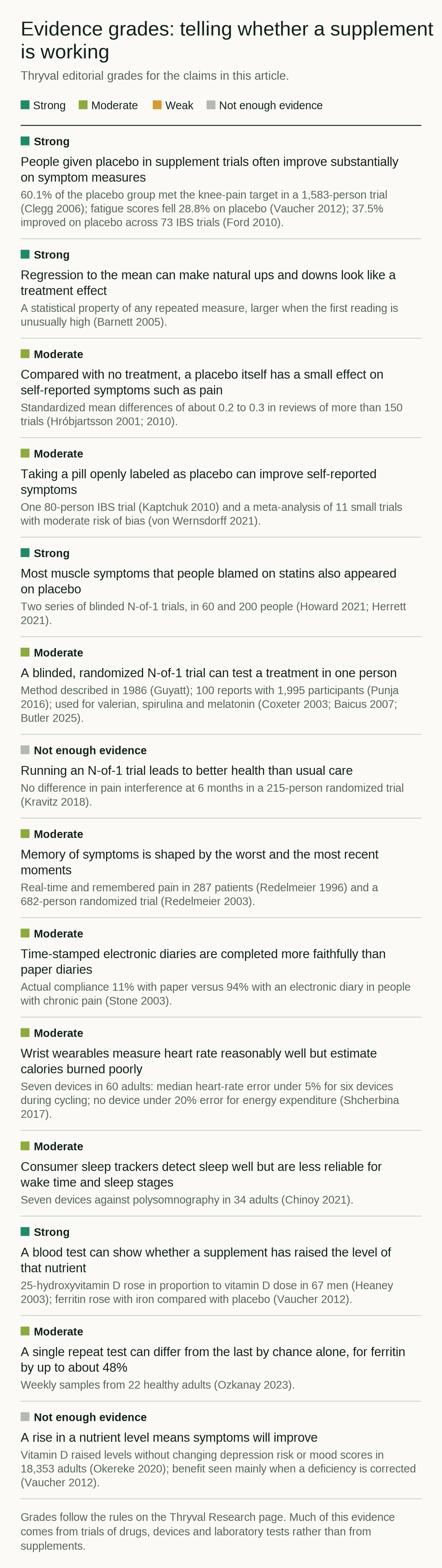
Evidence grades
The grades below are Thryval editorial judgments based on the studies cited in this article. The grading rules are set out on our Research page.
Frequently asked questions
Do supplements actually work?
Some do, for specific purposes, and many have not beaten placebo in good trials. Iron reduced fatigue more than placebo in women with low ferritin, while glucosamine for knee pain and saw palmetto for urinary symptoms did not outperform placebo in large NIH-funded trials.312 The answer has to be found supplement by supplement and outcome by outcome.
How do I know if my vitamins are working?
If a vitamin is taken to correct a measured deficiency, a repeat blood test after enough time can show whether the level rose; vitamin D is measured as 25-hydroxyvitamin D and vitamin B12 as serum B12, sometimes with methylmalonic acid.2931 If it is taken to feel better, the blood level does not answer the question, and only a comparison with placebo can.26
How do I know if my vitamin D supplement is working?
A 25-hydroxyvitamin D test shows whether your level has risen. In one study, each additional microgram a day raised it by about 0.7 nmol/L, and ODS gives it a half-life of about 15 days, so a new level takes weeks to settle.2529 In the VITAL-DEP trial, in which adults were not selected for low vitamin D, 2,000 IU a day for about five years did not change depression risk or mood.26
How do I know if my iron supplements are working?
Ferritin and hemoglobin show whether iron stores and red cells are responding. In one trial, iron raised ferritin by 11.4 µg/L more than placebo at 12 weeks, and the authors suggested checking blood markers after six weeks.3 Inflammation can raise ferritin, and a change smaller than about 48% between two tests may reflect normal variation.3027
Should I get blood work before starting a supplement?
A baseline result is needed to know whether a later result has changed, and it shows whether there is a deficiency to correct; ODS states that ferritin below 30 µg/L suggests iron deficiency.30 Some tests are less useful: serum magnesium does not reflect body stores.32 Tell whoever orders the test about any biotin, which can distort some results.28
How can you tell if a study is reliable?
Look for random allocation, a placebo or other control group, blinding, an outcome chosen in advance and a reasonable size. Placebo effects in reviews were larger in small trials and for self-reported outcomes, which is one reason small, unblinded studies tend to overstate benefits.67 Check who funded the study and who supplied the product.
Implications for patients and clinicians
For patients, an impression of benefit after starting a supplement deserves skepticism, especially when the supplement was started during a bad spell. A fair test needs a baseline, a consistent measure recorded at the time, enough weeks to match the trials, and ideally a blinded comparison with placebo. Blood tests answer narrower questions well: whether a deficiency exists and whether a supplement corrected it. Decisions about prescribed medicines should stay with the prescriber, and supplements taken alongside them should be checked for interactions.15243 For clinicians, the statin N-of-1 trials offer a model for patients convinced that a tablet is causing or relieving symptoms, and reference change values are a better basis than population ranges for judging whether two results really differ.101227
This article is for education and is not medical advice.
References
-
Clegg DO, Reda DJ, Harris CL, et al. Glucosamine, chondroitin sulfate, and the two in combination for painful knee osteoarthritis. N Engl J Med. 2006;354(8):795–808. Randomized, double-blind, placebo- and celecoxib-controlled trial (GAIT), n=1,583; funded by NIAMS (NIH contract). PubMed 16495392 ↩↩↩↩↩↩↩
-
Barry MJ, Meleth S, Lee JY, et al. Effect of increasing doses of saw palmetto extract on lower urinary tract symptoms: a randomized trial. JAMA. 2011;306(12):1344–1351. Randomized, double-blind, placebo-controlled trial (CAMUS), n=369; funded by NIDDK, NCCAM and ODS; extract and placebo donated by Rottapharm/Madaus. PMC3326341 · PubMed 21954478 ↩↩↩↩↩↩
-
Vaucher P, Druais PL, Waldvogel S, Favrat B. Effect of iron supplementation on fatigue in nonanemic menstruating women with low ferritin: a randomized controlled trial. CMAJ. 2012;184(11):1247–1254. Randomized controlled trial, n=198; sponsored, funded and designed by Pierre Fabre Médicament, maker of the iron product used. PMC3414597 · PubMed 22777991 ↩↩↩↩↩↩↩↩↩↩↩↩
-
Ford AC, Moayyedi P. Meta-analysis: factors affecting placebo response rate in the irritable bowel syndrome. Aliment Pharmacol Ther. 2010;32(2):144–158. Meta-analysis of 73 randomized trials, 8,364 patients given placebo; funding not stated in the abstract we accessed. PubMed 20412064 ↩↩↩↩
-
Barnett AG, van der Pols JC, Dobson AJ. Regression to the mean: what it is and how to deal with it. Int J Epidemiol. 2005;34(1):215–220. Methods review. PubMed 15333621 ↩↩↩
-
Hróbjartsson A, Gøtzsche PC. Is the placebo powerless? An analysis of clinical trials comparing placebo with no treatment. N Engl J Med. 2001;344(21):1594–1602. Systematic review of 130 trials (114 with outcome data). PubMed 11372012 ↩↩↩
-
Hróbjartsson A, Gøtzsche PC. Placebo interventions for all clinical conditions. Cochrane Database Syst Rev. 2010;(1):CD003974. Systematic review, 234 trials (202 with outcome data). PMC7156905 · PubMed 20091554 ↩↩↩↩↩
-
Kaptchuk TJ, Friedlander E, Kelley JM, et al. Placebos without deception: a randomized controlled trial in irritable bowel syndrome. PLoS One. 2010;5(12):e15591. Randomized controlled trial, n=80; funded by NCCAM (NIH) and the Bernard Osher Foundation; one author consults for drug companies unrelated to the study. PMC3008733 · PubMed 21203519 ↩↩↩
-
von Wernsdorff M, Loef M, Tuschen-Caffier B, Schmidt S. Effects of open-label placebos in clinical trials: a systematic review and meta-analysis. Sci Rep. 2021;11(1):3855. Systematic review of 13 trials, meta-analysis of 11; authors declared no competing interests. PMC7887232 · PubMed 33594150 ↩↩
-
Howard JP, Wood FA, Finegold JA, et al. Side effect patterns in a crossover trial of statin, placebo, and no treatment. J Am Coll Cardiol. 2021;78(12):1210–1222. Series of randomized N-of-1 trials (SAMSON), n=60 (49 completed); funded by the British Heart Foundation. PMC8453640 · PubMed 34531021 ↩↩↩↩↩
-
Wood FA, Howard JP, Finegold JA, et al. N-of-1 trial of a statin, placebo, or no treatment to assess side effects. N Engl J Med. 2020;383(22):2182–2184. Correspondence reporting the SAMSON trial. PubMed 33196154 ↩
-
Herrett E, Williamson E, Brack K, et al. Statin treatment and muscle symptoms: series of randomised, placebo controlled n-of-1 trials. BMJ. 2021;372:n135. Series of n-of-1 trials (StatinWISE), n=200 (151 analyzed); funded by the National Institute for Health Research. PMC7903384 · PubMed 33627334 ↩↩↩↩↩
-
Redelmeier DA, Kahneman D. Patients’ memories of painful medical treatments: real-time and retrospective evaluations of two minimally invasive procedures. Pain. 1996;66(1):3–8. Observational study, n=287. PubMed 8857625 ↩↩
-
Redelmeier DA, Katz J, Kahneman D. Memories of colonoscopy: a randomized trial. Pain. 2003;104(1-2):187–194. Randomized trial, n=682. PubMed 12855328 ↩↩
-
Guyatt G, Sackett D, Taylor DW, Chong J, Roberts R, Pugsley S. Determining optimal therapy: randomized trials in individual patients. N Engl J Med. 1986;314(14):889–892. Methods article with a single-patient trial. PubMed 2936958 ↩↩↩↩↩
-
Punja S, Bukutu C, Shamseer L, et al. N-of-1 trials are a tapestry of heterogeneity. J Clin Epidemiol. 2016;76:47–56. Systematic review of 100 reports, 1,995 participants. PubMed 27079847 ↩↩↩
-
Vohra S, Shamseer L, Sampson M, et al. CONSORT extension for reporting N-of-1 trials (CENT) 2015 statement. BMJ. 2015;350:h1738. Reporting guideline. PubMed 25976398 ↩
-
Coxeter PD, Schluter PJ, Eastwood HL, Nikles CJ, Glasziou PP. Valerian does not appear to reduce symptoms for patients with chronic insomnia in general practice using a series of randomised n-of-1 trials. Complement Ther Med. 2003;11(4):215–222. Series of N-of-1 trials, 42 enrolled, 24 analyzed; funding not stated in the abstract we accessed. PubMed 15022653 ↩↩↩
-
Baicus C, Baicus A. Spirulina did not ameliorate idiopathic chronic fatigue in four N-of-1 randomized controlled trials. Phytother Res. 2007;21(6):570–573. Four double-blind N-of-1 trials; funding not stated in the abstract we accessed. PubMed 17335116 ↩↩↩↩
-
Butler MJ, Chandereng T, Ahn H, et al. A series of personalized melatonin supplement interventions for poor sleep: feasibility randomized crossover trial for personalized N-of-1 treatment. JMIR Form Res. 2025;9:e58192. Series of 60 N-of-1 trials; funded by the National Library of Medicine (NIH); melatonin and placebo supplied by Pure Encapsulations; no conflicts declared. PMC12468169 · PubMed 41004640 ↩↩↩↩↩
-
Kravitz RL, Schmid CH, Marois M, et al. Effect of mobile device-supported single-patient multi-crossover trials on treatment of chronic musculoskeletal pain: a randomized clinical trial. JAMA Intern Med. 2018;178(10):1368–1377. Randomized trial, n=215; funded by the National Institute of Nursing Research and NCATS; no conflicts reported. PMC6233756 · PubMed 30193253 ↩↩↩
-
Shcherbina A, Mattsson CM, Waggott D, et al. Accuracy in wrist-worn, sensor-based measurements of heart rate and energy expenditure in a diverse cohort. J Pers Med. 2017;7(2):3. Validation study, n=60, seven devices; grants from the FDA and the National Library of Medicine listed in Europe PMC; authors declared no conflicts. PMC5491979 · PubMed 28538708 ↩↩↩↩
-
Chinoy ED, Cuellar JA, Huwa KE, et al. Performance of seven consumer sleep-tracking devices compared with polysomnography. Sleep. 2021;44(5):zsaa291. Validation study, n=34; funded by the Office of Naval Research; no funding from device companies. PMC8120339 · PubMed 33378539 ↩↩↩↩
-
Stone AA, Shiffman S, Schwartz JE, Broderick JE, Hufford MR. Patient compliance with paper and electronic diaries. Control Clin Trials. 2003;24(2):182–199. Comparison of instrumented paper and electronic diaries in people with chronic pain; NCI grant listed in Europe PMC; author disclosures not available in the abstract we accessed. PubMed 12689739 ↩↩↩↩
-
Heaney RP, Davies KM, Chen TC, Holick MF, Barger-Lux MJ. Human serum 25-hydroxycholecalciferol response to extended oral dosing with cholecalciferol. Am J Clin Nutr. 2003;77(1):204–210. Dose-response study, n=67 men; funding not stated in the abstract we accessed. PubMed 12499343 ↩↩↩↩
-
Okereke OI, Reynolds CF 3rd, Mischoulon D, et al. Effect of long-term vitamin D3 supplementation vs placebo on risk of depression or clinically relevant depressive symptoms and on change in mood scores: a randomized clinical trial. JAMA. 2020;324(5):471–480. Randomized trial (VITAL-DEP), n=18,353; funded by NIH; vitamin D and placebo donated by Pharmavite; several authors reported ties to supplement companies. PMC7403921 · PubMed 32749491 ↩↩↩↩↩↩
-
Ozkanay H, Arslan FD, Narin F, Koseoglu MH. Biological variation of plasma 25-hydroxyvitamin D3, serum vitamin B12, folate and ferritin in Turkish healthy subject. Scand J Clin Lab Invest. 2023;83(7):509–518. Biological variation study, n=22; funding not stated in the abstract we accessed. PubMed 37961767 ↩↩↩↩↩
-
Li D, Radulescu A, Shrestha RT, et al. Association of biotin ingestion with performance of hormone and nonhormone assays in healthy adults. JAMA. 2017;318(12):1150–1160. Nonrandomized crossover study, n=6; funded by NCATS; some authors reported grants or fees from diagnostics companies. PMC5818818 · PubMed 28973622 ↩↩
-
NIH Office of Dietary Supplements. Vitamin D: Fact Sheet for Health Professionals. Updated June 27, 2025. Accessed November 16, 2026. ods.od.nih.gov ↩↩↩↩↩↩
-
NIH Office of Dietary Supplements. Iron: Fact Sheet for Health Professionals. Updated September 4, 2025. Accessed November 16, 2026. ods.od.nih.gov ↩↩↩
-
NIH Office of Dietary Supplements. Vitamin B12: Fact Sheet for Health Professionals. Updated July 2, 2025. Accessed November 16, 2026. ods.od.nih.gov ↩↩
-
NIH Office of Dietary Supplements. Magnesium: Fact Sheet for Health Professionals. Updated January 6, 2026. Accessed November 16, 2026. ods.od.nih.gov ↩↩↩