
Do supplements help menopause symptoms? What the trials show
Black cohosh, soy isoflavones and red clover are the most studied supplements for hot flashes. In the larger publicly funded trials, black cohosh and red clover did no better than placebo, which on its own reduced hot flashes by more than half in some trials. Soy isoflavones show a small and inconsistent benefit.
The grade WeakDietary supplements for menopausal hot flashes; soy isoflavones show a small, inconsistent effect, and black cohosh, red clover and most other products did no better than placebo in the larger independent trials
In brief. In women who have frequent hot flashes and night sweats, the symptoms last a median of about seven years.1 In a Cochrane review of 16 trials, black cohosh did not reduce the number of hot flashes compared with placebo, and two publicly funded 12-month trials in the United States found no benefit for black cohosh or red clover.234 Soy isoflavone extracts reduced hot flashes by about a fifth more than placebo in one meta-analysis and by less than one a day in another, while a Cochrane review judged the evidence inconclusive.10119 Omega-3 capsules had no effect in a trial of 355 women.15 Placebo itself cut hot flashes by more than half in some trials, which makes small effects hard to detect.314 Hormone therapy reduced hot flashes by about 75%, and fezolinetant, a nonhormonal prescription drug, by about two more a day than placebo.3139 Black cohosh has been linked to rare cases of serious liver injury.2627
Between 40% and 50% of women in Western countries use complementary therapies for menopausal symptoms, according to one large review, and pharmacy shelves offer black cohosh, soy and red clover isoflavones, equol, evening primrose oil, pollen extracts and multi-ingredient blends.11 Most randomized trials of these products measured hot flashes and night sweats, known together as vasomotor symptoms, so this article concentrates on those. It explains what triggers a hot flash, reviews each common supplement in turn, sets the results beside hormone therapy and nonhormonal drugs, and notes who paid for the research. It does not cover the choice between prescription treatments, which belongs with a clinician.
What causes hot flashes in menopause?
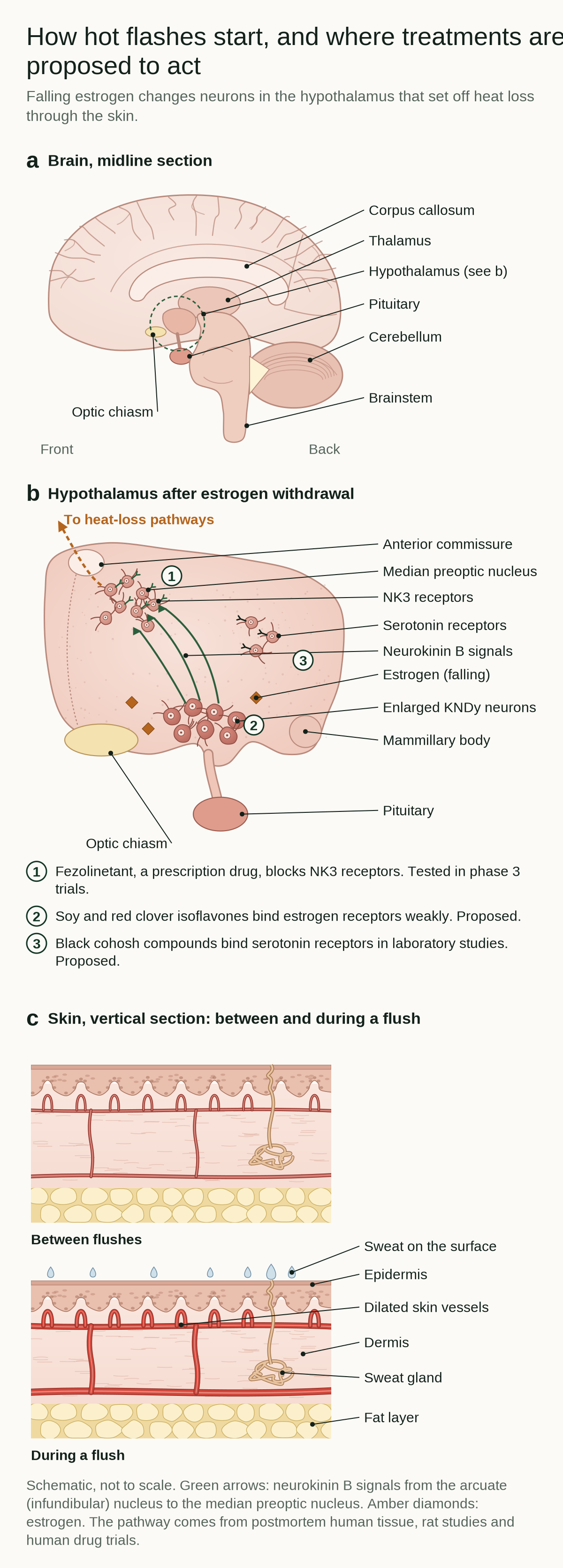
A hot flash is a brief, inappropriate activation of the body’s heat-loss responses. Blood vessels in the skin widen, sweating starts, and in many women the face and upper body redden.36 In the Study of Women’s Health Across the Nation (SWAN), which followed 1,449 women with frequent symptoms, the median total duration was 7.4 years and was longest in African American women, at 10.1 years.1
The trigger sits in the hypothalamus. In postmortem tissue from postmenopausal women, a group of neurons in the infundibular (arcuate) nucleus that make kisspeptin, neurokinin B and dynorphin, called KNDy neurons, is enlarged, a change linked to the loss of estrogen.36 In rats, these neurons project to the median preoptic nucleus, a temperature-control center, whose cells carry neurokinin 3 (NK3) receptors.36 Human studies support the same pathway. An infusion of neurokinin B caused flushing in 8 of 10 healthy premenopausal women and in none during a placebo infusion, and in a crossover trial of 37 postmenopausal women, the experimental NK3 receptor blocker MLE4901 reduced hot flush frequency by 45 percentage points compared with placebo.3738 Fezolinetant, an NK3 receptor blocker approved in the United States in 2023, acts at the same step.3941
What do menopause supplements do?
Most products rest on one of two ideas. The first is that plant compounds with a structure similar to estrogen, called phytoestrogens, can partly replace the hormone that falls at menopause. Soy and red clover isoflavones such as genistein and daidzein belong to this group, and so does equol, a compound some people’s gut bacteria make from daidzein.935 The second is that some herbs act on brain signaling, such as serotonin pathways, rather than on estrogen receptors; this has been proposed for black cohosh on the basis of laboratory studies.3528 Neither idea has been shown to explain an effect on hot flashes in people. What matters is whether the products reduce hot flashes in trials, and the major guidelines conclude that they mostly do not. The North American Menopause Society’s 2023 position statement does not recommend supplements or herbal remedies, soy foods and extracts or equol for hot flashes.8 A European Society of Gynecology statement published in 2026 rated the evidence for phytoestrogens, equol, pollen extract and black cohosh as moderate to limited.7
Does black cohosh help with hot flashes?
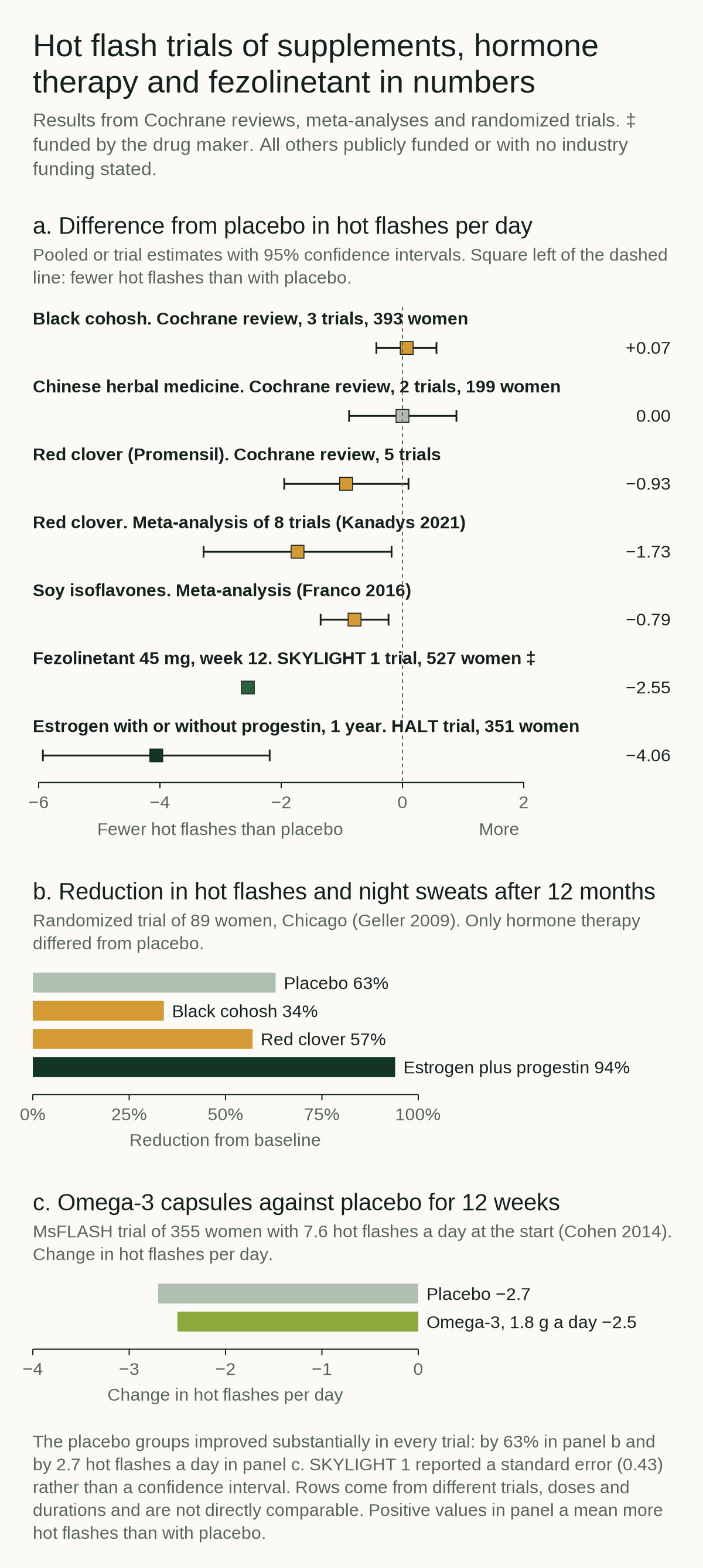
The largest summaries say no, with one dissenting meta-analysis. A 2012 Cochrane review pooled 16 randomized trials of black cohosh in 2,027 women, mostly at a median dose of 40 mg a day for an average of 23 weeks.2 In the three trials that counted hot flashes (393 women), black cohosh made no difference compared with placebo: 0.07 more hot flashes a day, with a confidence interval running from 0.43 fewer to 0.56 more. Symptom scores did not differ either, and hormone therapy did better than black cohosh in the trials that compared them. The reviewers concluded that there was insufficient evidence to support its use.
Two trials funded by the National Institutes of Health ran for a full year. In the Herbal Alternatives for Menopause (HALT) trial, 351 women aged 45 to 55 in Washington State were assigned to black cohosh 160 mg a day, a multibotanical blend, the blend plus soy diet counseling, hormone therapy or placebo.3 None of the herbal groups differed from placebo by more than about half a hot flash a day on average, whereas hormone therapy reduced them by 4.06 a day more than placebo, averaged over the year. In a Chicago trial of 89 women, hot flashes and night sweats fell by 34% with black cohosh, 57% with red clover and 63% with placebo after 12 months, compared with 94% with conjugated estrogens plus medroxyprogesterone; only hormone therapy differed from placebo.4
A 2023 meta-analysis that included more recent trials, many from Asia and Europe, reported a small benefit for hot flashes (Hedges’ g 0.315, where 0.2 is usually considered small) across 22 reports and 2,310 women.5 One of its authors reported speaker fees from supplement and drug companies. A 2026 review commissioned for the International Menopause Society rated the evidence for black cohosh on vasomotor and general menopausal symptoms as moderate certainty, and most other complementary therapies as low or very low.6 The authors of the Chicago trial noted that many black cohosh trials had been sponsored by manufacturers.4 We graded black cohosh as weak because the trials that counted hot flashes and the two longest independent trials found no effect, while the positive pooled results rely on symptom scales and on trials with more variable quality.
Do soy isoflavones and red clover help hot flashes?
For soy, the answer is a small effect at best. A 2012 meta-analysis of 19 trials found that extracted or synthesized soy isoflavones, at a median of 54 mg a day, reduced hot flash frequency by 20.6% more than placebo (95% confidence interval 12.9% to 28.4%) and severity by 26.2%; products with more than 18.8 mg of genistein were about twice as potent.10 We could not find a funding or conflict of interest statement for that review in the sources we could access. A 2016 meta-analysis in JAMA of 62 studies and 6,653 women found 0.79 fewer hot flashes a day with soy isoflavones than with placebo (0.23 to 1.35), no effect on night sweats, and a high risk of bias in at least three areas in 74% of the trials.11 The 2013 Cochrane review of 43 trials of phytoestrogens did not find conclusive evidence of benefit, although it noted that products providing more than 30 mg a day of genistein reduced hot flashes more consistently.9
Red clover results depend on which trials are pooled. In the Cochrane review, five trials of the red clover product Promensil showed 0.93 fewer hot flashes a day, a difference that was not statistically significant (0.10 more to 1.95 fewer).9 A 2021 meta-analysis of eight trials reported 1.73 fewer a day (0.18 to 3.28).12 In the 12-month Chicago trial, red clover did no better than placebo.4 The Cochrane reviewers found no stimulation of the uterine lining with phytoestrogens over up to two years, and one of them had authored two of the included trials.9
Equol is sold as a supplement for the women who do not make it from soy. In a 12-week Japanese trial of 160 such women, 10 mg of S-equol a day reduced hot flashes by 1.9 a day (58.7%), compared with 1.0 a day (34.5%) with placebo.13 A 2019 meta-analysis of six studies reported a benefit, but its first author worked in research and development at a supplement company.14 We graded equol as weak because the evidence rests largely on one trial.
Do omega-3, vitamin E, evening primrose oil or pollen extract help?
Omega-3 fatty acids were tested in the MsFLASH network, a set of trials funded by the National Institutes of Health. In 355 women with an average of 7.6 hot flashes a day, 1.8 g a day of fish oil for 12 weeks reduced them by 2.5 a day, and placebo by 2.7.15 A pooled analysis of the MsFLASH trials found no effect of omega-3, yoga or exercise, against reductions of 1.4 to 2.4 a day more than placebo with escitalopram, venlafaxine and low-dose estradiol.16 Omega-3 may have other uses; our article on omega-3 and depression covers mood.
The other products rest on single small trials. Vitamin E, 800 IU a day, reduced hot flashes by about one a day more than placebo in a crossover trial of 120 breast cancer survivors, and the women did not prefer it to placebo.17 Evening primrose oil gave no benefit over placebo in a six-month trial of 56 women.18 A purified pollen extract reduced hot flushes by 27% more than placebo in one trial of 64 women, but when the controlled studies were pooled the difference was not significant.1920
Do maca, vitex, St John’s wort or DHEA help?
Maca was tested in four small randomized trials, which a 2011 systematic review judged too limited to draw conclusions from.21 Vitex (chasteberry) has been tested for menopause mainly in combination: in a 16-week trial of 100 women, St John’s wort with vitex did no better than placebo.22 A meta-analysis of St John’s wort preparations, alone or in combination, reported improvement on menopausal symptom scales compared with placebo (standardized mean difference 1.08).23 St John’s wort also speeds the breakdown of many medicines, a point taken up below.
DHEA is a hormone precursor that the body converts to androgens and estrogens. A Cochrane review of 28 trials in 1,273 peri- and postmenopausal women found no clear effect on quality of life, inconsistent effects on menopausal symptoms, a small improvement in sexual function, and more androgenic side effects, mainly acne (odds ratio 3.77).24
Does traditional Chinese medicine help menopause symptoms?
Most trials of Chinese herbal medicine for menopause have tested a herbal formula against placebo, hormone therapy, a drug or another formula, usually for 12 weeks. A 2016 Cochrane review of 22 such trials in 2,902 women found no difference from placebo in hot flashes a day in the two trials that measured them (199 women) and rated the quality of the evidence as very low to moderate.25 The 2026 International Menopause Society review found moderate-certainty evidence that Chinese herbal medicine improved overall menopausal symptom scores, sleep and blood pressure.6 The North American Menopause Society does not recommend acupuncture for hot flashes.8
Are menopause supplements safe?
Most trials lasted three to twelve months and reported few side effects, but they were too small to detect rare harms. Black cohosh carries the clearest warning. The National Institutes of Health’s LiverTox database states that products labeled as black cohosh have been implicated in many cases of acute liver injury, some severe enough to require liver transplantation or to cause death.26 A United States Pharmacopeia review of 30 case reports judged the link possible but not proven, partly because some products may have been contaminated or contained the wrong species, and recommended a label statement advising people with a liver disorder or symptoms of liver trouble, such as abdominal pain, dark urine or jaundice, to stop the product and consult a health care practitioner.2728 Australia has required a liver warning on black cohosh products since 2007; the US Food and Drug Administration does not.28 A meta-analysis of five trials in 1,117 women found no effect of one isopropanolic extract on liver tests, but its first author was employed by the extract’s manufacturer.29
For soy and red clover, the concern has been breast tissue. A systematic review of 131 studies found no evidence that soy or red clover increased breast cancer risk or recurrence and no estrogenic effect on breast tissue in the trials, though it did not confirm the safety of high doses of 100 mg or more of isoflavones a day.30 DHEA causes acne and other androgenic effects more often than placebo.24
Can you take menopause supplements with HRT?
No trial we found tested whether adding a supplement to hormone therapy changes hot flashes, and hormone therapy alone reduced them by about 75% in a Cochrane review of 24 trials, which leaves little room for an added effect to show.31 The interaction evidence is uneven. St John’s wort is the best documented: in a systematic review by scientists at the Centers for Disease Control and Prevention and the Food and Drug Administration, three of four studies found lower exposure to the hormones in combined birth control pills and three found more breakthrough bleeding when women took St John’s wort.32 In one of those trials, in 12 women, the half-life of ethinyl estradiol fell from 23.4 to 12.2 hours.33 Menopausal hormone therapy uses different estrogens at lower doses, and we found no study of St John’s wort with it. Black cohosh did not change the activity of CYP3A, the enzyme that clears many drugs, in a study of healthy volunteers, and the Office of Dietary Supplements lists no known clinically relevant drug interactions, while noting that this has not been studied systematically.3428
Anyone combining a supplement with hormone therapy or another prescription is best served by telling the prescriber or pharmacist, who can check the specific products. Our overview of supplement interactions with prescription medicines covers St John’s wort and other common inducers in more detail.
How do supplements compare with prescription treatments?
Prescription treatments reduce hot flashes considerably more. Hormone therapy reduced weekly hot flash frequency by 75% compared with placebo in the Cochrane review, and by 4.06 a day more than placebo in HALT, in which the herbal products showed no effect.313 Among nonhormonal options, the North American Menopause Society recommends cognitive behavioral therapy, clinical hypnosis, certain antidepressants (SSRIs and SNRIs), gabapentin and fezolinetant on the basis of good and consistent evidence.8 In two phase 3 trials funded by Astellas, fezolinetant 45 mg reduced moderate to severe hot flashes by about 2.5 a day more than placebo at 12 weeks.3940 Its US label now carries a boxed warning for liver injury, requires liver tests before treatment and at set intervals during the first nine months, and lists cases of serious liver injury within 40 days of starting.41 The European statement lists fezolinetant and a second drug of the same class, elinzanetant, as the most effective nonhormonal treatments.7 Which of these suits a given woman depends on her history and preferences, and that decision belongs with her clinician. No supplement in this article is a substitute for a prescribed treatment.
How can the Thryval app help?
The Thryval app (App Store, Google Play) can help when comparing products marketed for menopause. Each herb or supplement entry, including black cohosh, soy isoflavones, red clover and St John’s wort, shows what kind of research backs it, from meta-analyses and randomized trials to observational studies and traditional use, with the citations, journals and publication years, and maps it to conditions, body systems and related FDA medicines. The app also flags interactions between a substance and FDA-approved medicines, drawn from clinical pharmacology references; a flag is a prompt to check with a pharmacist, and the absence of one does not mean a combination has been studied. For anyone trying a product, our guide to tracking whether a supplement is working explains why a hot flash diary helps, given how much symptoms improve with placebo.
How good is the evidence, and who paid for it?
The supplement evidence comes mainly from small, short trials of varying quality. In the JAMA meta-analysis, 74% of the trials had a high risk of bias in at least three areas, and placebo groups in the Cochrane phytoestrogen review improved by anywhere from 1% to 59%.119 Large placebo responses, 57.7% across the hormone therapy trials and 63% in the Chicago trial, mean that uncontrolled reports of improvement say little.314 Products also differ in species, plant part, extraction method and dose, so a result for one black cohosh or soy extract may not apply to another.210
The longest and most informative supplement trials were publicly funded: HALT by the National Institute on Aging, the Chicago trial by a National Institutes of Health botanical research center, and MsFLASH by the National Institutes of Health.3415 All three found no benefit. Industry funding is concentrated elsewhere. Astellas funded both fezolinetant phase 3 trials, and its employees were among the authors.3940 The meta-analysis that found no liver effect of an isopropanolic black cohosh extract was led by an employee of the extract’s maker, the equol meta-analysis by a supplement company scientist, and one author of the 2023 black cohosh meta-analysis reported speaker fees from several supplement and drug companies.29145 A coauthor of the Chicago trial was a paid consultant to Pharmavite, a supplement maker.4 The MLE4901 trial was funded by the UK Medical Research Council and the National Institute for Health Research.38 The Cochrane reviews reported no relevant industry funding, although one author of the phytoestrogen review had written two of the included trials and authors of the hormone therapy review had received drug company grants.292531
What remains uncertain?
It is not known whether any supplement helps a subgroup of women, such as those with mild symptoms or those who make equol, because few trials were designed to test this.139 Most trials lasted 12 weeks to a year, while hot flashes often last seven years or more, so long-term benefit and safety are unknown.128 The true frequency of liver injury with black cohosh, and whether it comes from the plant or from contaminated or mislabeled products, is uncertain.2726 Few trials have tested supplements for sleep, mood, vaginal dryness or bone, and those outcomes are not covered here. Our articles on magnesium and sleep and ashwagandha cover the sleep and stress evidence in other groups.
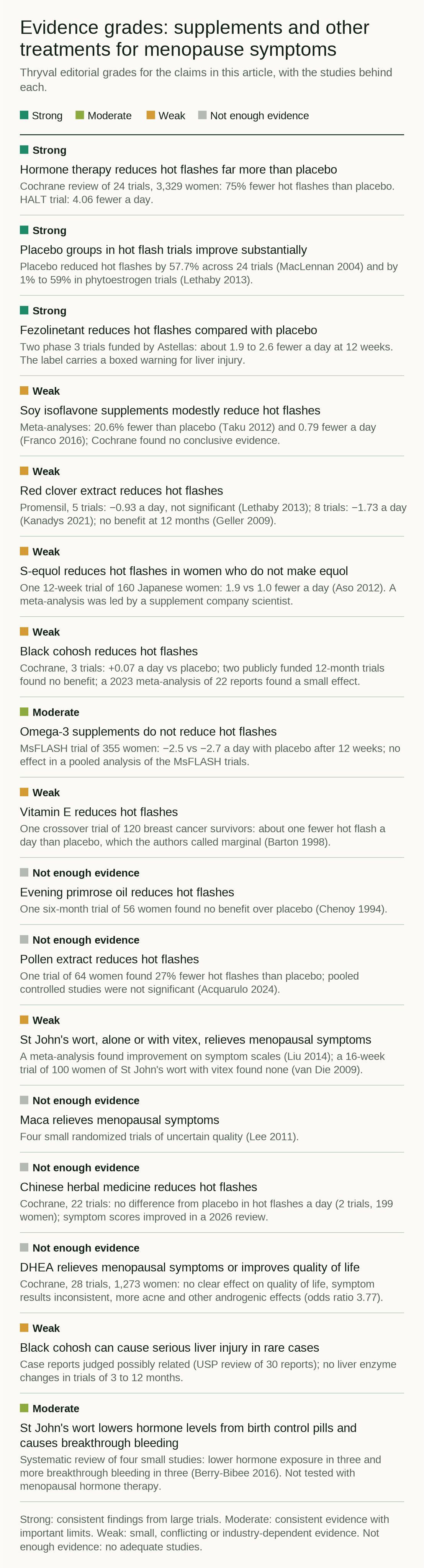
Evidence grades
The grades below are Thryval editorial judgments based on the studies cited in this article. The grading rules are set out on our Research page.
Frequently asked questions
What do menopause supplements do?
Most are sold to reduce hot flashes and night sweats, either by acting weakly on estrogen receptors, as soy and red clover isoflavones are thought to do, or by acting on brain signaling, as has been proposed for black cohosh.35 In randomized trials, soy isoflavones showed a small and inconsistent benefit, and black cohosh, red clover, omega-3 and evening primrose oil did no better than placebo in the larger trials.11241518
Are menopause supplements safe?
Short trials reported few side effects, but they were too small to detect rare harms. Black cohosh has been linked to rare cases of serious liver injury, DHEA causes acne more often than placebo, and St John’s wort interacts with many medicines.262432
Can you take menopause supplements with HRT?
No trial has tested whether adding a supplement to hormone therapy improves hot flashes. St John’s wort lowers hormone levels from birth control pills, and its effect on menopausal hormone therapy has not been studied.32 A prescriber or pharmacist can check a specific combination.
Is black cohosh a phytoestrogen?
Probably not. Early laboratory studies suggested estrogen-like effects, but later studies gave conflicting results, and the Office of Dietary Supplements describes its mechanism as unknown.28 Laboratory work suggests that some of its compounds act on serotonin receptors instead.35
What not to take with black cohosh?
No clinically relevant drug interactions are known, but they have not been studied systematically.28 In a study of healthy volunteers, black cohosh did not change the activity of CYP3A, an enzyme that clears many drugs.34 The main caution concerns the liver: the United States Pharmacopeia advises people with a liver disorder to avoid it, and anyone who develops abdominal pain, dark urine or jaundice while taking it to stop and contact a doctor.2728
How long does black cohosh take to work?
Trials in the Cochrane review lasted 23 weeks on average, and the HALT trial found no benefit over placebo at 3, 6 or 12 months.23 Any improvement in the first weeks may reflect the large placebo response seen in these trials.4
Implications for patients and clinicians
For a woman bothered by hot flashes, the trials suggest that most supplements on sale perform about as well as placebo. Soy isoflavones may give a small benefit, and the evidence for black cohosh is conflicting, with the longest independent trials negative. The large placebo response means that a product may seem to work even when it does not, and a symptom diary kept for a few weeks before and during use gives a fairer picture. Black cohosh carries a rare risk of liver injury. Hormone therapy and several nonhormonal prescription treatments reduce hot flashes substantially more, and the choice among them, including whether a supplement fits alongside them, is a conversation to have with a clinician or pharmacist.
This article is for education and is not medical advice.
References
-
Avis NE, Crawford SL, Greendale G, et al. Duration of menopausal vasomotor symptoms over the menopause transition. JAMA Intern Med. 2015;175(4):531–539. Prospective cohort (SWAN), 1,449 women with frequent symptoms; funded by the National Institutes of Health. PMC4433164 · PubMed 25686030 ↩↩↩
-
Leach MJ, Moore V. Black cohosh (Cimicifuga spp.) for menopausal symptoms. Cochrane Database Syst Rev. 2012;(9):CD007244. Systematic review and meta-analysis: 16 randomized trials, 2,027 women; authors declared no conflicts. PMC6599854 · PubMed 22972105 ↩↩↩↩↩↩↩
-
Newton KM, Reed SD, LaCroix AZ, et al. Treatment of vasomotor symptoms of menopause with black cohosh, multibotanicals, soy, hormone therapy, or placebo: a randomized trial. Ann Intern Med. 2006;145(12):869–879. Randomized trial (HALT), 351 women, 12 months; funded by the National Institute on Aging. PubMed 17179056 ↩↩↩↩↩↩↩
-
Geller SE, Shulman LP, van Breemen RB, et al. Safety and efficacy of black cohosh and red clover for the management of vasomotor symptoms: a randomized controlled trial. Menopause. 2009;16(6):1156–1166. Randomized trial, 89 women, 12 months; funded by the National Institutes of Health (P50 AT000155); one coauthor was a paid consultant to Pharmavite. PMC2783540 · PubMed 19609225 ↩↩↩↩↩↩↩↩↩↩↩↩↩↩
-
Sadahiro R, Matsuoka LN, Zeng BS, et al. Black cohosh extracts in women with menopausal symptoms: an updated pairwise meta-analysis. Menopause. 2023;30(7):766–773. Meta-analysis: 22 articles, 2,310 women; one author reported speaker fees from supplement and drug companies. PubMed 37192826 ↩↩↩
-
Maunder A, Mardon AK, Rao V, et al. Complementary therapies for management of menopausal symptoms: a systematic review to inform the update of the International Menopause Society recommendations on women’s midlife health. Climacteric. 2026;29(2):165–209. Systematic review of reviews and trials. PubMed 41498229 ↩↩↩
-
Castelo-Branco C, Kiesel L, Yoldemir T, et al. Non-hormonal management of menopause symptoms: the statement of the European Society of Gynecology. Gynecol Endocrinol. 2026;42(1):2751783. Expert consensus statement. PubMed 43049482 ↩↩
-
The North American Menopause Society. The 2023 nonhormone therapy position statement of The North American Menopause Society. Menopause. 2023;30(6):573–590. Position statement with graded evidence levels. PubMed 37252752 ↩↩↩
-
Lethaby A, Marjoribanks J, Kronenberg F, et al. Phytoestrogens for menopausal vasomotor symptoms. Cochrane Database Syst Rev. 2013;(12):CD001395. Systematic review: 43 randomized trials, 4,364 women; one author had written two included trials. PMC10247921 · PubMed 24323914 ↩↩↩↩↩↩↩↩↩↩↩
-
Taku K, Melby MK, Kronenberg F, et al. Extracted or synthesized soybean isoflavones reduce menopausal hot flash frequency and severity: systematic review and meta-analysis of randomized controlled trials. Menopause. 2012;19(7):776–790. Meta-analysis: 19 trials (17 pooled). PubMed 22433977 ↩↩↩↩
-
Franco OH, Chowdhury R, Troup J, et al. Use of plant-based therapies and menopausal symptoms: a systematic review and meta-analysis. JAMA. 2016;315(23):2554–2563. Meta-analysis: 62 studies, 6,653 women. PubMed 27327802 ↩↩↩↩↩↩
-
Kanadys W, Barańska A, Błaszczuk A, et al. Evaluation of clinical meaningfulness of red clover (Trifolium pratense L.) extract to relieve hot flushes and menopausal symptoms in peri- and post-menopausal women: a systematic review and meta-analysis of randomized controlled trials. Nutrients. 2021;13(4):1258. Meta-analysis: 8 trials for hot flush frequency; authors declared no conflicts. PMC8069620 · PubMed 33920485 ↩↩
-
Aso T, Uchiyama S, Matsumura Y, et al. A natural S-equol supplement alleviates hot flushes and other menopausal symptoms in equol nonproducing postmenopausal Japanese women. J Womens Health (Larchmt). 2012;21(1):92–100. Randomized trial, 160 women, 12 weeks. PubMed 21992596 ↩↩↩
-
Daily JW, Ko BS, Ryuk J, et al. Equol decreases hot flashes in postmenopausal women: a systematic review and meta-analysis of randomized clinical trials. J Med Food. 2019;22(2):127–139. Meta-analysis: 6 studies; first author affiliated with a supplement manufacturer’s research and development department. PubMed 30592686 ↩↩↩
-
Cohen LS, Joffe H, Guthrie KA, et al. Efficacy of omega-3 for vasomotor symptoms treatment: a randomized controlled trial. Menopause. 2014;21(4):347–354. Randomized trial (MsFLASH), 355 women, 12 weeks; funded by the National Institutes of Health. PMC4072122 · PubMed 23982113 ↩↩↩↩↩
-
Guthrie KA, LaCroix AZ, Ensrud KE, et al. Pooled analysis of six pharmacologic and nonpharmacologic interventions for vasomotor symptoms. Obstet Gynecol. 2015;126(2):413–422. Pooled analysis of three MsFLASH trials, 899 women; funded by the National Institutes of Health. PMC4526122 · PubMed 26241433 ↩↩
-
Barton DL, Loprinzi CL, Quella SK, et al. Prospective evaluation of vitamin E for hot flashes in breast cancer survivors. J Clin Oncol. 1998;16(2):495–500. Randomized crossover trial, 120 women. PubMed 9469333 ↩↩
-
Chenoy R, Hussain S, Tayob Y, et al. Effect of oral gamolenic acid from evening primrose oil on menopausal flushing. BMJ. 1994;308(6927):501–503. Randomized trial, 56 women, 6 months. PMC2542782 · PubMed 8136666 ↩↩↩
-
Winther K, Rein E, Hedman C. Femal, a herbal remedy made from pollen extracts, reduces hot flushes and improves quality of life in menopausal women: a randomized, placebo-controlled, parallel study. Climacteric. 2005;8(2):162–170. Randomized trial, 64 women. PubMed 16096172 ↩↩
-
Acquarulo EL, Hernandez EC, Kodzodziku F, et al. The efficacy of purified pollen extract for reducing vasomotor symptoms in women: a systematic review and meta-analysis. Menopause. 2024;31(2):154–159. Meta-analysis: 1 randomized trial and 4 observational studies; authors declared no conflicts. PubMed 38194609 ↩↩
-
Lee MS, Shin BC, Yang EJ, et al. Maca (Lepidium meyenii) for treatment of menopausal symptoms: a systematic review. Maturitas. 2011;70(3):227–233. Systematic review: 4 randomized trials. PubMed 21840656 ↩↩
-
van Die MD, Burger HG, Bone KM, et al. Hypericum perforatum with Vitex agnus-castus in menopausal symptoms: a randomized, controlled trial. Menopause. 2009;16(1):156–163. Randomized trial, 100 women, 16 weeks. PubMed 18791483 ↩↩
-
Liu YR, Jiang YL, Huang RQ, et al. Hypericum perforatum L. preparations for menopause: a meta-analysis of efficacy and safety. Climacteric. 2014;17(4):325–335. Meta-analysis of randomized trials. PubMed 24188229 ↩↩
-
Scheffers CS, Armstrong S, Cantineau AE, et al. Dehydroepiandrosterone for women in the peri- or postmenopausal phase. Cochrane Database Syst Rev. 2015;(1):CD011066. Systematic review: 28 trials, 1,273 women. PMC10662543 · PubMed 25879093 ↩↩↩↩
-
Zhu X, Liew Y, Liu ZL. Chinese herbal medicine for menopausal symptoms. Cochrane Database Syst Rev. 2016;(3):CD009023. Systematic review: 22 trials, 2,902 women; authors declared no conflicts. PMC4951187 · PubMed 26976671 ↩↩↩
-
National Institute of Diabetes and Digestive and Kidney Diseases. Black cohosh. In: LiverTox: Clinical and Research Information on Drug-Induced Liver Injury. Updated April 15, 2025. Government database entry. PubMed 31643322 ↩↩↩↩↩
-
Mahady GB, Low Dog T, Barrett ML, et al. United States Pharmacopeia review of the black cohosh case reports of hepatotoxicity. Menopause. 2008;15(4 Pt 1):628–638. Review of 30 case reports. PubMed 18340277 ↩↩↩↩↩
-
NIH Office of Dietary Supplements. Black Cohosh: Fact Sheet for Health Professionals. Updated June 3, 2020. Accessed November 18, 2026. Government fact sheet. ods.od.nih.gov ↩↩↩↩↩↩↩↩
-
Naser B, Schnitker J, Minkin MJ, et al. Suspected black cohosh hepatotoxicity: no evidence by meta-analysis of randomized controlled clinical trials for isopropanolic black cohosh extract. Menopause. 2011;18(4):366–375. Meta-analysis: 5 trials, 1,117 women; first author employed by the extract’s manufacturer, Schaper & Brümmer. PubMed 21228727 ↩↩↩
-
Fritz H, Seely D, Flower G, et al. Soy, red clover, and isoflavones and breast cancer: a systematic review. PLoS One. 2013;8(11):e81968. Systematic review: 131 studies. PMC3842968 · PubMed 24312387 ↩
-
MacLennan AH, Broadbent JL, Lester S, et al. Oral oestrogen and combined oestrogen/progestogen therapy versus placebo for hot flushes. Cochrane Database Syst Rev. 2004;(4):CD002978. Systematic review: 24 trials, 3,329 women; some authors had received drug company grants. PMC7004247 · PubMed 15495039 ↩↩↩↩↩↩↩↩
-
Berry-Bibee EN, Kim MJ, Tepper NK, et al. Co-administration of St. John’s wort and hormonal contraceptives: a systematic review. Contraception. 2016;94(6):668–677. Systematic review: 4 studies; authors from the CDC and FDA declared no conflicts. PMC11283811 · PubMed 27444983 ↩↩↩↩
-
Hall SD, Wang Z, Huang SM, et al. The interaction between St John’s wort and an oral contraceptive. Clin Pharmacol Ther. 2003;74(6):525–535. Pharmacokinetic study, 12 women. PubMed 14663455 ↩↩
-
Gurley B, Hubbard MA, Williams DK, et al. Assessing the clinical significance of botanical supplementation on human cytochrome P450 3A activity: comparison of a milk thistle and black cohosh product to rifampin and clarithromycin. J Clin Pharmacol. 2006;46(2):201–213. Pharmacokinetic study in healthy volunteers. PMC1865122 · PubMed 16432272 ↩↩
-
Hajirahimkhan A, Dietz BM, Bolton JL. Botanical modulation of menopausal symptoms: mechanisms of action? Planta Med. 2013;79(7):538–553. Narrative review of laboratory and clinical studies. PMC3800090 · PubMed 23408273 ↩↩↩↩
-
Rance NE, Dacks PA, Mittelman-Smith MA, et al. Modulation of body temperature and LH secretion by hypothalamic KNDy (kisspeptin, neurokinin B and dynorphin) neurons: a novel hypothesis on the mechanism of hot flushes. Front Neuroendocrinol. 2013;34(3):211–227. Review of human postmortem and rat studies. PMC3833827 · PubMed 23872331 ↩↩↩
-
Jayasena CN, Comninos AN, Stefanopoulou E, et al. Neurokinin B administration induces hot flushes in women. Sci Rep. 2015;5:8466. Randomized, blinded crossover infusion study, 10 women. PMC4329553 · PubMed 25683060 ↩
-
Prague JK, Roberts RE, Comninos AN, et al. Neurokinin 3 receptor antagonism as a novel treatment for menopausal hot flushes: a phase 2, randomised, double-blind, placebo-controlled trial. Lancet. 2017;389(10081):1809–1820. Randomized crossover trial, 37 women; funded by the UK Medical Research Council and the National Institute for Health Research. PMC5439024 · PubMed 28385352 ↩↩
-
Lederman S, Ottery FD, Cano A, et al. Fezolinetant for treatment of moderate-to-severe vasomotor symptoms associated with menopause (SKYLIGHT 1): a phase 3 randomised controlled study. Lancet. 2023;401(10382):1091–1102. Randomized trial, 527 women; funded by Astellas, with Astellas employees among the authors. PubMed 36924778 ↩↩↩↩↩
-
Johnson KA, Martin N, Nappi RE, et al. Efficacy and safety of fezolinetant in moderate to severe vasomotor symptoms associated with menopause: a phase 3 RCT. J Clin Endocrinol Metab. 2023;108(8):1981–1997. Randomized trial (SKYLIGHT 2); funded by Astellas, with Astellas employees among the authors. PMC10348473 · PubMed 36734148 ↩↩↩
-
Astellas Pharma US. Veozah (fezolinetant) tablets: prescribing information. Published on DailyMed March 6, 2026. Accessed November 18, 2026. US prescribing information. DailyMed ↩↩↩