
Does collagen improve skin, hair or joints? What the trials show
Collagen peptides are mostly digested like any other protein, and a small share reaches the blood as short fragments. Trials report a small benefit for osteoarthritis pain, the skin results shrink when industry-funded trials are set aside, and the evidence for hair, nails, bone and muscle is thin.
The grade WeakCollagen supplements for skin aging, hair, nails, joints and bone in adults; the most consistent finding is a small reduction in osteoarthritis pain
In brief. Collagen taken by mouth is digested like other dietary protein, although a small share reaches the blood as two- and three-amino-acid fragments such as prolyl-hydroxyproline (Pro-Hyp).23 For skin, meta-analyses that pooled all trials found modest gains in hydration and elasticity, but a 2025 analysis of 23 trials found no effect once it was limited to trials without industry funding or to trials of high quality.911 For osteoarthritis, a 2024 meta-analysis of 35 trials found small to moderate reductions in pain and improvements in function.17 Evidence for hair, nails, bone density and muscle rests on a handful of small trials, most of them funded by a collagen manufacturer or using its product.14162627 In a trial in older women, whey protein raised muscle protein synthesis and collagen did not.29 Collagen has caused no more side effects than placebo in trials, and the individual trials discussed here compared it with placebo or other supplements, not with prescribed treatment for osteoarthritis or osteoporosis.1721
Collagen supplements are sold for skin, hair, nails and joints, often with the same powder promoted for all of them. The idea is intuitive, since collagen is the protein that gives skin and cartilage their strength, but eating a protein is not the same as delivering it to a tissue. This article reviews what happens to collagen after it is swallowed, what the randomized trials found for each claimed benefit, and how much of that research was paid for by the companies that make the products.
What does collagen do for your body?
Collagen is the most abundant protein in animals. In humans it makes up about a third of total protein and three-quarters of the dry weight of skin, and 28 types have been identified in vertebrates. Type I collagen forms the fibrils of fibrous tissues such as skin and tendon, while cartilage is built mainly from type II.1 Every third amino acid in a collagen chain is glycine, and the other two positions are often proline (28%) and hydroxyproline (38%); hydroxyproline is made inside cells by modifying proline after the chain has been assembled.1
Most supplements are collagen hydrolysates, also sold as collagen peptides: gelatin from cattle, pig, chicken or fish tissue broken down by enzymes into fragments. The products used in the German trials discussed below averaged about 2 to 3 kDa, roughly 20 to 30 amino acids per fragment.625 A different product, undenatured type II collagen (UC-II), is made from chicken sternum cartilage and taken in milligram rather than gram doses; it is thought to act on the immune system rather than as a source of amino acids, and the trial that tested it called for further study of its mechanism.21
Is collagen a complete protein?
No. Collagen contains no tryptophan, one of the indispensable amino acids, so it is classified as an incomplete protein under the standard PDCAAS method. A modeling study calculated that collagen peptides could make up as much as 36% of protein intake in a typical American diet before the diet fell short of indispensable amino acids, which is far more than the 2.5 to 15 g a day used in trials. One author of that study provided research services to a supplement company that sells collagen, and the other two worked for the collagen maker Gelita and the Collagen Research Institute in Kiel, Germany.5
What happens to collagen peptides after you swallow them?
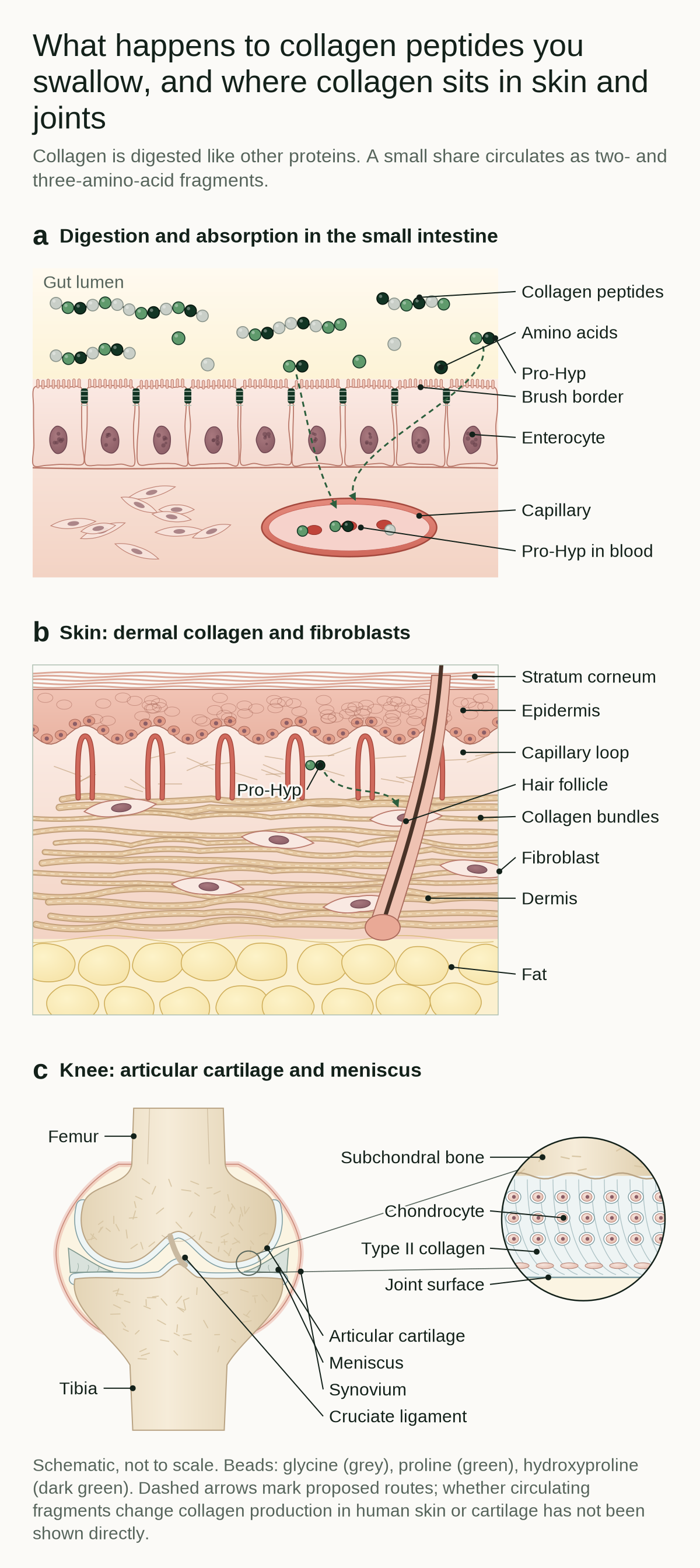
Like other proteins, collagen is digested in the stomach and small intestine, mostly into single amino acids. What sets it apart is that some fragments containing hydroxyproline resist digestion. In a study from Kyoto Prefectural University, healthy volunteers who fasted overnight and then took 9.4 to 23 g of gelatin hydrolysate had almost no peptide-bound hydroxyproline in their blood beforehand; afterward, levels peaked at 20 to 60 nmol per mL of plasma within one to two hours and fell by half by four hours. The main fragment was the dipeptide Pro-Hyp.2 In a crossover study in five men, about 30% of the hydroxyproline detected in blood was in peptide form, and the amount and type of fragments depended on whether the gelatin came from fish scale, fish skin or pig skin.3
Whether those fragments do anything in the skin or joints of people is less clear. In cultured mouse skin, Pro-Hyp increased the number of fibroblasts migrating out of the tissue at 200 nmol per mL and increased their growth in a dose-dependent way, at concentrations several times the peak blood levels recorded in volunteers.42 The most direct human evidence comes from one trial: in a subgroup of women who had suction blister samples taken from the skin, procollagen type I was 65% higher and elastin 18% higher after eight weeks of 2.5 g of collagen peptides a day than after placebo.7 Gelita supplied the product, and two of the authors worked at the Collagen Research Institute.7
What does collagen do for skin?
The best-known trials were run at the University of Kiel with Gelita’s Verisol peptides. In one, 69 women aged 35 to 55 took 2.5 g or 5.0 g a day, or placebo, for eight weeks; skin elasticity, the main outcome, improved with both doses compared with placebo, and changes in skin moisture did not reach statistical significance.6 In the second, 114 women aged 45 to 65 took 2.5 g a day or placebo for eight weeks, and eye wrinkle volume was 20% lower than with placebo.7
Several meta-analyses have pooled trials like these. A 2021 review of 19 randomized trials with 1,125 participants, 95% of them women, found that hydrolyzed collagen improved hydration, elasticity and wrinkles compared with placebo.8 A 2023 review of 26 trials with 1,721 participants found improvements in hydration and elasticity but noted several sources of bias in the included trials.9 A 2019 systematic review of 11 trials with 805 patients found that most used 2.5 to 10 g of collagen hydrolysate a day for 8 to 24 weeks.10
The picture changed when trials were sorted by who paid for them. Seung-Kwon Myung and Yunseo Park, of Korea’s National Cancer Center and Monash University, analyzed 23 randomized trials with 1,474 participants. All 23 together showed improvements in hydration, elasticity and wrinkles. Trials that had not received funding from pharmaceutical companies showed no effect on any of the three, while company-funded trials did, and high-quality trials showed no significant effect in any category. The authors concluded that there was no clinical evidence to support collagen for preventing or treating skin aging.11 That analysis has itself been criticized. In a letter to the same journal, Manuel Hermann and Dale Kientopf reported that at least eight of the included trials combined collagen with another active ingredient, such as astaxanthin or chondroitin sulfate, and that effect sizes for two trials appeared to have been calculated incorrectly; correcting one reduced a standardized mean difference of 11.02 to 0.92.12 Errors of this kind make pooled estimates less reliable in either direction.
Our reading is that collagen peptides may produce small, short-term changes in instrument measurements of skin elasticity, that this rests largely on trials funded by manufacturers, and that the trials did not test whether the differences are visible to the people taking them.
Does collagen help with hair growth or nails?
There is little evidence either way. A 2023 systematic review in JAMA Dermatology of 30 studies of supplements for hair loss, 17 of them randomized trials, listed the products with the best evidence; none was a collagen-only supplement.13 Two small Korean trials published in 2026 tested low-molecular-weight collagen peptides. In one, adults aged 19 to 60 with damaged hair but no hair loss took 3 g a day or placebo for 24 weeks and had improvements in hair gloss, elasticity and diameter; one co-author worked in the research department of the company Geltech.14 In the other, 114 women aged 20 to 50 with cellulite and self-reported hair thinning took 1,000 mg a day or placebo for 24 weeks, and hair diameter increased by week 24; the authors were from a university and two companies, NEWTREE and UKON Solutions, and declared no competing interests.15 Neither trial studied people with diagnosed hair loss.
For nails, the only study we found was open-label: 25 people with brittle nails took 2.5 g of Verisol peptides a day for 24 weeks, and nail growth rate rose by 12% and broken nails fell by 42%, with no comparison group. Two authors were from the Collagen Research Institute.16
Does collagen help joint pain and osteoarthritis?
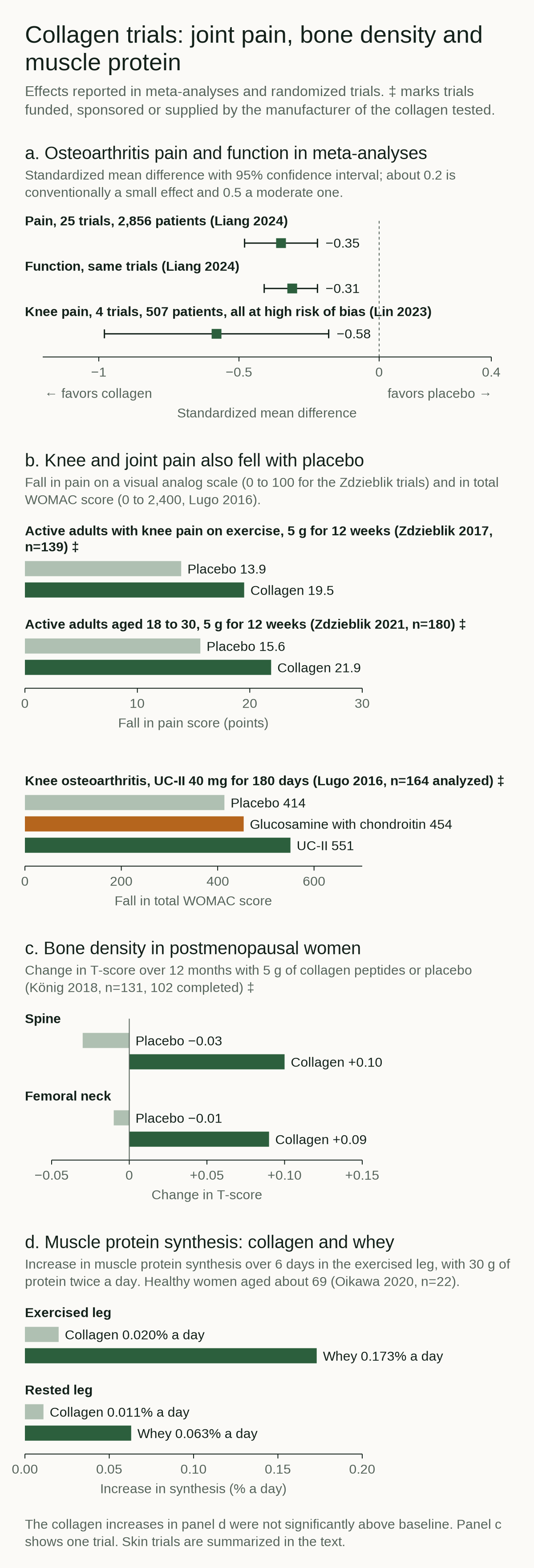
This is where the evidence is most consistent. A 2024 meta-analysis from Taipei Medical University included 35 randomized trials with 3,165 patients with osteoarthritis; in the main analysis of 25 trials with 2,856 patients, collagen products reduced pain with a standardized mean difference of −0.35 (moderate certainty) and improved function with a difference of −0.31 (high certainty), effects the authors described as small to moderate. Withdrawals and adverse events did not increase.17 A smaller 2023 meta-analysis of four knee osteoarthritis trials with 507 patients found a larger effect on pain, −0.58, but judged all four trials at high risk of bias.18 A 2025 update of 11 trials with 870 participants found improvements in pain and function with very large differences between trials (I² of 88% for pain).19
A broader 2018 review in the British Journal of Sports Medicine of 20 supplements in 69 trials for hand, hip or knee osteoarthritis found large, clinically important short-term pain relief with collagen hydrolysate and a clinically important medium-term effect with undenatured type II collagen, but no supplement had clinically important effects in the long term, and the overall quality of evidence was very low.20 The same review covered curcumin, which we discuss in our article on curcumin and osteoarthritis.
Individual trials show both the effect and its limits. In a trial at 13 centers in southern India, 191 people with knee osteoarthritis took 40 mg of UC-II, glucosamine with chondroitin, or placebo for 180 days. The total WOMAC score, on a scale of 0 to 2,400, fell by 551 points with UC-II, 454 with glucosamine and chondroitin, and 414 with placebo.21 About three-quarters of the improvement seen with UC-II also occurred with placebo. In a trial in 250 people with knee osteoarthritis, 10 g of collagen hydrolysate a day for six months improved pain scores, and people with the most joint damage and the least meat in their diet benefited most.22
Three trials tested collagen hydrolysate in active people with knee or joint pain but no joint disease. Among 147 athletes at Penn State University, 97 of whom could be analyzed, 10 g a day for 24 weeks reduced pain during walking, standing, lifting and other activities by 0.4 to 0.7 points more than placebo on a 10-point scale.23 Two trials at the University of Freiburg gave 5 g a day for 12 weeks. In 139 athletes, pain during activity fell by 19.5 points with collagen and 13.9 with placebo on a 100-point scale; in 180 active adults aged 18 to 30, it fell by 21.9 and 15.6 points.2425 All three tested Gelita products and were funded at least in part by Gelita.232425
Does collagen strengthen bones or build muscle?
One randomized trial has tested collagen peptides for bone. In 131 postmenopausal women with reduced bone density, 5 g a day for 12 months raised the spine T-score by 0.10 and the femoral neck T-score by 0.09, compared with changes of −0.03 and −0.01 with placebo; 102 women completed the study. Part of the study was paid for by Gelita.26 The trial did not measure fractures. Anyone with osteoporosis should treat this as a reason for further research rather than as an alternative to prescribed treatment.
For muscle, a trial in 53 men aged about 72 with sarcopenia combined 12 weeks of supervised resistance training with 15 g a day of collagen peptides or placebo, taken within an hour after training. Both groups gained lean body mass and strength; the collagen group gained 4.2 kg of lean body mass against 2.9 kg and improved quadriceps strength by 16.5 Nm against 7.3 Nm.27 The placebo was silica, which contains no protein, so the trial cannot separate an effect of collagen from an effect of extra protein. A correction published in 2025 added that Gelita had provided the samples and paid for participant compensation and sample analysis, and that one author was a co-inventor on a related patent application.28
A trial at McMaster University compared collagen directly with whey. Twenty-two healthy women aged about 69 took 30 g of whey or collagen twice a day for six days. Whey raised muscle protein synthesis in both the exercised and the rested leg, while collagen did not raise it significantly above baseline in either; the authors concluded that whey is the more effective supplement for preserving muscle in older women.29 The study was funded by the Canadian Institutes of Health Research.
Is collagen safe to take daily?
In the osteoarthritis trials pooled in 2024, collagen products did not increase withdrawals or adverse events compared with control.17 The smaller 2023 meta-analysis found an odds ratio for adverse events of 1.66 that was not statistically significant (95% CI 0.99 to 2.78), and it rated the certainty of that estimate as very low.18 The Kiel skin trial reported no side effects, and the 2026 hair trial reported no treatment-related adverse events.614 Most of these trials lasted between two months and a year, so they say little about use over many years. We found no trials in pregnancy or breastfeeding.
Collagen supplements come from cattle, pigs, chickens or fish, which matters for anyone who avoids one of those for reasons of allergy, religion or diet.321 Collagen is a protein, so people who have been told to limit protein intake, for example because of kidney disease, should count it and discuss it with the clinician who set the limit.5
How can the Thryval app help?
The Thryval app (App Store, Google Play) can help when comparing collagen with other supplements marketed for the same purpose. Each herb or supplement entry shows what kind of research backs it, from meta-analyses and randomized trials to observational studies and traditional use, with the citations, journals and publication years, and maps it to conditions, body systems and related FDA medicines. Reading the cited studies shows which outcome was measured, for how long, and in whom, which matters for a supplement whose skin, joint and bone trials enrolled very different people. The app also flags interactions between a substance and FDA-approved medicines, drawn from clinical pharmacology references; a flag is a prompt to check with a pharmacist, and the absence of one does not mean a combination has been studied.
How good is the evidence, and who paid for it?
The osteoarthritis evidence is the strongest: dozens of randomized trials and a meta-analysis that rated the pain result as moderate certainty and the function result as high certainty.17 Even so, the four knee trials in one analysis were all at high risk of bias, between-trial differences were large, and an earlier review rated the overall quality of osteoarthritis supplement evidence as very low.181920 The skin trials are numerous but small and short, and the pooled results depend on how trials are classified and how their data are extracted.1112 The hair, nail, bone and muscle findings each rest on one or two trials.
Industry funding runs through this literature. The skin, nail, joint-pain, bone and muscle trials from Kiel and Freiburg tested Gelita products, and Gelita funded, partly funded or supplied most of them; authors from the Collagen Research Institute in Kiel took part in most, and one of them is named on a related patent application.671624252628 The Penn State athlete trial was sponsored by Gelita, and one author worked in Gelita’s research department.23 The UC-II trial was sponsored by InterHealth Nutraceuticals; two of its three authors were company employees and the third consulted for the company.21 The 2026 hair trials had authors from collagen and health food companies.1415 The protein-quality modeling study had authors from Gelita, the Collagen Research Institute and a consultant to a supplement company.5 Independent work includes the McMaster whey trial, funded by the Canadian Institutes of Health Research; the 2023 skin meta-analysis, funded by a hospital grant; the 2023 knee meta-analysis, which reported no funding; the British Journal of Sports Medicine review, whose authors declared no competing interests; and the Hermann letter, funded by the German public broadcaster SWR.299182012 In the sources we accessed, we could not find funding statements for the 2009 knee osteoarthritis trial, the absorption and cell studies, or the 2019, 2021, 2023 hair-loss, 2024 and 2025 reviews.
What remains uncertain?
It is not known whether the small benefits on osteoarthritis pain last beyond a few months, since no supplement in the 2018 review showed clinically important long-term effects.20 The trials discussed here compared collagen with placebo or with glucosamine and chondroitin, so they do not show how it compares with exercise or established osteoarthritis treatments. The mechanism in people has not been settled: blood levels of Pro-Hyp after a dose are lower than those that stimulated fibroblasts in culture, and the human biopsy evidence comes from one subgroup.247 Products differ in source and peptide size, and the trials mostly tested single branded ingredients, so a result for one product may not apply to another.39 The skin question would be settled best by large trials funded independently of manufacturers, with outcomes that people can see.
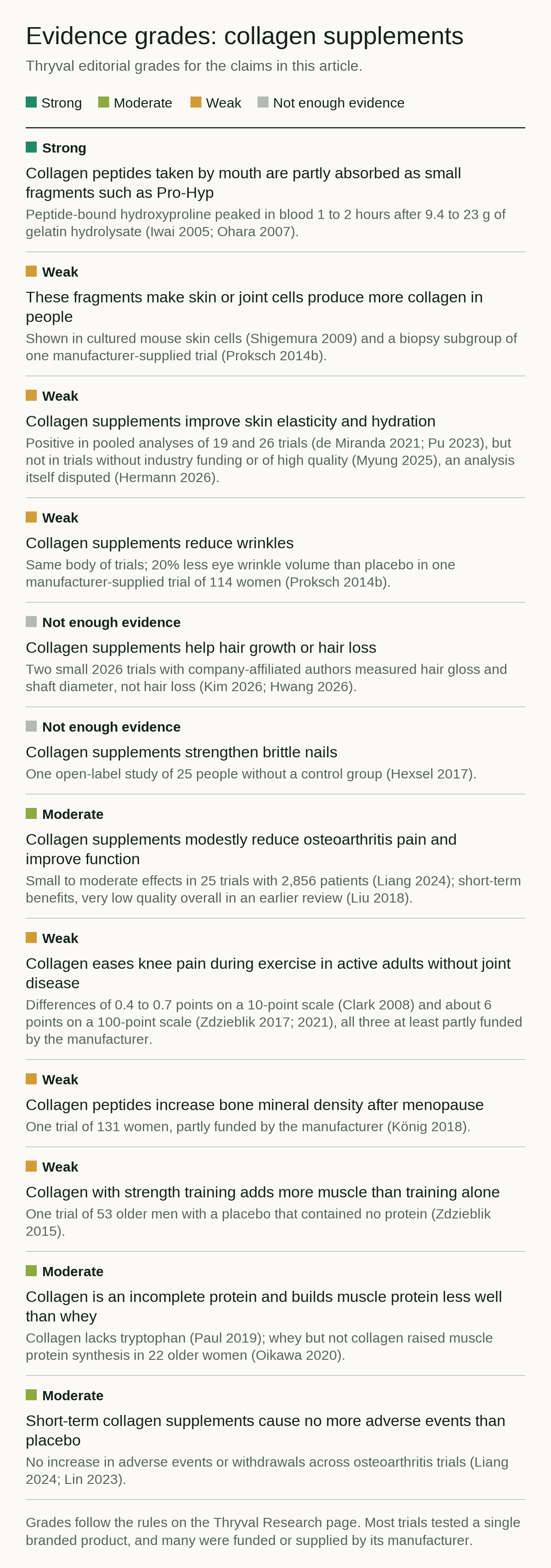
Evidence grades
The grades below are Thryval editorial judgments based on the studies cited in this article. The grading rules are set out on our Research page.
Frequently asked questions
How long does collagen take to work?
The skin trials measured changes after four and eight weeks, the joint-pain trials after 12 weeks to six months, and the bone trial after 12 months.6242326 In the joint trials, pain also fell substantially with placebo, so improvement over those periods is not by itself evidence that collagen is responsible. Our article on how to tell if a supplement is working explains why.2521
How much collagen should you take a day?
Trials of collagen hydrolysate mostly used 2.5 to 10 g a day, the sarcopenia trial used 15 g, and the UC-II trial used 40 mg.102721 No trial has established a best dose; in the 69-woman skin trial, 2.5 g and 5.0 g had similar effects on elasticity.6
Is collagen better than whey protein?
For building muscle, no. Collagen lacks tryptophan, and in older women whey raised muscle protein synthesis while collagen did not.529 Collagen is sold for different purposes than whey, but it is not a substitute for a complete protein source.
When should you take collagen, morning or night?
None of the trials cited here compared different times of day. They gave collagen once a day, and in the sarcopenia trial it was taken within an hour after training.62627 There is no evidence that timing changes the effect.
Who should not take collagen?
Trials have reported few side effects.17 We found no trials in pregnancy or breastfeeding. Products come from cattle, pigs, chickens or fish, so the source matters for people with allergies or dietary restrictions, and collagen counts toward protein intake for anyone on a protein limit.35
Can you take collagen with medication?
Collagen is not among the supplements with well-documented interactions in our article on supplement and prescription drug interactions, but the absence of evidence of an interaction is not the same as evidence of safety. Tell your pharmacist about any supplement taken with prescription medicines, and do not change a prescribed medicine on the strength of a supplement trial.
Implications for patients and clinicians
For patients, the trials offer the most support for collagen as an addition to usual care for osteoarthritis pain, with an expected benefit that is small and may fade; it should not replace prescribed treatment, exercise or weight management advised by a clinician.1720 For skin, the evidence that collagen produces visible changes is weak once industry-funded trials are set aside, and for hair and nails it is too thin to judge.111416 People who want more protein for muscle will do better with complete proteins such as whey.29 For clinicians, the collagen literature is a clear example of why the funding and product source of each trial should be checked before a pooled result is quoted.1112
This article is for education and is not medical advice.
References
-
Shoulders MD, Raines RT. Collagen structure and stability. Annu Rev Biochem. 2009;78:929–958. Narrative review; the authors’ collagen research was supported by an NIH grant. PMC2846778 · PubMed 19344236 ↩↩
-
Iwai K, Hasegawa T, Taguchi Y, et al. Identification of food-derived collagen peptides in human blood after oral ingestion of gelatin hydrolysates. J Agric Food Chem. 2005;53(16):6531–6536. Human absorption study in healthy volunteers; funding not stated in the abstract we accessed. PubMed 16076145 ↩↩↩↩↩
-
Ohara H, Matsumoto H, Ito K, Iwai K, Sato K. Comparison of quantity and structures of hydroxyproline-containing peptides in human blood after oral ingestion of gelatin hydrolysates from different sources. J Agric Food Chem. 2007;55(4):1532–1535. Single-blind crossover study, n=5; funding not stated in the abstract we accessed. PubMed 17253720 ↩↩↩↩↩↩
-
Shigemura Y, Iwai K, Morimatsu F, et al. Effect of prolyl-hydroxyproline (Pro-Hyp), a food-derived collagen peptide in human blood, on growth of fibroblasts from mouse skin. J Agric Food Chem. 2009;57(2):444–449. Laboratory study in cultured mouse skin; funding not stated in the abstract we accessed. PubMed 19128041 ↩↩↩
-
Paul C, Leser S, Oesser S. Significant amounts of functional collagen peptides can be incorporated in the diet while maintaining indispensable amino acid balance. Nutrients. 2019;11(5):1079. Modeling study; no external funding; one author provides research services to Designs for Health, which sells collagen peptides, and the other authors are from Gelita and the Collagen Research Institute. PMC6566836 · PubMed 31096622 ↩↩↩↩↩↩
-
Proksch E, Segger D, Degwert J, Schunck M, Zague V, Oesser S. Oral supplementation of specific collagen peptides has beneficial effects on human skin physiology: a double-blind, placebo-controlled study. Skin Pharmacol Physiol. 2014;27(1):47–55. Randomized trial, n=69; product (Verisol) supplied by Gelita; two authors from the Collagen Research Institute, Kiel. PubMed 23949208 ↩↩↩↩↩↩↩
-
Proksch E, Schunck M, Zague V, Segger D, Degwert J, Oesser S. Oral intake of specific bioactive collagen peptides reduces skin wrinkles and increases dermal matrix synthesis. Skin Pharmacol Physiol. 2014;27(3):113–119. Randomized trial, n=114; product (Verisol) supplied by Gelita; two authors from the Collagen Research Institute, Kiel. PubMed 24401291 ↩↩↩↩↩↩↩
-
de Miranda RB, Weimer P, Rossi RC. Effects of hydrolyzed collagen supplementation on skin aging: a systematic review and meta-analysis. Int J Dermatol. 2021;60(12):1449–1461. Meta-analysis of 19 randomized trials, n=1,125; funding not stated in the abstract we accessed. PubMed 33742704 ↩↩
-
Pu SY, Huang YL, Pu CM, et al. Effects of oral collagen for skin anti-aging: a systematic review and meta-analysis. Nutrients. 2023;15(9):2080. Meta-analysis of 26 randomized trials, n=1,721; funded by Taipei Municipal Wanfang Hospital; no conflicts declared. PMC10180699 · PubMed 37432180 ↩↩↩↩↩
-
Choi FD, Sung CT, Juhasz ML, Mesinkovsk NA. Oral collagen supplementation: a systematic review of dermatological applications. J Drugs Dermatol. 2019;18(1):9–16. Systematic review of 11 randomized trials, n=805; funding not stated in the abstract we accessed. PubMed 30681787 ↩↩
-
Myung SK, Park Y. Effects of collagen supplements on skin aging: a systematic review and meta-analysis of randomized controlled trials. Am J Med. 2025;138(9):1264–1277. Meta-analysis of 23 randomized trials, n=1,474, with subgroups by funding source and quality; funding not stated in the abstract we accessed. PubMed 40324552 ↩↩↩↩↩↩↩
-
Hermann M, Kientopf D. Inconsistencies found in the meta-analysis on collagen supplementation. Am J Med. 2026;139(11):e349. Letter; funded by the German public broadcaster Südwestrundfunk (SWR), which had no role in the analysis. PubMed 42822893 ↩↩↩↩↩
-
Drake L, Reyes-Hadsall S, Martinez J, et al. Evaluation of the safety and effectiveness of nutritional supplements for treating hair loss: a systematic review. JAMA Dermatol. 2023;159(1):79–86. Systematic review of 30 studies, 17 of them randomized trials; funding not stated in the abstract we accessed. PubMed 36449274 ↩↩
-
Kim TK, Oh J, Ha YS, et al. Efficacy and safety of low-molecular-weight collagen peptide GT for improving hair condition in individuals with damaged hair: a randomized, double-blind, placebo-controlled trial. Int J Stem Cells. Published online August 21, 2026. Randomized trial; number of participants not given in the abstract; one co-author from the research department of Geltech, Busan. PubMed 42624827 ↩↩↩↩↩↩
-
Hwang S, Won J, Kim S, Kang W, Park M. Low-molecular-weight collagen peptide supplementation improves cellulite severity, skin elasticity, and hair shaft diameter: a clinical study with pharmacokinetic evaluation. J Med Food. 2026;29(4):187–195. Randomized trial, n=114 women; authors from Chung-Ang University, NEWTREE Co. and UKON Solutions; no competing interests declared. PubMed 41788055 ↩↩↩
-
Hexsel D, Zague V, Schunck M, Siega C, Camozzato FO, Oesser S. Oral supplementation with specific bioactive collagen peptides improves nail growth and reduces symptoms of brittle nails. J Cosmet Dermatol. 2017;16(4):520–526. Open-label single-arm study, n=25; tested Gelita’s Verisol; two authors from the Collagen Research Institute, Kiel. PubMed 28786550 ↩↩↩↩↩
-
Liang CW, Cheng HY, Lee YH, Liao CD, Huang SW. Efficacy and safety of collagen derivatives for osteoarthritis: a trial sequential meta-analysis. Osteoarthritis Cartilage. 2024;32(5):574–584. Meta-analysis of 35 randomized trials, n=3,165; funding not stated in the abstract we accessed. PubMed 38218227 ↩↩↩↩↩↩↩↩↩
-
Lin CR, Tsai SHL, Huang KY, Tsai PA, Chou H, Chang SH. Analgesic efficacy of collagen peptide in knee osteoarthritis: a meta-analysis of randomized controlled trials. J Orthop Surg Res. 2023;18(1):694. Meta-analysis of 4 randomized trials, n=507; no funding; no conflicts declared. PMC10505327 · PubMed 37717022 ↩↩↩↩↩↩
-
Simental-Mendía M, Ortega-Mata D, Acosta-Olivo CA, et al. Effect of collagen supplementation on knee osteoarthritis: an updated systematic review and meta-analysis of randomised controlled trials. Clin Exp Rheumatol. 2025;43(1):126–134. Meta-analysis of 11 randomized trials, n=870; funding not stated in the abstract we accessed. PubMed 39212129 ↩↩
-
Liu X, Machado GC, Eyles JP, Ravi V, Hunter DJ. Dietary supplements for treating osteoarthritis: a systematic review and meta-analysis. Br J Sports Med. 2018;52(3):167–175. Systematic review and meta-analysis of 69 trials of 20 supplements; authors declared no competing interests. PubMed 29018060 ↩↩↩↩↩↩
-
Lugo JP, Saiyed ZM, Lane NE. Efficacy and tolerability of an undenatured type II collagen supplement in modulating knee osteoarthritis symptoms: a multicenter randomized, double-blind, placebo-controlled study. Nutr J. 2016;15:14. Randomized trial, n=191; sponsored by InterHealth Nutraceuticals; two authors were company employees and the third consulted for it. PMC4731911 · PubMed 26822714 ↩↩↩↩↩↩↩
-
Benito-Ruiz P, Camacho-Zambrano MM, Carrillo-Arcentales JN, et al. A randomized controlled trial on the efficacy and safety of a food ingredient, collagen hydrolysate, for improving joint comfort. Int J Food Sci Nutr. 2009;60(Suppl 2):99–113. Randomized trial, n=250; funding not stated in the abstract we accessed. PubMed 19212858 ↩
-
Clark KL, Sebastianelli W, Flechsenhar KR, et al. 24-week study on the use of collagen hydrolysate as a dietary supplement in athletes with activity-related joint pain. Curr Med Res Opin. 2008;24(5):1485–1496. Randomized trial, n=147 (97 analyzed); sponsored by Gelita Health, which supplied the product; one author from Gelita’s research department. PubMed 18416885 ↩↩↩↩↩
-
Zdzieblik D, Oesser S, Gollhofer A, König D. Improvement of activity-related knee joint discomfort following supplementation of specific collagen peptides. Appl Physiol Nutr Metab. 2017;42(6):588–595. Randomized trial, n=139; funded by Gelita Health, which supplied the product (Fortigel); one author from the Collagen Research Institute. PubMed 28177710 ↩↩↩↩↩
-
Zdzieblik D, Brame J, Oesser S, Gollhofer A, König D. The influence of specific bioactive collagen peptides on knee joint discomfort in young physically active adults: a randomized controlled trial. Nutrients. 2021;13(2):523. Randomized trial, n=180; product (Fortigel) provided and study partly funded by Gelita. PMC7915677 · PubMed 33562729 ↩↩↩↩↩↩
-
König D, Oesser S, Scharla S, Zdzieblik D, Gollhofer A. Specific collagen peptides improve bone mineral density and bone markers in postmenopausal women: a randomized controlled study. Nutrients. 2018;10(1):97. Randomized trial, n=131 (102 completed); partly funded by Gelita. PMC5793325 · PubMed 29337906 ↩↩↩↩↩↩
-
Zdzieblik D, Oesser S, Baumstark MW, Gollhofer A, König D. Collagen peptide supplementation in combination with resistance training improves body composition and increases muscle strength in elderly sarcopenic men: a randomised controlled trial. Br J Nutr. 2015;114(8):1237–1245. Randomized trial, n=53; Gelita paid part of the costs. PMC4594048 · PubMed 26353786 ↩↩↩↩↩
-
Zdzieblik D, Oesser S, Baumstark MW, Gollhofer A, König D. Collagen peptide supplementation in combination with resistance training improves body composition and increases muscle strength in elderly sarcopenic men: a randomised controlled trial. Corrigendum. Br J Nutr. 2025;134(5):440. Correction stating that Gelita provided the study samples and paid for participant compensation and sample analysis, and that one author is a co-inventor on a related patent application. PMC12580965 · PubMed 40859798 ↩↩↩
-
Oikawa SY, Kamal MJ, Webb EK, McGlory C, Baker SK, Phillips SM. Whey protein but not collagen peptides stimulate acute and longer-term muscle protein synthesis with and without resistance exercise in healthy older women: a randomized controlled trial. Am J Clin Nutr. 2020;111(3):708–718. Randomized trial, n=22; funded by the Canadian Institutes of Health Research. PMC7049534 · PubMed 31919527 ↩↩↩↩↩↩